Unit 2 · Topic 2.4 · about 30 minutes · 7 parts · 10 scored checks, 1 of them multiple choice, plus 2 from earlier lessons
AP Microeconomics 2.4: Price Elasticity of Supply
Unit 2: 20 to 25% of the multiple-choice section
What you'll be able to do
- Define price elasticity of supply, calculate it from a table or a graph, call supply elastic, inelastic or unit elastic over a price range, and explain what makes sellers more or less able to respond.
Key vocabulary
| Term | What it means | The exam trap |
|---|---|---|
| Price elasticity of supply | The percentage change in quantity supplied divided by the percentage change in the good's own price. | It is built from quantity supplied, the sellers' side, so do not take quantities from a demand schedule. |
| Elastic supply | Supply whose price elasticity is greater than 1 over a given price range. | The label belongs to a range of prices, so say which range you measured over. |
| Inelastic supply | Supply whose price elasticity is less than 1 over a given price range. | It describes how far output responds over a price range, not whether the seller is willing to sell more at all. |
| Unit elastic supply | Supply whose price elasticity is exactly 1 over a given price range. | Getting exactly 1 over one price range does not make the whole curve unit elastic; another range of the same curve can give a different result. |
| Midpoint method | Finding each percentage change by dividing the change by the average of the starting and ending values. | Average the two prices and, separately, the two quantities; never mix a price with a quantity. |
 Tap to open the picture full size
Part 1 Think first A sudden jump in price
Make a guess first. Even a wrong guess helps the answer stick.
Predict first
On Monday, the price buyers will pay jumps 20 percent for two things at once: fresh strawberries from a local farm, and printed T-shirts from a shop in the same town. Which seller can raise its output more by Friday?
In short. Price elasticity of supply measures how strongly sellers change the quantity they offer when the price changes: the percentage change in quantity supplied divided by the percentage change in price.
- Supply is elastic when the result is above 1, inelastic below 1 and unit elastic at exactly 1.
- Because quantity supplied moves the same way as price, a supply elasticity is a positive number.
- Sellers respond more when they can get extra inputs, or switch to other inputs, without paying more for them, and when they have time to adjust.
Part 2 Learn it Three ideas, with a check after each
2a. Measuring how sellers respond
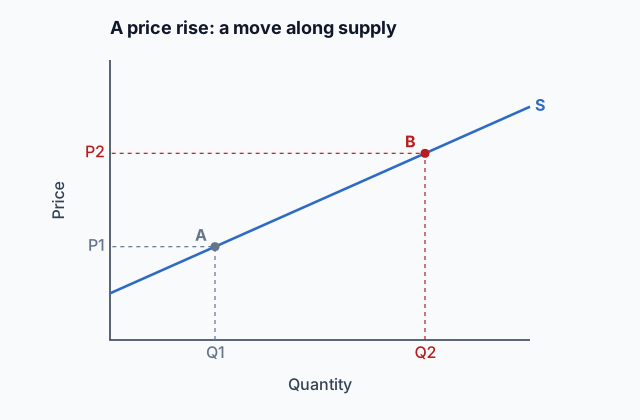
The law of supply says a higher price brings out a larger quantity supplied. Price elasticity of supply says how much larger, in percentages:
$$\text{price elasticity of supply} = \frac{\text{percentage change in quantity supplied}}{\text{percentage change in price}}$$
Percentages let you compare goods measured in different units: a rise of 50 cars and a rise of 50 cups of coffee mean very different things, but a rise of 10 percent means the same thing for both.
Use the midpoint method, as in the lesson on demand: divide each change by the average of the two values, so the answer is the same whichever way the price moves.
Say the price of a desk lamp rises from $20 to $30 and a factory's quantity supplied rises from 100 to 140 lamps a week.
- Quantity: 40 ÷ 120 (the average of 100 and 140) is about 33.3%.
- Price: 10 ÷ 25 (the average of $20 and $30) is 40%.
- Elasticity: 33.3% ÷ 40% is about 0.83.
Quantity supplied rises with price, so both changes have the same sign and the result is positive.
Quick check · Calculate
When the price of a bag of potting soil rises from $8 to $12, a garden supplier's quantity supplied rises from 300 to 500 bags a month. Using the midpoint method, what is the price elasticity of supply over this range? Round to two decimal places.
2b. Elastic, inelastic or unit elastic
The dividing line is 1, where quantity supplied changes by the same percentage as the price.
- Above 1: supply is elastic over that range. A 10% price rise draws out more than 10% more output.
- Below 1: supply is inelastic. Output still rises, but by a smaller percentage than the price.
- Exactly 1: supply is unit elastic.
The desk lamp result, 0.83, is inelastic: output rose about 33% when the price rose 40%.
Two extremes help on a graph. If sellers cannot change the quantity at all (the seats in a theater for tonight's show), the supply curve is vertical: perfectly inelastic. If sellers will offer any quantity at one price and none below it, the curve is horizontal: perfectly elastic.
The label always belongs to a price range. The same seller can be elastic over cheap prices, while it has idle machines, and inelastic once every machine is busy.
Quick check · Sort it
Tap a description of a seller's supply over one price range, then tap the label it earns.
Elastic
Inelastic
Unit elastic
2c. What makes supply responsive
Supply is elastic when producing more costs a seller little extra per unit. Three things decide that.
- Other inputs, and what they cost. A furniture maker that can switch from oak to pine or maple, which it buys at steady prices, can expand without its costs climbing. One that depends on a single scarce input bids that input's price up as it buys more, so each extra unit costs more and output responds less.
- Time. Given a day, a seller works with the machines, land and workers it has. Given a year, it can hire, build and plant. Supply is more elastic the longer sellers have to adjust.
- Spare capacity and stock. Idle machines, or goods in a warehouse, let a seller answer a higher price at once.
In Think first, the T-shirt shop could buy more of its main input at the usual price. The farm needed time no one could buy.
Quick check · Decide and justify
The price of roasted coffee rises. Roaster X makes blends and can use beans from many growers, and buying more beans does not change what it pays. Roaster Y sells only a single-estate bean from one farm, and that bean's price climbs as Y buys more. Whose supply of roasted coffee is more price elastic?
Which reason supports your choice?
Part 3 Watch it done A firewood seller in a cold winter
Follow each step, then finish the last one yourself.
A cold winter pushes the price of firewood from $150 to $250 a cord. A firewood seller's quantity supplied rises from 40 to 50 cords a month. Find the price elasticity of supply by the midpoint method, and say whether supply is elastic or inelastic over this range.
Step 1 · Percentage change in quantity
The change is 50 − 40 = 10 cords. The average of 40 and 50 is 45, so the change is 10 ÷ 45, about 22.2%.
Step 2 · Percentage change in price
The change is $250 − $150 = $100. The average of $150 and $250 is $200, so the change is 100 ÷ 200 = 50%.
Why this step?
Why divide by the averages instead of the starting values?
With the starting values, a rise from $150 to $250 is a 66.7% change but a fall from $250 to $150 is a 40% change, so the same stretch of the curve would get two elasticities. The averages give one answer whichever way the price moves.
Your step · Calculate
Finish it: what is the seller's price elasticity of supply over this range? Round to two decimal places.
Part 4 Try it New sellers, your turn
Try it · Rank it
Three bakeries each see the price of bread rise. At Bakery A, quantity supplied rises 30% after a 10% price rise. At Bakery B, it rises 10% after a 20% price rise. At Bakery C, it rises 15% after a 15% price rise. Rank the bakeries by price elasticity of supply.
Most elastic first
Give each one a place, 1 for first. Give two the same place if they are equal.
Your ranking: none yet
Part 5 Explain it Answer a short free-response question
Nothing you type leaves this page. Draw the graph on paper, then compare it with the model.
Free response is 33.35% of the exam score. This one is shaped like Question 3, Short.
Free-response practice · Question 3 style
Holm Cycles builds bicycles. When the price of a bicycle rises from $400 to $600, Holm's quantity supplied rises from 900 to 1,100 bicycles a year. (a) Calculate Holm's price elasticity of supply over this range, using the midpoint method. Show your work. (b) Is Holm's supply elastic, inelastic or unit elastic over this range? Explain. (c) Draw a correctly labeled graph with Holm's supply curve, labeled S1, passing through the point at $400 and 900 bicycles. On the same graph, draw a supply curve labeled S2 through the same point that is more price elastic there than S1. (d) Holm finds a second supplier of frames that sells at the same price as its current one. Explain how this affects the price elasticity of Holm's supply.
Model answer
(a) Quantity: (1,100 − 900) ÷ 1,000 = 20%. Price: (600 − 400) ÷ 500 = 40%. Elasticity = 20% ÷ 40% = 0.5. (b) Inelastic: 0.5 is less than 1, because quantity supplied rose by a smaller percentage (20%) than the price (40%). (c) Price on the vertical axis and quantity of bicycles on the horizontal axis, with S1 and S2 both sloping upward through $400 and 900, and S2 flatter than S1 at that point. (d) Supply becomes more elastic. With a second source of frames at the same price, Holm can build more bicycles without paying more for frames, so its output can respond more to a change in price.
Two supply curves through one point
Through the same point, the flatter curve S2 shows a larger change in quantity supplied for the same change in price.
Score your own answer. This is a self-check, not a grade. Tick each point your answer makes.
Part 6 Check yourself Read a tour operator's supply
The case questions can all be answered from this table.
Bayside Kayaks runs guided tours on a lake. It owns 40 kayaks and uses about 25 of them in a busy week. It has 4 trained guides, and training a new one takes a season. The table shows how many tours it offers each week at different prices.
| Price per tour | Tours offered per week |
|---|---|
| $40 | 100 |
| $50 | 140 |
| $60 | 160 |
| $70 | 170 |
Case question 1 · Calculate
Using the midpoint method, what is Bayside's price elasticity of supply when the price rises from $40 to $50? Round to two decimal places.
Case question 2 · Multiple choice
Which statement describes Bayside's supply as the price rises from $60 to $70?
Case question 3 · Fill the statement
Tap a blank, then tap a word or phrase.
Between $50 and $60, Bayside's supply is . The likeliest reason its output responds less at higher prices is that it runs short of .
The rest stand on their own and do not use the case.
Check yourself · Spot the error
When the price of tutoring rises from $30 to $50 an hour, the hours a tutoring center offers rise from 60 to 90 a week. A student worked out the price elasticity of supply. Tap the first line with a mistake.
Check yourself · Select all
A bakery's supply of bread is inelastic. Which two changes would make its supply more price elastic? Select two.
Select 2 answers, then check.
Part 7 Keep it Keep it
From 2.3 Price Elasticity of Demand · Multiple choice
The demand curve for monthly bus passes in a city is a straight line. A cut in the price from $9 to $8 raises the quantity demanded from 100 to 200 passes, and a cut from $2 to $1 raises it from 800 to 900. Which statement is true?
From 1.3 Production Possibilities Curve · Decide and justify
Kirin makes only smartphones and rice. A new chip design lets each factory worker assemble twice as many phones a day. Rice farming does not change, and neither do Kirin's resources. What happens to Kirin's PPC?
Which reason supports your choice?
In three lines
- Price elasticity of supply is the percentage change in quantity supplied divided by the percentage change in price, each by the midpoint method.
- Above 1 is elastic, below 1 inelastic, and exactly 1 unit elastic, always over a stated price range.
- Supply responds more when extra or substitute inputs cost no more, when sellers have spare capacity, and when they have time to adjust.
Exam strategy for this topic
- Section I, Multiple Choice: 60 questions in 70 minutes.
- Section II, Free Response: 3 questions in 60 minutes.
- This lesson's Explain it is shaped like free-response question 3, Short.
- A four-function calculator is allowed on both sections of the exam.
Write both midpoint percentages, then the division, with quantity supplied on top, and state the price range. When a question asks why supply is more elastic, name the cause, such as inputs that can be bought or switched at steady prices, or more time to adjust.
Questions students ask
Why is price elasticity of supply never negative?
Quantity supplied moves the same way as the price, so the two percentage changes share a sign and their ratio is positive. A negative supply elasticity would mean an arithmetic slip.
Is a steeper supply curve always less elastic?
When two straight supply curves pass through the same point, the steeper one is less elastic there. Comparing curves through different points by slope alone can mislead, because elasticity uses percentages, not raw changes.
Why is supply more elastic in the long run?
In a short period, sellers are stuck with the machines, land and workers they have. Over a longer one they can build, hire and plant, so a price change draws out a larger change in output.
What does the price of other inputs have to do with elasticity?
If a producer can switch to an alternative input, or buy more of its input, without paying more per unit, expanding output costs little extra. Its supply is then more elastic than one whose inputs grow pricier as it buys more.
Why use the midpoint method?
It divides each change by the average of the two values, so a price rise and a price fall over the same stretch give the same elasticity.
Course alignment, for teachers
AP Microeconomics topic 2.4, Unit 2: Supply and Demand.
- Skill 3.C: Determine the effect(s) of a change in an economic situation using quantitative data or calculations.
This lesson maps all 3 essential knowledge statements of the topic to the part that teaches each one: 3 are checked by a scored question. The map is in the lesson file.