Unit 2 · Topic 2.9 · about 30 minutes · 7 parts · 11 scored checks, 1 of them multiple choice, plus 2 from earlier lessons
AP Microeconomics 2.9: International Trade and Public Policy
Unit 2: 20 to 25% of the multiple-choice section
What you'll be able to do
- Define tariffs and quotas, explain with a graph how opening to trade and trade policy change a domestic market, and calculate the changes in price, quantity, government revenue and surplus.
Key vocabulary
| Term | What it means | The exam trap |
|---|---|---|
| Autarky | A situation in which a country does not trade a good with other countries. | Autarky means no trade in that good at all, not simply fewer imports. |
| World price | The price at which a good is bought and sold on world markets. | In these models the country is small next to the world market, so its buyers and sellers take the world price as given. |
| Imports | Goods and services a country buys from producers in other countries. | The name depends on which side you stand: one country's imports are another country's exports. |
| Exports | Goods and services a country sells to buyers in other countries. | A country can export a good and still consume plenty of it at home. |
| Tariff | A tax on imported goods. | The importing country's government sets and collects it, not the government of the country selling the goods. |
| Quota | A limit on the quantity of a good that may be imported. | In this course you describe a quota's effects in words. You are not asked to graph it. |
 Tap to open the picture full size
Part 1 Think first Cheap sugar arrives
Make a guess first. Even a wrong guess helps the answer stick.
Predict first
For years a country has banned imports of sugar, and sugar there sells for $1.20 a pound. The ban is lifted, and sugar from abroad sells there for $0.60 a pound. Who in the country is better off because of the change?
In short. When a country opens a market to trade, its price moves to the world price, and the gap between what its own buyers want and what its own producers supply is filled by imports or sold abroad as exports.
- A world price below the no-trade price means imports: buyers gain, domestic producers lose, and total surplus rises.
- A world price above it means exports: producers gain, domestic buyers lose, and total surplus still rises.
- A tariff or a quota raises the domestic price and cuts imports, which helps domestic producers, hurts buyers and lowers total surplus.
Part 2 Learn it Four ideas, with a check after each
2a. Opening a market to trade
Without trade, called autarky, a country's price for a good is set where its own demand and its own supply cross.
Open the market to the world, and buyers and sellers can trade at the world price instead. Treat the country as small next to the world market, so it can buy or sell as much as it likes at that price without moving it.
- World price below the no-trade price. Domestic buyers move down their demand curve and buy more; domestic producers move down their supply curve and make less. The gap, quantity demanded minus quantity supplied at the world price, is filled by imports.
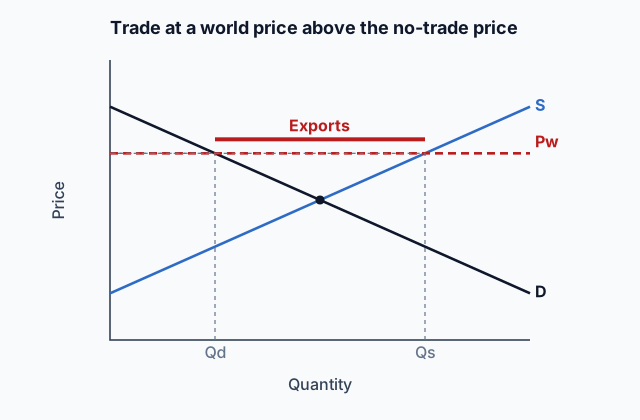
- World price above the no-trade price. Domestic producers make more and domestic buyers buy less. The extra, quantity supplied minus quantity demanded, is sold abroad as exports.
In both cases the two domestic curves do not shift. The price changes, and buyers and producers move along their curves to the new price.
Quick check · Calculate
A country's domestic market for blankets has this schedule. At $3, its buyers want 800 blankets and its producers supply 100. At $4, buyers want 700 and producers supply 200. At $5, 600 and 300. At $6, 500 and 400. At $7, 400 and 500. The country opens to trade at a world price of $4. How many blankets does it import?
2b. Who gains and who loses
Trade moves surplus around inside the country, and it adds some.
An importing country (world price below the no-trade price):
- Buyers pay less and buy more, so consumer surplus rises.
- Domestic producers get a lower price and sell less, so producer surplus falls.
- What buyers gain is more than producers lose, so total surplus rises. The extra is the triangle above the world price line and between the two curves, with its point at the no-trade equilibrium.
An exporting country (world price above it): producers gain, domestic buyers lose, and once again the winners gain more than the losers lose, so total surplus rises.
That is why economists say a country gains from trade as a whole, while still expecting the losing group to object.
Quick check · Sort it
A country opens its market for steel to free trade, and the world price of steel is below its price without trade. Tap each item, then tap what happens to it in that country.
Rises
Falls
2c. A tariff
A tariff is a tax on imported goods. A per-unit tariff of t raises the domestic price from the world price to the world price plus t, since no importer will sell at home for less than the world price plus the tax. (This assumes the tariff leaves the price below the no-trade price.)
At the higher domestic price:
- domestic producers make more, and domestic buyers buy less, so imports shrink;
- the government collects tariff revenue = t × imports after the tariff;
- consumer surplus falls and producer surplus rises;
- total surplus falls. Part of what buyers lose goes to producers and part to the government, and two triangles go to nobody. One stands for units now made at home at a higher cost than the world price; the other for units buyers no longer buy even though they value them above the world price.
A tariff is the import version of the per-unit tax: same reasoning, with the world price in place of the supply curve.
Quick check · Calculate
A small country imports sneakers at a world price of $40 a pair. It adds a tariff of $10 a pair, which raises its domestic price to $50. At $50, its consumers buy 9,000 pairs a month and its own firms make 5,000. How much tariff revenue does the government collect each month, in dollars?
2d. A quota
A quota limits the quantity of a good that may be imported, such as 2 million pairs of shoes a year. If the limit is smaller than what the country imported at the world price, it works like this:
- With fewer imports available, buyers compete for less, and the domestic price rises above the world price.
- At the higher price, domestic producers make more, moving up their supply curve.
- Domestic buyers pay more and buy less, so consumer surplus falls.
- Total surplus falls, for the same reason as with a tariff: some units are made at home at a cost above the world price, and some trades buyers valued are lost.
One difference from a tariff: a quota is a limit, not a tax, so it does not bring the government tariff revenue.
In this course you explain a quota's effects in words like these; you do not graph it.
Quick check · Decide and justify
A country imports shoes. It replaces free trade with a quota that allows fewer pairs to be imported than came in at the world price. What happens to the quantity of shoes the country's own firms produce?
Which reason supports your choice?
Part 3 Watch it done A tariff on rice
Follow each step, then finish the last one yourself.
A small country's domestic market for rice has demand P = 12 − 0.01Q and supply P = 2 + 0.01Q, with P in dollars per bushel and Q in bushels a day. The world price is $4. The country opens to free trade, and later puts a tariff of $1 a bushel on imported rice. Find imports with free trade, imports and tariff revenue with the tariff, and the deadweight loss of the tariff.
Step 1 · No trade
Set demand equal to supply: 12 − 0.01Q = 2 + 0.01Q, so Q = 500 bushels at $7. The world price of $4 is lower, so the country will import.
Step 2 · Free trade at $4
Buyers want (12 − 4) ÷ 0.01 = 800 bushels, and domestic farmers supply (4 − 2) ÷ 0.01 = 200. Imports are 800 − 200 = 600 bushels a day.
Why this step?
Why do the country's farmers grow less rice once trade opens, when nobody has told them to?
At $4 a bushel, only the rice they can grow for $4 or less is worth growing. Bushels that cost more to grow than the world price are cheaper to import, so farmers move down their supply curve.
Step 3 · With the $1 tariff
The domestic price rises to $5. Buyers want (12 − 5) ÷ 0.01 = 700 and farmers supply (5 − 2) ÷ 0.01 = 300, so imports fall to 400. Tariff revenue is 1 × 400 = $400 a day.
Your step · Calculate
With free trade at $4, the country's farmers supply 200 bushels and its buyers purchase 800. With the $1 tariff, the price is $5, farmers supply 300 and buyers purchase 700. Demand and supply are straight lines. What is the deadweight loss of the tariff, in dollars a day?
dollars
Part 4 Try it Move the price line
Before each check, say whether the country will import or export, and which group in the country gains.
Part 5 Explain it Answer a long free-response question
Nothing you type leaves this page. Draw the graph on paper, then compare it with the model.
Free response is 33.35% of the exam score. This one is shaped like Question 1, Long.
Free-response practice · Question 1 style
Velmora's domestic market for rice is perfectly competitive, and at first Velmora does not trade rice with other countries. (a) Draw a correctly labeled graph of Velmora's rice market, and label the price PA and quantity QA without trade. (b) Velmora opens its rice market to free trade. The world price PW is below PA, and Velmora can buy as much rice as it wants at PW. On your graph, show PW, and label the quantity Velmora's farmers produce QS and the quantity Velmora's consumers buy QD. (c) Compared with no trade, what happens to the producer surplus of Velmora's rice farmers? Explain. (d) Velmora then puts a per-unit tariff on imported rice that raises its domestic price but leaves it below PA. Will the quantity of rice Velmora imports increase, decrease or stay the same? Explain. (e) What happens to total surplus in Velmora's rice market because of the tariff? (f) Suppose that instead of the tariff, Velmora limits rice imports with a quota smaller than its free-trade imports. What happens to the quantity of rice Velmora's farmers produce? Explain.
Model answer
(a) Price on the vertical axis and quantity on the horizontal axis, a downward-sloping domestic demand curve D and an upward-sloping domestic supply curve S crossing at PA and QA. (b) A horizontal line at PW below PA. QS is where PW meets S and QD is where PW meets D, with QS to the left of QA and QD to the right of it. (c) Producer surplus decreases, because farmers receive a lower price and sell less. (d) Decrease. The higher domestic price raises the quantity farmers supply and lowers the quantity consumers buy, so the gap filled by imports narrows. (e) Total surplus decreases. (f) It increases. With fewer imports, the domestic price rises, and farmers respond by producing more.
Velmora opens to trade
At the world price PW, below the no-trade price PA, farmers produce QS and consumers buy QD. Imports fill the gap between them.
Score your own answer. This is a self-check, not a grade. Tick each point your answer makes.
Part 6 Check yourself Arlan sells wheat abroad
The case questions can all be answered from this table.
Arlan is a small country whose domestic wheat market is perfectly competitive. It opens the market to free trade, and the world price of wheat is $6 a bushel. The table shows Arlan's own weekly demand and supply, in thousands of bushels.
| Price per bushel | Quantity demanded in Arlan (thousand bushels) | Quantity supplied in Arlan (thousand bushels) |
|---|---|---|
| $3 | 700 | 300 |
| $4 | 600 | 400 |
| $5 | 500 | 500 |
| $6 | 400 | 600 |
| $7 | 300 | 700 |
Case question 1 · Calculate
Trading freely at the world price of $6, how many thousand bushels of wheat a week does Arlan export?
Case question 2 · Multiple choice
Compared with no trade, who in Arlan is better off once it trades wheat at $6?
Case question 3 · Fill the statement
Tap a blank, then tap a word or phrase.
Compared with no trade, the quantity of wheat consumed in Arlan , and total surplus in Arlan's wheat market .
The rest stand on their own and do not use the case.
Check yourself · Spot the error
A small country imports bicycles at a world price of $200. It adds a tariff of $50 a bicycle, and its price without trade is above $250. A student worked out the effects. Tap the first line with a mistake.
Check yourself · Select all
A small country that imports cheese replaces free trade with a per-unit tariff on cheese. Compared with free trade, which two statements are correct? Select two.
Select 2 answers, then check.
Check yourself · Rank it
A small country imports cheese. Compare consumer surplus in its cheese market in three cases: no trade at all; free trade at a world price below its no-trade price; and a tariff that raises its price above the world price but leaves it below the no-trade price. Rank the three by consumer surplus.
Largest consumer surplus first
Give each one a place, 1 for first. Give two the same place if they are equal.
Your ranking: none yet
Part 7 Keep it Keep it
From 2.8 The Effects of Government Intervention in Markets · Sort it
Each statement describes one policy placed on the sellers in a competitive market. Tap a statement, then tap the policy it describes.
Per-unit tax
Per-unit subsidy
From 2.6 Market Equilibrium and Consumer and Producer Surplus · Fill the statement
Tap a blank, then tap a phrase.
When the market price of copper rises to a new equilibrium, it tells electrical firms that buy copper to and mining companies to .
In three lines
- Opening to trade moves the price to the world price; the gap between domestic demand and supply is imports below the no-trade price and exports above it.
- Trade raises total surplus, with buyers gaining in an importing country and producers in an exporting one.
- A tariff or quota raises the domestic price, cuts imports, helps domestic producers and lowers consumer and total surplus.
Exam strategy for this topic
- Section I, Multiple Choice: 60 questions in 70 minutes.
- Section II, Free Response: 3 questions in 60 minutes.
- This lesson's Explain it is shaped like free-response question 1, Long.
- A four-function calculator is allowed on both sections of the exam.
On a trade graph, draw the world price as a horizontal line and label the domestic quantity supplied and quantity demanded where it meets each curve; imports or exports are the gap between them. For a tariff, draw a second horizontal line at the world price plus the tariff and read the new quantities there.
Questions students ask
Why is the world price a horizontal line?
The country is small next to the world market, so it can buy or sell as much as it wants without moving the world price. At that one price, any quantity is available.
If total surplus rises with trade, why do some groups oppose it?
The total hides a split. In an importing country, buyers gain and domestic producers lose, and the producers who lose have a strong reason to object even though the country gains overall.
How is a tariff like the per-unit tax in 2.8?
Both are a tax on each unit that raises the price buyers pay, cuts the quantity bought and leaves deadweight loss. A tariff is charged only on imported units, so its revenue is the tariff times imports.
Does a quota raise money for the government?
Not in itself. A quota limits the quantity imported rather than taxing it, so it brings in no tariff revenue, while still raising the domestic price.
Why is a quota not graphed?
College Board leaves the graphing of quotas out of this course. What you need is how a quota changes the quantities produced and imported, the domestic price, consumer surplus and total surplus.
Beyond the AP Exam
College Board sets this limit on what the AP Exam asks about this topic. Anything past it is not on the exam.
The graphing of quotas is beyond the scope of the course and the AP Exam, but understanding how quotas affect quantities produced is within the scope.
Course alignment, for teachers
AP Microeconomics topic 2.9, Unit 2: Supply and Demand.
- Skill 4.C: Demonstrate the effect of a change in an economic situation on an accurately labeled graph or visual.
This lesson maps all 3 essential knowledge statements of the topic to the part that teaches each one: 3 are checked by a scored question. The map is in the lesson file.