Unit 3 · Topic 3.1 · about 30 minutes · 7 parts · 12 scored checks, 1 of them multiple choice, plus 2 from earlier lessons
AP Microeconomics 3.1: The Production Function
Unit 3: 22 to 25% of the multiple-choice section
What you'll be able to do
- Define the production function in the short run and the long run, explain how marginal and average product change as a firm adds workers, and calculate total, marginal and average product from a table.
Key vocabulary
| Term | What it means | The exam trap |
|---|---|---|
| Production function | The relationship between the quantities of inputs a firm uses and the quantity of output it gets from them. | It is about physical quantities, such as workers and loaves, not dollars. Costs come in the next lesson. |
| Inputs | The resources a firm uses to make its product, such as workers (labor) and machines and buildings (capital). | A machine a firm uses is one of its inputs, even though it was another firm's output. |
| Output | The quantity of a good or service a firm produces. | Output is counted over a period, such as loaves an hour, so compare quantities over the same length of time. |
| Short run | A period in which at least one of the firm's inputs cannot be changed. | It is not a set number of months. How long it lasts depends on how long the firm needs to change its slowest input. |
| Long run | A period long enough for the firm to change all of its inputs. | Long run describes what the firm is able to change, not how far ahead it plans. |
| Total product (TP) | The total quantity of output a firm produces with a given quantity of an input. | TP is a quantity of the good, so its units are the product's units, not workers. |
| Marginal product (MP) | The change in total product from using one more unit of an input. | MP is measured in units of output, such as loaves, never in dollars. |
| Average product (AP) | Total product divided by the quantity of the input used, such as output per worker. | AP describes the workers already hired; on its own it does not tell you what the next worker will add. |
| Diminishing marginal returns | When a firm adds more of one input while its other inputs stay fixed, each added unit eventually adds less output than the one before. | In everyday speech returns can mean money. Here it means extra output, counted in units of the product. |
 Tap to open the picture full size
Part 1 Think first Two cooks on one truck
Make a guess first. Even a wrong guess helps the answer stick.
Predict first
Mia runs a taco truck with one grill. Working alone, she makes 30 tacos an hour. She hires a cook who is exactly as skilled as she is, and together they make 80 tacos an hour. How can the second cook add 50 tacos an hour when Mia alone made only 30?
In short. A production function shows how a firm's output changes with the inputs it uses, and in the short run, with some inputs fixed, adding more of one input eventually adds less and less output.
- In the short run at least one input is fixed; in the long run the firm can change every input.
- Marginal product is the extra output from one more unit of an input, and average product is output per unit of that input.
- Past some point each added worker adds less output than the one before: diminishing marginal returns.
Part 2 Learn it Three ideas, with a check after each
2a. Inputs, output and the two time frames
A production function describes how much output a firm gets from the inputs it uses. For Mia's truck the inputs are cooks (labor) and the grill and truck (capital), and the output is tacos an hour.
Economists split time by what a firm is able to change.
- In the short run, at least one input is fixed. Mia owns one grill this month, so the only way to make more tacos is to add cooks.
- In the long run, the firm can change every input. Mia can buy a second truck with a bigger grill and staff it.
The short run is not a set number of weeks. It lasts as long as some input cannot yet be changed: perhaps a month for a taco truck, several years for a steel mill that must build a new furnace.
The production function covers both time frames. The rest of this lesson stays in the short run, where one input changes and the others stay put.
Quick check · Sort it
Each card is a change a firm makes. Tap a card, then tap the time frame it belongs to.
Short run
Long run
2b. Total, marginal and average product
Total product (TP) is the firm's output with a given number of workers. Two measures come from it.
- Marginal product (MP) is the extra output from one more worker: MP = change in TP ÷ change in workers. If a car wash goes from 30 to 48 cars a day when its 3rd worker starts, the 3rd worker's MP is 48 − 30 = 18 cars.
- Average product (AP) is output per worker: AP = TP ÷ number of workers. With 3 workers and 48 cars, AP = 48 ÷ 3 = 16 cars per worker.
In a table, MP sits between two rows, because it belongs to the worker who was just added. AP sits on one row.
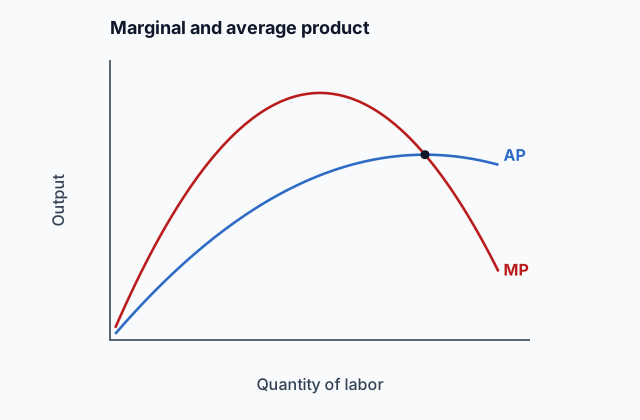
The two are linked the way a test score is linked to your average. When the added worker's MP is above the current AP, hiring that worker pulls the average up. When MP is below AP, it pulls the average down.
As the firm uses more labor, MP and AP change, and so total product changes by a different amount with each worker.
Quick check · Calculate
A print shop with a fixed number of presses prints 54 posters an hour with 3 workers and 68 posters an hour with 4 workers. What is the marginal product of the 4th worker, in posters an hour?
2c. Diminishing marginal returns
In the short run, adding workers to a fixed amount of capital follows a common pattern.
At first, MP can rise. A cook working alone takes orders, grills and wraps. A second cook lets each one stick to one job, so the second adds more than the first did.
Past some point, MP falls. The grill and the counter do not grow. A fifth cook mostly waits for a turn at the grill and adds fewer tacos than the fourth. This is diminishing marginal returns: as a firm employs more of one input while holding its other inputs constant, the extra output from each added unit eventually falls. It is a short-run idea, because it needs a fixed input for the added workers to crowd.
Falling MP does not mean falling output. As long as MP is above zero, TP still rises, just by less each time. TP stops rising when MP reaches zero, and it falls only if MP turns negative, when workers get in each other's way so badly that one more cuts output.
Quick check · Decide and justify
A farm works a fixed 10 acres. The marginal products of its 1st to 5th workers are 8, 12, 10, 6 and 3 tons of potatoes a season. When the farm hires its 4th worker, what happens to the farm's total product?
Which reason supports your choice?
Part 3 Watch it done Bakers and one oven
Follow each step, then finish the last one yourself.
A bakery has one oven and hires bakers. With 1, 2, 3, 4, 5 and 6 bakers it makes 12, 30, 45, 56, 60 and 60 loaves an hour. Find each baker's marginal product, the baker with whom diminishing marginal returns begin, and the average product at several staff sizes.
Step 1 · Marginal product
Subtract each total from the one before it. The MP of the 1st to 6th bakers is 12, 18, 15, 11, 4 and 0 loaves an hour.
Step 2 · Where diminishing returns begin
MP rises from 12 to 18 with the 2nd baker, then falls to 15 with the 3rd. Diminishing marginal returns begin with the 3rd baker, the first to add less than the baker before. Total product keeps rising through the 5th baker, because every MP up to there is above zero.
Why this step?
Why does the 2nd baker add more than the 1st, while the 3rd adds less than the 2nd?
Two bakers can split the work, one mixing and one shaping, so the 2nd adds a lot. The oven is fixed, though, so from the 3rd baker on, bakers start waiting for it, and each adds less.
Step 3 · Average product
AP = TP ÷ bakers. With 2 bakers, 30 ÷ 2 = 15 loaves each; with 4 bakers, 56 ÷ 4 = 14. The 4th baker's MP of 11 is below the AP of 15 with 3 bakers, so hiring that baker pulls the average down.
Your step · Calculate
A bakery with one oven makes 56 loaves an hour with 4 bakers and 60 loaves an hour with 5 bakers. What is the average product with 5 bakers, in loaves per baker?
loaves
Part 4 Try it Draw total product
Before you sketch, say in one sentence how much one more mechanic adds near 2 mechanics compared with near 5.
Try it · Sketch the graph
A repair shop has a fixed number of workbenches and hires mechanics one at a time. Each of the first three mechanics adds more repairs a week than the mechanic before. From the 4th mechanic on, each adds fewer repairs than the one before, but every mechanic adds some. Sketch the shop's total product for 0 to 6 mechanics. The first point is fixed at 0 repairs with 0 mechanics.
One shape that fits
Drag a point up or down, or tap it and use the arrow keys. Only the shape is checked.
When an added worker gets in the way. One more question about total product, this time with a worker whose marginal product is below zero.
Try it · Fill the statement
Tap a blank, then tap a word or phrase.
A warehouse with one loading dock adds workers. The 6th worker's marginal product is 5 boxes an hour, and the 7th worker's is −2 boxes an hour. When the 6th worker is hired, total product . When the 7th worker is hired, total product .
Part 5 Explain it Answer a short free-response question
Nothing you type leaves this page. Write your answer, then compare it with the model.
Free response is 33.35% of the exam score. This one is shaped like Question 2, Short.
Free-response practice · Question 2 style
Greenline Landscaping has a fixed number of mowers and trailers and hires workers. With 1, 2, 3, 4 and 5 workers, it mows 6, 14, 21, 24 and 25 lawns a day. (a) Is Greenline operating in the short run or the long run? Explain. (b) Calculate the marginal product of the 3rd worker. Show your work. (c) Identify the worker with whom diminishing marginal returns begin. (d) Explain why diminishing marginal returns occur at Greenline. (e) Calculate the average product of labor when Greenline has 4 workers. Show your work.
Model answer
(a) The short run, because the number of mowers and trailers is fixed while the number of workers changes. (b) MP = 21 − 14 = 7 lawns a day. (c) The 3rd worker. MP rises from 6 to 8 with the 2nd worker, then falls to 7 with the 3rd. (d) The workers share a fixed number of mowers and trailers, so each added worker has less equipment to work with and adds less output than the worker before. (e) AP = 24 ÷ 4 = 6 lawns per worker.
| Workers | Total product (lawns a day) | Marginal product | Average product |
|---|---|---|---|
| 1 | 6 | 6 | 6 |
| 2 | 14 | 8 | 7 |
| 3 | 21 | 7 | 7 |
| 4 | 24 | 3 | 6 |
| 5 | 25 | 1 | 5 |
Score your own answer. This is a self-check, not a grade. Tick each point your answer makes.
Part 6 Check yourself Pressworks prints T-shirts
The case questions can all be answered from this table.
Pressworks prints T-shirts with two printing presses, which it cannot replace this year. It can hire as many workers as it likes. The table shows its daily output with each number of workers.
| Workers | Total product (shirts a day) |
|---|---|
| 0 | 0 |
| 1 | 20 |
| 2 | 50 |
| 3 | 90 |
| 4 | 120 |
| 5 | 140 |
| 6 | 150 |
Case question 1 · Calculate
What is the marginal product of Pressworks' 5th worker, in shirts a day?
Case question 2 · Multiple choice
With which worker do diminishing marginal returns begin at Pressworks?
Case question 3 · Rank it
Rank the marginal products of three of Pressworks' workers: the 2nd, the 4th and the 6th.
Largest marginal product first
Give each one a place, 1 for first. Give two the same place if they are equal.
Your ranking: none yet
The rest stand on their own and do not use the case.
Check yourself · Spot the error
A kitchen with a fixed number of stoves makes 40 meals an hour with 2 cooks and 54 meals an hour with 3 cooks. A student worked out what the 3rd cook adds and the output per cook. Tap the first line with a mistake.
Check yourself · Select all
A sandwich shop with a fixed kitchen hires workers. The marginal products of its 1st to 5th workers are 9, 12, 10, 7 and 4 sandwiches an hour. Which two statements are correct? Select two.
Select 2 answers, then check.
Check yourself · Decide and justify
A coffee shop with two espresso machines hires equally skilled baristas one at a time. From the 3rd barista on, each one adds fewer drinks an hour than the barista before, though total drinks keep rising. Is this an example of diminishing marginal returns?
Which reason supports your choice?
Part 7 Keep it Keep it
From 2.9 International Trade and Public Policy · Calculate
A country's domestic market for blankets has this schedule. At $3, its buyers want 800 blankets and its producers supply 100. At $4, buyers want 700 and producers supply 200. At $5, 600 and 300. At $6, 500 and 400. At $7, 400 and 500. The country opens to trade at a world price of $4. How many blankets does it import?
From 2.7 Market Disequilibrium and Changes in Equilibrium · Decide and justify
At this week's fares, airlines have many more seats on flights to a holiday resort than travelers want to buy. Fares are free to change. What happens next?
Which reason supports your choice?
In three lines
- A production function links inputs to output; in the short run some input is fixed, and in the long run every input can change.
- Marginal product is the change in total product from one more worker, and average product is total product divided by workers.
- With a fixed input, MP eventually falls (diminishing marginal returns), and total product still rises while MP is above zero.
Exam strategy for this topic
- Section I, Multiple Choice: 60 questions in 70 minutes.
- Section II, Free Response: 3 questions in 60 minutes.
- This lesson's Explain it is shaped like free-response question 2, Short.
- A four-function calculator is allowed on both sections of the exam.
When a table gives total product, write each worker's marginal product between the rows before you answer anything else. Diminishing marginal returns begin with the first worker whose MP is smaller than the worker before, and total product keeps rising until MP reaches zero.
Questions students ask
Is diminishing marginal returns the same as negative marginal returns?
No. Diminishing means each added worker adds less than the one before but still adds something, so total product rises. Negative means an added worker lowers total product, which happens only when workers get badly in each other's way.
Why can marginal product rise at first?
With few workers, each must do several jobs. Adding workers lets them specialize, so the next worker can add more than the last. That stops once the fixed inputs get crowded.
Does diminishing marginal returns happen in the long run?
It is a short-run idea, because it needs at least one fixed input. In the long run a firm can change all of its inputs, and what happens to output then is the subject of returns to scale in 3.3.
How long is the short run?
There is no set length. It is any period in which at least one input cannot be changed, which might be a month for a taco truck and years for a power plant.
Why does average product fall when marginal product is below it?
An average moves toward each new value added to it. A worker who adds less than the current output per worker pulls the average down, the way a low test score lowers your average.
Course alignment, for teachers
AP Microeconomics topic 3.1, Unit 3: Production, Cost, and the Perfect Competition Model.
- Skill 1.A: Describe economic concepts, principles, or models.
This lesson maps all 3 essential knowledge statements of the topic to the part that teaches each one: 3 are checked by a scored question. The map is in the lesson file.