Unit 3 · Topic 3.2 · about 30 minutes · 7 parts · 12 scored checks, 1 of them multiple choice, plus 2 from earlier lessons
AP Microeconomics 3.2: Short-Run Production Costs
Unit 3: 22 to 25% of the multiple-choice section
What you'll be able to do
- Define fixed, variable, marginal and average costs, explain with a graph how they change with output and why marginal cost eventually rises, and calculate each cost from a table.
Key vocabulary
| Term | What it means | The exam trap |
|---|---|---|
| Total fixed cost (TFC) | The total of the costs that do not change with the quantity a firm produces, such as the payment on a loan for equipment. | Fixed does not mean paid only once. A cost paid every month can still be fixed. |
| Total variable cost (TVC) | The total of the costs that change with the quantity a firm produces, such as hourly wages and materials. | TVC is the variable cost of all the units made so far, not the cost of the last one. |
| Total cost (TC) | Total fixed cost plus total variable cost at a given output. | You read and analyze total cost from tables and graphs, but you are not asked to draw the total cost curve. |
| Marginal cost (MC) | The change in total cost from producing one more unit of output. | MC belongs to one particular unit, such as the 4th, so in a table it sits between two rows. |
| Average fixed cost (AFC) | Total fixed cost divided by the quantity of output. | Students mix up AFC with TFC. One is a cost per unit, the other a total. |
| Average variable cost (AVC) | Total variable cost divided by the quantity of output. | AVC is a cost per unit of output, so it is in dollars per unit, not in dollars. |
| Average total cost (ATC) | Total cost divided by the quantity of output, which also equals AFC plus AVC. | ATC is a cost per unit, not a total, so compare it with a price per unit. |
| Diminishing marginal returns | The short-run pattern, with some inputs fixed, in which each added worker eventually adds less output than the one before. It is the link between a firm's production and its marginal cost. | Returns here means extra output from an input, not money. |
| Specialization | Each worker concentrating on a narrow set of tasks instead of doing every job. | Here it happens among the workers inside one firm, not between countries as with comparative advantage. |
| Division of labor | Splitting a production process into separate tasks, each done by different workers. | It is about how the same work is split up, not about hiring more of every input. |
| Productivity | The quantity of output produced per unit of input, such as units per worker-hour. | Higher output is not the same as higher productivity. A firm can make more just by hiring more, with output per worker unchanged. |
| Input costs | The prices a firm pays for its inputs, such as wages, rent and the price of materials. | An input's price and the quantity of it a firm uses are separate. A wage rise is a change in price, not in the number of workers. |
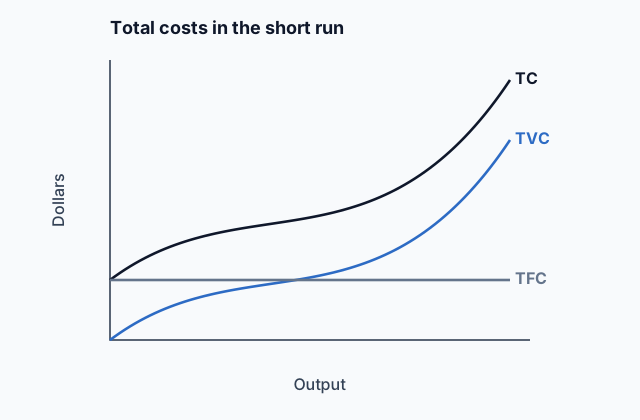 Tap to open the picture full size
Part 1 Think first Flour costs more
Make a guess first. Even a wrong guess helps the answer stick.
Predict first
Rosa's bakery pays $2,500 a month to rent its shop and buys flour for every batch of bread it bakes. The price of flour rises by 50 cents a pound, and her rent stays the same. What happens to Rosa's cost of baking one more loaf?
In short. In the short run a firm's total cost is its fixed cost plus its variable cost, and the per-unit costs that come from them change with output in a pattern set by the firm's production.
- Total fixed cost is the same at every output, zero included, while total variable cost rises with output.
- Marginal cost usually falls at first and then rises, and it crosses AVC and ATC at their lowest points.
- Cost curves are drawn for given input prices and productivity, so a change in either one shifts them.
Part 2 Learn it Four ideas, with a check after each
2a. Fixed and variable costs
In the short run a firm's total cost (TC) has two parts.
- Total fixed cost (TFC) does not change with output: rent on a lease, insurance, the loan payment on an oven. The firm pays it even in a month when it produces nothing, so TFC is the same at every output, zero included.
- Total variable cost (TVC) changes with output: wages of hourly workers, ingredients, the power that runs the machines. At zero output, TVC is zero.
TC = TFC + TVC.
That gives two ways to pull the parts out of a table of total cost. TFC is total cost at zero output, since nothing variable is spent there. TVC at any output is TC minus TFC.
Fixed costs exist only because some inputs cannot be changed yet. Rosa's rent is fixed because her lease cannot be undone this year.
Quick check · Calculate
A bakery's total cost is $300 a day when it bakes nothing and $700 a day when it bakes 200 loaves. What is its total variable cost of baking 200 loaves, in dollars a day?
2b. Marginal and average costs
Four more measures come from the totals. Q is the quantity of output.
- Marginal cost (MC) = change in TC ÷ change in Q, the cost of one more unit. TFC never changes, so MC is also the change in TVC.
- Average fixed cost (AFC) = TFC ÷ Q.
- Average variable cost (AVC) = TVC ÷ Q.
- Average total cost (ATC) = TC ÷ Q, which equals AFC + AVC.
Say TFC is $90 and TVC is $150 at 5 units. AFC = $18, AVC = $30 and ATC = $240 ÷ 5 = $48. If TC at 4 units was $214, the 5th unit's MC is $240 − $214 = $26.
Every one of these changes as output changes, except TFC. AFC gets smaller at every larger output, because the same fixed cost is shared by more units, so the gap between ATC and AVC narrows. MC passes through the lowest points of AVC and ATC: an average falls while the added unit costs less than the average, and rises once it costs more.
Quick check · Match
A firm's total fixed cost is $40. At 4 units of output its total variable cost is $80, and at 3 units its total cost was $105. Tap a measure, then tap its value at 4 units.
2c. Why marginal cost falls, then rises
Marginal cost comes straight from the product numbers in 3.1 The Production Function. Say a worker costs $120 a day and labor is the only variable input. If the 3rd worker adds 40 units, each of those units costs $120 ÷ 40 = $3 of labor. So MC is the wage divided by the added worker's marginal product.
At low output, MC falls. Specialization and the division of labor let each added worker add more than the last: with more hands, each sticks to one task. More output per added worker means each added unit takes less paid time, so MC falls.
Past some point, MC rises. With capital fixed, diminishing marginal returns set in. Each added worker adds less output, so each added unit takes more paid time and costs more. That is why a production function with diminishing marginal returns gives an upward-sloping MC curve.
When MP rises, MC falls; when MP falls, MC rises. The U shape of MC is the hump of MP turned upside down.
Quick check · Calculate
A firm pays each worker $120 a day, and labor is its only variable input. Its 3rd worker adds 40 units a day and its 4th worker adds 30 units a day. What is the marginal cost of each unit the 4th worker adds, in dollars?
2d. What shifts the cost curves
Cost curves are drawn for given input costs and a given productivity. Change either one and the curves move.
An input cost changes. If a variable input costs more, such as a higher wage or pricier flour, every unit costs more to make: MC, AVC and ATC all shift up. If a fixed cost rises, such as the rent, AFC and ATC shift up, but MC and AVC stay where they are, because one more unit costs no more than before. A cheaper input works the same way in reverse.
Productivity changes. If training or a better machine lets each worker produce more an hour, each unit takes less paid time, so MC, AVC and ATC shift down.
Ask the same question each time: does this change what one more unit costs? If yes, MC moves. If it changes only a cost the firm pays whatever it makes, MC stays put.
Quick check · Sort it
Each card is one change at a bakery, with nothing else changing. Tap a card, then tap what happens to the bakery's marginal cost curve.
MC shifts up
MC shifts down
MC does not shift
Part 3 Watch it done A bakery's cost schedule
Follow each step, then finish the last one yourself.
A small bakery's total cost is $60 an hour when it bakes nothing, and $90, $110, $126, $148, $180 and $222 an hour when it bakes 1 to 6 batches. Find its fixed and variable costs, the marginal cost of each batch, and its average costs at 4 batches.
Step 1 · Fixed and variable cost
TFC is total cost at zero output: $60. TVC at each output is TC − 60: $30, $50, $66, $88, $120 and $162 for 1 to 6 batches.
Step 2 · Marginal cost
Subtract each total from the one before. The MC of the 1st to 6th batches is $30, $20, $16, $22, $32 and $42.
Why this step?
Why does MC fall for the first three batches and rise after that?
With few bakers, adding one lets them split the work, so each batch takes less paid time. Once the ovens are crowded, diminishing marginal returns set in, each batch takes more paid time, and MC rises.
Step 3 · AFC and AVC at 4 batches
AFC = 60 ÷ 4 = $15. AVC = 88 ÷ 4 = $22.
Your step · Calculate
A bakery's total cost is $60 an hour when it bakes nothing and $148 an hour when it bakes 4 batches. What is its average total cost at 4 batches, in dollars per batch?
dollars
Part 4 Try it Costs from new tables
A new table each time. Every question gives a firm's total cost at each output and asks for one cost: fixed, variable, marginal or one of the averages.
Draw average fixed cost. Before you sketch, say in one sentence why AFC at 6 batches is smaller than AFC at 3 batches.
Try it · Sketch the graph
A food cart pays $60 a day for its permit and parking space, however much it sells. Sketch its average fixed cost at outputs of 1 to 6 batches of food a day. The first point is fixed at $60 for 1 batch.
One shape that fits
Drag a point up or down, or tap it and use the arrow keys. Only the shape is checked.
Part 5 Explain it Answer a short free-response question
Nothing you type leaves this page. Draw the graph on paper, then compare it with the model.
Free response is 33.35% of the exam score. This one is shaped like Question 3, Short.
Free-response practice · Question 3 style
Spoke and Chain, a bicycle repair shop, operates in the short run with a fixed shop and fixed tools, and hires mechanics by the hour. (a) Draw a correctly labeled graph showing the shop's marginal cost (MC), average total cost (ATC) and average variable cost (AVC) curves. (b) On your graph, label the output at which ATC is at its minimum as Q1. (c) The monthly rent on the shop rises. What happens to each of the following? Explain. (i) MC (ii) ATC (d) Explain why the shop's MC curve slopes upward at larger outputs.
Model answer
(a) Dollars per unit on the vertical axis and output on the horizontal axis. A U-shaped MC curve, a U-shaped AVC curve and a U-shaped ATC curve above AVC, with the gap between ATC and AVC narrowing as output rises, and MC passing through the lowest points of both AVC and ATC. (b) Q1 is the output where MC crosses ATC. (c)(i) MC does not change, because rent is a fixed cost and does not change the cost of one more repair. (ii) ATC increases at every output, because average fixed cost rises. (d) The shop and tools are fixed, so diminishing marginal returns set in: each added mechanic adds fewer repairs, each added repair takes more paid time, and MC rises.
Short-run per-unit cost curves
MC falls and then rises, crossing AVC and then ATC at their lowest points. Q1 is the output where MC meets ATC. ATC lies above AVC, and the gap between them, AFC, narrows as output rises.
Score your own answer. This is a self-check, not a grade. Tick each point your answer makes.
Part 6 Check yourself Deli Bay's costs
The case questions can all be answered from this table.
Deli Bay makes sandwich platters for offices. Its kitchen is fixed this year, and it hires more workers to make more platters. The table shows its total cost each hour at each output.
| Output (platters an hour) | Total cost |
|---|---|
| 0 | $60 |
| 1 | $90 |
| 2 | $108 |
| 3 | $123 |
| 4 | $144 |
| 5 | $180 |
Case question 1 · Calculate
What is Deli Bay's average variable cost at 3 platters an hour, in dollars?
Case question 2 · Multiple choice
Deli Bay's marginal cost falls from $30 for the 1st platter to $15 for the 3rd. Which best explains the fall?
Case question 3 · Fill the statement
Tap a blank, then tap a word or phrase.
As Deli Bay's output rises from 1 to 5 platters an hour, its average fixed cost and its average variable cost .
The rest stand on their own and do not use the case.
Check yourself · Decide and justify
A firm's average variable cost is $24 a unit at 6 units of output. The marginal cost of the 7th unit is $21. As output rises from 6 to 7 units, what happens to the firm's AVC?
Which reason supports your choice?
Check yourself · Select all
A café's cost curves are drawn for its current input costs and productivity. Which two changes would shift its marginal cost curve up? Select two.
Select 2 answers, then check.
Check yourself · Rank it
A firm's total fixed cost is $80. Its total cost is $185 at 3 units and $200 at 4 units. Rank these four measures at 4 units of output.
Largest first
Give each one a place, 1 for first. Give two the same place if they are equal.
Your ranking: none yet
Part 7 Keep it Keep it
From 3.1 The Production Function · Sort it
Each card is a change a firm makes. Tap a card, then tap the time frame it belongs to.
Short run
Long run
From 2.8 The Effects of Government Intervention in Markets · Calculate
In a perfectly competitive market for plastic bags, 600 bags a week are sold at equilibrium. A tax of $5 on each bag cuts the quantity sold to 480 bags a week. Demand and supply are straight lines. What is the deadweight loss of the tax, in dollars a week?
In three lines
- Total cost is fixed cost plus variable cost, and fixed cost is the same at every output, even zero.
- MC is the change in total cost from one more unit; AFC, AVC and ATC divide a total by output, and MC crosses AVC and ATC at their lowest points.
- MC falls with specialization and rises with diminishing marginal returns; input costs and productivity shift the curves.
Exam strategy for this topic
- Section I, Multiple Choice: 60 questions in 70 minutes.
- Section II, Free Response: 3 questions in 60 minutes.
- This lesson's Explain it is shaped like free-response question 3, Short.
- A four-function calculator is allowed on both sections of the exam.
When you draw short-run cost curves, draw MC through the lowest points of AVC and ATC, and keep ATC above AVC with the gap narrowing as output rises. When a question changes a cost, decide first whether it is fixed or variable: only a variable cost or a change in productivity moves MC.
Questions students ask
Why does the gap between ATC and AVC shrink as output rises?
The gap is average fixed cost. The same fixed cost is shared by more units at each larger output, so AFC keeps falling and the two curves get closer, though they never meet.
Why does marginal cost cross AVC and ATC at their lowest points?
An average falls whenever the added unit costs less than the average and rises whenever it costs more. So AVC and ATC turn upward exactly where MC climbs past them.
Does a rise in rent change how much a firm should produce?
Rent is a fixed cost, so it does not change marginal cost. It raises average total cost, which matters for profit, a question taken up from 3.4 on.
Is marginal cost the same as the change in total variable cost?
Yes. Fixed cost does not change between two outputs, so the change in total cost and the change in total variable cost are the same number.
What makes cost curves shift down?
A cheaper variable input or higher productivity lowers the cost of each unit, so MC, AVC and ATC shift down. A lower fixed cost moves only AFC and ATC down.
Course alignment, for teachers
AP Microeconomics topic 3.2, Unit 3: Production, Cost, and the Perfect Competition Model.
- Skill 4.A: Draw an accurately labeled graph or visual to represent an economic model or market.
This lesson maps all 5 essential knowledge statements of the topic to the part that teaches each one: 5 are checked by a scored question. The map is in the lesson file.