Unit 3 · Topic 3.4 · about 30 minutes · 7 parts · 10 scored checks, 1 of them multiple choice, plus 2 from earlier lessons
AP Microeconomics 3.4: Types of Profit
Unit 3: 22 to 25% of the multiple-choice section
What you'll be able to do
- Define accounting, economic and normal profit, explain how firms respond to a chance to earn economic profit, and calculate a firm's profit or loss.
Key vocabulary
| Term | What it means | The exam trap |
|---|---|---|
| Explicit cost | A payment a firm makes to someone else for something it uses, such as the bill for its supplies. | Explicit does not mean large. A small bill is as explicit as a big one. |
| Accounting profit | Total revenue minus explicit costs, the payments a firm makes to others. | Revenue is not profit. Revenue is what comes in before any cost is subtracted. |
| Economic profit | Total revenue minus explicit and implicit costs. | When it is below zero it is called an economic loss. In a calculation, keep the minus sign. |
| Implicit cost | The value of a resource the firm's owner supplies without being paid for it, measured by what it would earn in its best other use. | It is measured by the single best alternative given up, not by adding up every alternative. |
| Cost of financial capital | The return the owner's own money could have earned elsewhere, such as interest from a bank, given up when the money goes into the firm. | Read whether a number is the amount invested or the return it would earn. |
| Compensation for risk | The expected reward an owner needs for putting money into a firm that might fail instead of somewhere safer. | It grows with how likely the firm is to fail, so a riskier business needs a larger one. |
| Normal profit | The accounting profit that just covers a firm's implicit costs, so that its economic profit is zero. | Despite the name, it is not the average profit firms in an industry happen to earn. |
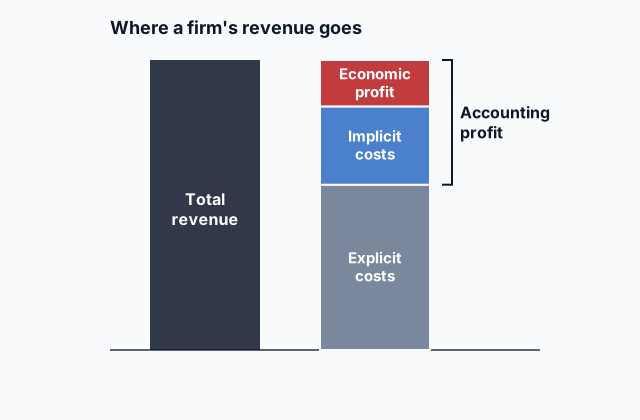 Tap to open the picture full size
Part 1 Think first The food truck that clears $60,000
Make a guess first. Even a wrong guess helps the answer stick.
Predict first
Priya's food truck took in $150,000 last year and paid out $90,000 for food, fuel, a helper's wages and a parking permit. To run the truck full time, Priya turned down a job as a head cook that pays $70,000 a year, and the job is still open. Judged by money alone, what should she do next year?
In short. Accounting profit is total revenue minus the explicit costs a firm pays out; economic profit also subtracts implicit costs, the value of what the owner puts in without being paid.
- Implicit costs are what the owner gives up without being paid, valued at their best other use.
- Economic profit can fall below zero, and the zero point has a name of its own: normal profit.
- Firms decide whether to enter or leave a market by comparing it with their best alternative.
Part 2 Learn it Three ideas, with a check after each
2a. Costs paid out and costs given up
A firm has two kinds of cost.
Explicit costs are payments the firm makes to someone else: rent to a landlord, wages to workers, supplies, and interest paid to a bank on a loan. Money leaves the firm, so they show up in its books.
Implicit costs are the value of resources the owner supplies without being paid for them. No money changes hands, so the books leave them out, but the owner still gives something up. Economists count three:
- The owner's time. Valued at what the owner could earn in her best other job.
- The cost of financial capital. Savings the owner puts into the firm could have earned interest or another return somewhere else. That forgone return, not the savings themselves, is the cost.
- Compensation for risk. An owner who puts money into a firm that might fail needs an expected reward for taking that chance, or she would put the money somewhere safer.
The test for which list a cost goes on is simple: did the firm pay someone, or did the owner give up something she already had?
Quick check · Sort it
Jonah quit his job as a mechanic to open a bike-repair shop. He paid for its tools partly with his own savings and partly with a bank loan. Tap each item, then tap the kind of cost it is for the shop.
Explicit cost
Implicit cost
2b. Accounting, economic and normal profit
Each kind of profit subtracts a different set of costs from total revenue.
- Accounting profit = total revenue − explicit costs. It is the profit on the firm's income statement.
- Economic profit = total revenue − explicit costs − implicit costs. Since accounting profit already took out the explicit costs, economic profit = accounting profit − implicit costs.
A bakery takes in $200,000 in a year and pays $140,000 in explicit costs, so its accounting profit is $60,000. Its owner gave up a $45,000 salary and put in $60,000 of savings that earned 5% a year, $3,000. Economic profit is 60,000 − 45,000 − 3,000 = $12,000.
When economic profit is below zero, the firm has an economic loss.
When accounting profit exactly covers the implicit costs, economic profit is zero. The owner is then paid in full for her time, her money and her risk, as much as she could get in her best other use of them. That accounting profit is called normal profit.
Quick check · Calculate
Dana's tutoring business had total revenue of $180,000 last year. It paid $35,000 in rent, $70,000 in wages to tutors and $15,000 for supplies. To run it, Dana left a job paying $50,000 a year, and she put $40,000 of her savings into the business, money that had been earning 5% interest a year. She has no other implicit costs. What was the business's economic profit last year, in dollars? Give a negative number for a loss.
2c. Firms respond to economic profit
An owner deciding whether to start, keep or close a firm compares it with the best other use of her time and money. Economic profit makes exactly that comparison, so it is what firms respond to, not accounting profit.
- Positive economic profit. The owner earns more than in her best alternative. Other people with the same choices want in, so firms are drawn into the market.
- Economic loss. The owner would earn more elsewhere, even if the books show a profit. Over time, owners close and move their time and money to the better use.
- Zero economic profit (normal profit). The owner earns exactly what she could get elsewhere. She has no reason to leave, and no one else has an extra reason to come in.
A shop with an accounting profit of $40,000 whose owner could earn $50,000 managing someone else's shop has an economic loss of $10,000. The books say it is profitable, and the owner still has a reason to close it.
Quick check · Decide and justify
The owner-run restaurants in a city each report an accounting profit of $80,000 a year. Each owner could instead earn $95,000 a year as a restaurant manager and has no other implicit costs. Over the next few years, what happens to the number of owner-run restaurants in the city?
Which reason supports your choice?
Part 3 Watch it done Omar's print shop
Follow each step, then finish the last one yourself.
Omar's print shop had total revenue of $240,000 last year. It paid $30,000 in rent, $80,000 in wages, $40,000 for paper and ink and $6,000 in interest on a bank loan. To run the shop, Omar gave up a $65,000 salary as a graphic designer, and he put $100,000 of his own savings into it, money that had been earning 4% interest a year. He has no other implicit costs. Find the shop's accounting profit and its economic profit.
Step 1 · List the explicit costs
Every payment the shop made to someone: 30,000 + 80,000 + 40,000 + 6,000 = $156,000. The loan interest is on this list, because the shop pays it to the bank.
Step 2 · Accounting profit
Total revenue − explicit costs = 240,000 − 156,000 = $84,000.
Why this step?
Why does the interest Omar's savings would have earned never appear in the shop's books?
No one pays it. Omar used his own money, so nothing changed hands; he simply gave up the interest the bank would have paid him. Books record payments, so an economist adds it back as an implicit cost.
Step 3 · List the implicit costs
Omar's time, valued at the $65,000 salary he gave up, and the cost of his financial capital, 4% of $100,000 = $4,000. Together, $69,000.
Your step · Calculate
Omar's print shop had total revenue of $240,000 last year and an accounting profit of $84,000. To run it, Omar gave up a $65,000 salary as a graphic designer, and he put $100,000 of his own savings into it, money that had been earning 4% interest a year. He has no other implicit costs. What was the shop's economic profit last year, in dollars? Give a negative number for a loss.
dollars
Part 4 Try it Fresh businesses, fresh numbers
Before each answer, write the costs in two columns: paid out, and given up. Accounting profit uses the first column only. Economic profit uses both. Then say whether the owner would do better in her other job.
Part 5 Explain it Answer a short free-response question
Nothing you type leaves this page.
Free response is 33.35% of the exam score. This one is shaped like Question 2, Short.
Free-response practice · Question 2 style
Mateo owns a lawn-care business in a market that new firms can enter freely. Last year the business had total revenue of $150,000 and explicit costs of $95,000. To run it, Mateo gave up a job that pays $48,000 a year, and he has no other implicit costs. (a) Calculate the business's accounting profit. Show your work. (b) Calculate the business's economic profit. Show your work. (c) Identify one implicit cost, other than an owner's forgone salary, that a business owner can have. (d) Is Mateo's business earning more than a normal profit, less than a normal profit or exactly a normal profit? Explain. (e) Assume every lawn-care business in the market has the same revenue and costs as Mateo's. Will people outside the market want to start lawn-care businesses? Explain.
Model answer
(a) Accounting profit = 150,000 − 95,000 = $55,000. (b) Economic profit = 55,000 − 48,000 = $7,000. (c) The interest or other return the owner's own money could have earned elsewhere (the cost of financial capital), or the compensation the owner needs for taking on risk. (d) More than a normal profit. Accounting profit of $55,000 is above the $48,000 of implicit costs, so economic profit is positive. (e) Yes. The firms earn a positive economic profit, so owning one pays more than the best alternative, and that draws new firms into the market.
Score your own answer. This is a self-check, not a grade. Tick each point your answer makes.
Part 6 Check yourself Two coffee carts
The case questions can all be answered from this table.
Rosa and Theo each own and run a coffee cart. Each gave up a job to do it and put some of their own savings into the cart. Neither owner has any other implicit costs. The table shows last year's figures for both carts.
| Item | Rosa's cart | Theo's cart |
|---|---|---|
| Total revenue | $90,000 | $120,000 |
| Explicit costs | $40,000 | $55,000 |
| Salary the owner gave up | $38,000 | $70,000 |
| Interest the owner's savings would have earned | $2,000 | $1,000 |
Case question 1 · Calculate
What was the economic profit of Theo's cart last year, in dollars? Give a negative number for a loss.
Case question 2 · Multiple choice
Judged by money alone, which statement about the two owners is correct?
Case question 3 · Rank it
Using the table, rank these four figures for last year.
Largest first
Give each one a place, 1 for first. Give two the same place if they are equal.
Your ranking: none yet
The rest stand on their own and do not use the case.
Check yourself · Spot the error
Lucia's pottery studio had total revenue of $130,000 last year. It paid $24,000 in rent, $50,000 in wages and $3,000 in interest on a bank loan. To run it, Lucia gave up a salary of $40,000 a year, and she has no other implicit costs. A student worked out the studio's economic profit. Tap the first line with a mistake.
Check yourself · Match
Each line describes a different firm's year. Tap a firm, then tap its result.
Check yourself · Select all
Every bakery in a town earns an accounting profit of $52,000 a year. For each owner, the salary she gave up and the interest her savings would have earned also total $52,000 a year, and she has no other implicit costs. Which two statements are correct? Select two.
Select 2 answers, then check.
Part 7 Keep it Keep it
From 3.3 Long-Run Production Costs · Multiple choice
A bakery pays $3,000 a month in rent under a lease that ends in two years. It is planning how big to be over the next ten years, long enough to change all of its inputs. In that plan, how should the bakery treat the rent?
From 2.6 Market Equilibrium and Consumer and Producer Surplus · Calculate
In a competitive market for phone chargers, demand is Qd = 200 − 4P and supply is Qs = −40 + 8P, where P is the price in dollars. What is the equilibrium price, in dollars?
In three lines
- Accounting profit is total revenue minus explicit costs; economic profit also subtracts implicit costs.
- Implicit costs are the owner's time, the forgone return on her own money and the reward for risk; when accounting profit just covers them, the firm earns normal profit.
- Firms are drawn in by economic profit and leave because of economic loss, whatever the books show.
Exam strategy for this topic
- Section I, Multiple Choice: 60 questions in 70 minutes.
- Section II, Free Response: 3 questions in 60 minutes.
- This lesson's Explain it is shaped like free-response question 2, Short.
- A four-function calculator is allowed on both sections of the exam.
When a question gives an owner's forgone salary or the interest her savings would have earned, it is asking you to work with economic profit. Write the explicit and implicit costs as two separate lists before you subtract, and keep the minus sign on a loss.
Questions students ask
Why do accountants leave out implicit costs?
An income statement records payments, and no money changes hands for an implicit cost. That suits taxes and reporting. For a decision about whether to keep running a firm, the owner needs economic profit, which counts what she gave up.
Is interest always an implicit cost?
No. Interest the firm pays a lender is explicit, because money leaves the firm. Interest the owner's own savings would have earned is implicit, because she gives it up without anyone paying her.
If economic profit is zero, is the owner earning nothing?
No. Her accounting profit equals her implicit costs, so she is paid for her time, money and risk as well as she could be anywhere else. That is normal profit.
Can accounting profit be positive while economic profit is negative?
Yes, whenever implicit costs are larger than accounting profit. A business can look profitable on paper while its owner would earn more doing something else.
How is compensation for risk measured?
In these questions it is usually given as a number, or folded into the return the owner's money could earn. The idea is that an owner needs an expected reward for putting money into a firm that might fail.
Course alignment, for teachers
AP Microeconomics topic 3.4, Unit 3: Production, Cost, and the Perfect Competition Model.
- Skill 1.C: Identify an economic concept, principle, or model using quantitative data or calculations.
This lesson maps all 2 essential knowledge statements of the topic to the part that teaches each one: 2 are checked by a scored question. The map is in the lesson file.