Unit 3 · Topic 3.5 · about 30 minutes · 7 parts · 11 scored checks, 1 of them multiple choice, plus 2 from earlier lessons
AP Microeconomics 3.5: Profit Maximization
Unit 3: 22 to 25% of the multiple-choice section
What you'll be able to do
- State the profit-maximizing rule, MR = MC, and use a table or a graph to find and explain the output at which a firm's profit is largest.
Key vocabulary
| Term | What it means | The exam trap |
|---|---|---|
| Profit | Total revenue minus total cost. In economics, total cost includes implicit costs, so profit means economic profit. | When a question says profit with no other word, work with economic profit, not accounting profit. |
| Marginal revenue (MR) | The change in total revenue from selling one more unit: the change in total revenue divided by the change in quantity. | MR is what one more unit adds to revenue, not the firm's total revenue. |
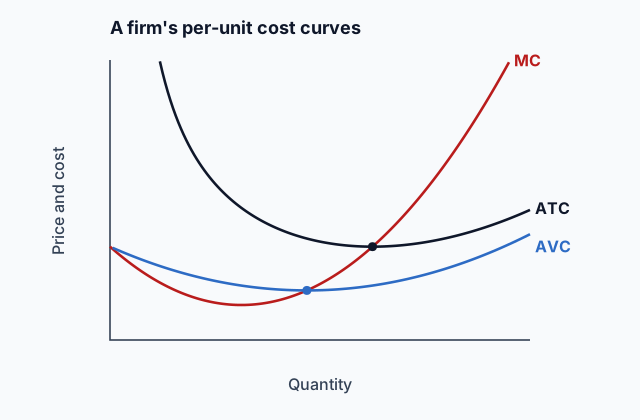
| Marginal cost (MC) | The change in total cost from producing one more unit: the change in total cost divided by the change in quantity. | MC is not the average cost of all the units made so far. It is what the last unit alone adds to total cost. |
 Tap to open the picture full size
Part 1 Think first When to stop making pizza
Make a guess first. Even a wrong guess helps the answer stick.
Predict first
A pizza shop sells every pizza for $12. On a busy night, making the 40th pizza adds $7 to the shop's costs. By the 60th pizza, the oven is crowded and the staff are rushed, and making that pizza adds $14 to costs. The owner wants as much profit as possible tonight. What should she do?
In short. A firm chooses its output by comparing marginal revenue with marginal cost, and the profit-maximizing rule is MR = MC.
- Marginal revenue is what one more unit brings in, and marginal cost is what one more unit adds to cost.
- The rule is read the same way from a table or from a graph, and later units use it for every kind of market.
- MR = MC picks the output; profit itself is total revenue minus total cost at that output.
Part 2 Learn it Four ideas, with a check after each
2a. What one more unit adds
A firm chooses its output one unit at a time, and for each unit it asks two questions.
- Marginal revenue (MR) is how much one more unit adds to total revenue: the change in total revenue divided by the change in quantity.
- Marginal cost (MC) is how much one more unit adds to total cost: the change in total cost divided by the change in quantity.
Profit is total revenue minus total cost, so each unit changes profit by MR − MC.
- If MR > MC, the unit adds to profit. Make it.
- If MR < MC, the unit lowers profit. Leave it out.
A bakery sells its 50th loaf of the day for $4, and baking it adds $2.50 to its costs. That loaf raises profit by $1.50, so the bakery should bake it. If the 90th loaf also sells for $4 but adds $4.60 to costs, baking it lowers profit by $0.60.
So the firm keeps adding units while they add to profit and stops where one more unit would add nothing: where MR = MC. That is the profit-maximizing rule.
Quick check · Calculate
A firm's total revenue is $60 when it sells 3 units and $76 when it sells 4 units. Its total cost is $50 at 3 units and $62 at 4 units. By how many dollars does producing and selling the 4th unit change the firm's profit? Give a negative number if profit falls.
2b. Reading the rule from a table
Many firms can sell as many units as they want at the market price. Each extra unit then brings in exactly that price, so MR = P for every unit. (3.7 explains why a firm in a perfectly competitive market is in this position.)
A cutting-board maker sells every board for $9. The table gives the MC of each board in a day.
| Board | 1st | 2nd | 3rd | 4th | 5th | 6th |
|---|---|---|---|---|---|---|
| MC | $7 | $5 | $6 | $8 | $11 | $14 |
Go unit by unit. Boards 1 to 4 each cost $8 or less to make and bring in $9, so each adds to profit. The 5th costs $11 and brings in $9, so it lowers profit. The firm makes 4 boards: the last unit whose MC is at or below MR, once MC has started rising.
Do not stop at the 2nd board just because its MC is the lowest. The 3rd and 4th still add to profit.
If a unit's MC exactly equals MR, making it adds nothing and loses nothing, and the rule MR = MC names that output, so count it.
Quick check · Calculate
A firm can sell as many units as it wants at $10 each. The marginal cost of its 1st unit is $8, 2nd $6, 3rd $7, 4th $9, 5th $12 and 6th $15. How many units should it produce to maximize its profit?
2c. Reading the rule from a graph
On a graph of a firm that sells at the market price, MR is a horizontal line at that price, labeled P = MR. The MC curve falls at first and then rises.
The profit-maximizing quantity, often labeled q\*, is where the P = MR line crosses the rising part of MC.
- At any quantity left of q\*, MC is below MR, so one more unit adds to profit. The firm should make more.
- At any quantity right of q\*, MC is above MR, so the last unit lowered profit. The firm should make less.
If the market price rises, the P = MR line moves up, and it now crosses MC farther to the right: the firm's best quantity rises, moving up along its MC curve. A lower price moves q\* to the left.
Where MC is still falling, it can cross the price line too, but that crossing is not the answer. Just past it, MC is below the price, so each further unit adds to profit.
Quick check · Decide and justify
A firm sells every unit at a market price of $15. At its current output, the marginal cost of its last unit is $11, and marginal cost is rising. To maximize profit, should it produce more units or fewer?
Which reason supports your choice?
2d. How much profit at the best output
MR = MC tells the firm how many units to make. It does not tell you how much profit it earns. Work that out at the chosen output:
- profit = total revenue − total cost, or
- profit = (P − ATC) × q, since total revenue is P × q and total cost is ATC × q.
A flower grower sells every bunch for $8. Its MR = MC output is 300 bunches a week, where its ATC is $5. Profit is (8 − 5) × 300 = $900 a week.
On the graph, that profit is a rectangle: its height runs from ATC up to P at q\, and its width runs from 0 to q\.
Two cautions. MR = MC does not mean profit is zero: only the last unit adds nothing, while every unit before it added MR − MC. And when ATC at q\* is above the price, the same rule picks the output with the smallest loss; whether the firm should then produce at all is the question of 3.6.
Quick check · Calculate
A firm can sell as many units as it wants at $20 each. It maximizes profit by producing 50 units, where its marginal cost is $20 and its average total cost is $16. What is the firm's profit, in dollars?
Part 3 Watch it done Batches of popcorn
Follow each step, then finish the last one yourself.
A popcorn maker can sell as many batches as it wants at $80 a batch. Its total cost is $60 for 0 batches, $120 for 1, $160 for 2, $210 for 3, $280 for 4, $380 for 5 and $510 for 6. How many batches maximize its profit, and what is that profit?
Step 1 · Marginal revenue
Every batch sells for $80, so each one adds $80 to total revenue: MR = $80 for every batch.
Step 2 · Marginal cost
Subtract each total cost from the next. The 1st batch adds 120 − 60 = $60, the 2nd $40, the 3rd $50, the 4th $70, the 5th $100 and the 6th $130.
Why this step?
The 2nd batch has the lowest marginal cost. Why not stop there?
The lowest MC is not the goal. The 3rd batch adds $50 to cost and the 4th $70, and each brings in $80, so each still raises profit. Stopping at 2 would give up that profit.
Step 3 · Find the best output
Batches 1 to 4 each cost $70 or less and bring in $80. The 5th costs $100 and brings in $80, so it would lower profit by $20. The firm makes 4 batches.
Your step · Calculate
A popcorn maker can sell as many batches as it wants at $80 a batch. Its total cost is $60 for 0 batches, $120 for 1, $160 for 2, $210 for 3, $280 for 4, $380 for 5 and $510 for 6. It produces the number of batches that maximizes its profit. What is that profit, in dollars?
dollars
Part 4 Try it Find the best output, then draw it
Before each check in the lab, say whether the firm's quantity will rise or fall, and name the curve it moves along.
Part 5 Explain it Answer a short free-response question
Nothing you type leaves this page. Draw the graph on paper, then compare it with the model.
Free response is 33.35% of the exam score. This one is shaped like Question 3, Short.
Free-response practice · Question 3 style
Ridgeway Farm sells strawberries in a perfectly competitive market, where it can sell as many as it wants at the market price. Ridgeway is earning a positive economic profit. (a) Draw a correctly labeled graph for Ridgeway showing its marginal cost (MC) and average total cost (ATC) curves and the market price, labeled P = MR. Label Ridgeway's profit-maximizing quantity q. (b) Shade the area that shows Ridgeway's economic profit. (c) Ridgeway considers producing one unit more than q. For that unit, is marginal revenue greater than, less than or equal to marginal cost? Explain what producing it does to Ridgeway's profit. (d) The market price of strawberries rises. Will Ridgeway's profit-maximizing quantity increase, decrease or stay the same? Explain.
Model answer
(a) Price and cost on the vertical axis and quantity on the horizontal axis. A U-shaped ATC curve, an MC curve that rises through the lowest point of ATC, and a horizontal line P = MR above the lowest point of ATC. q* is where P = MR crosses the rising part of MC. (b) The rectangle between P and ATC, from the vertical axis out to q. (c) Less than. Beyond q, MC is above P = MR, so that unit adds more to cost than to revenue and lowers profit. (d) Increase. A higher price raises MR, and the new P = MR line crosses the rising MC curve at a larger quantity.
Ridgeway Farm at the market price
P = MR crosses the rising MC curve at q. Profit is the rectangle between the price and ATC, out to q.
Score your own answer. This is a self-check, not a grade. Tick each point your answer makes.
Part 6 Check yourself A fishing-trip business
The case questions can all be answered from this table.
Lakeside Charters runs guided fishing trips. There are many such businesses on the lake, so Lakeside can sell as many trips as it wants at the going price of $300 a trip. The table shows its total cost for each number of trips a week.
| Trips per week | Total cost |
|---|---|
| 0 | $200 |
| 1 | $450 |
| 2 | $630 |
| 3 | $830 |
| 4 | $1,070 |
| 5 | $1,360 |
| 6 | $1,710 |
| 7 | $2,130 |
Case question 1 · Calculate
How many trips a week should Lakeside run to maximize its profit?
Case question 2 · Fill the statement
Tap a blank, then tap an amount.
At its profit-maximizing number of trips, Lakeside's total revenue is a week, its total cost is and its profit is .
Case question 3 · Multiple choice
Why should Lakeside not run a 6th trip each week?
The rest stand on their own and do not use the case.
Check yourself · Spot the error
A firm can sell as many units as it wants at $40 each. On its graph, its MC curve crosses the $40 price line on its rising part at 120 units, and its ATC curve is lowest at 100 units. A student explains how the firm should choose its output. Tap the first line with a mistake.
Check yourself · Put it in order
A firm sells every unit at the market price, and you have its total cost at each output. Put the steps for finding its profit-maximizing output and its profit in order. Tap them from first to last.
Check yourself · Select all
A firm sells every unit at a market price of $25 and produces the quantity where its rising marginal cost curve meets the $25 price line. Which two statements are correct? Select two.
Select 2 answers, then check.
Part 7 Keep it Keep it
From 3.4 Types of Profit · Calculate
Dana's tutoring business had total revenue of $180,000 last year. It paid $35,000 in rent, $70,000 in wages to tutors and $15,000 for supplies. To run it, Dana left a job paying $50,000 a year, and she put $40,000 of her savings into the business, money that had been earning 5% interest a year. She has no other implicit costs. What was the business's economic profit last year, in dollars? Give a negative number for a loss.
From 2.7 Market Disequilibrium and Changes in Equilibrium · Decide and justify
At this week's fares, airlines have many more seats on flights to a holiday resort than travelers want to buy. Fares are free to change. What happens next?
Which reason supports your choice?
In three lines
- Each unit changes profit by MR − MC, so a firm makes every unit with MR at least MC and stops where MR = MC on the rising part of MC.
- A firm that sells at the market price has MR = P, so in a table it makes the last unit whose MC is at or below the price.
- MR = MC picks the output; profit there is total revenue minus total cost, or (P − ATC) × q.
Exam strategy for this topic
- Section I, Multiple Choice: 60 questions in 70 minutes.
- Section II, Free Response: 3 questions in 60 minutes.
- This lesson's Explain it is shaped like free-response question 3, Short.
- A four-function calculator is allowed on both sections of the exam.
On a perfectly competitive firm's graph, draw P = MR as a horizontal line and drop a dashed line from where it meets the rising MC curve to the quantity axis. Label that quantity before you shade anything, since every area you shade runs out to it.
Questions students ask
Why MR = MC and not MR > MC?
While MR is above MC, one more unit still adds to profit, so the firm has not finished. It stops where the next unit would add nothing, which is where MR = MC.
What if no unit in the table has MR exactly equal to MC?
Go unit by unit and make every unit whose MC is at or below MR. The last such unit, before MC climbs above MR, is the profit-maximizing output.
Why does only the rising part of MC count?
Where MC is falling and crosses the price line, the units just after the crossing cost less than the price, so making them raises profit. The firm's best output is where MC crosses MR on the way up.
Does the MR = MC rule work only in perfect competition?
No. Every profit-maximizing firm compares MR with MC. In perfect competition MR equals the price, which makes the rule easy to read. Unit 4 applies it to firms whose MR is below their price.
Can a firm lose money at the MR = MC output?
Yes. If the price is below ATC at that output, the rule finds the output with the smallest loss. Whether the firm should then produce at all is a question for 3.6.
Course alignment, for teachers
AP Microeconomics topic 3.5, Unit 3: Production, Cost, and the Perfect Competition Model.
- Skill 2.A: Using economic concepts, principles, or models, explain how a specific economic outcome occurs or what action should be taken in order to achieve a specific economic outcome.
This lesson maps the one essential knowledge statement of the topic to the part that teaches each one: 1 is checked by a scored question. The map is in the lesson file.