Unit 3 · Topic 3.6 · about 30 minutes · 7 parts · 10 scored checks, 1 of them multiple choice, plus 2 from earlier lessons
AP Microeconomics 3.6: Firms’ Short-Run Decisions to Produce and Long-Run Decisions to Enter or Exit a Market
Unit 3: 22 to 25% of the multiple-choice section
What you'll be able to do
- Explain, using a graph or a table, when a firm produces or shuts down in the short run, and when firms enter or leave a market in the long run in response to profits and losses.
Key vocabulary
| Term | What it means | The exam trap |
|---|---|---|
| Shut down | To produce zero output in the short run. | Students mix up which of a firm's costs stop when it shuts down and which do not. |
| Total revenue (TR) | The price times the quantity sold. | Students treat revenue as profit. Revenue counts no costs at all. |
| Total variable cost (TVC) | The cost of the inputs that change with output, such as hourly labor and materials. | Students sometimes fold the fixed cost into it. TVC leaves the fixed cost out. |
| Average variable cost (AVC) | Total variable cost divided by the quantity of output. | AVC and ATC look alike on a graph and in a table; read the label before you use one. |
| Long run | A period long enough that every input, including those fixed in the short run, can be changed. | It is not a set number of months. It lasts as long as the firm's fixed commitments, which differs from one industry to another. |
| Barriers to entry | Anything that keeps new firms from starting to sell in a market, such as a patent or a very large startup cost. | Students sometimes count only government rules. A very large startup cost can keep new firms out just as well. |
| Economic loss | A negative economic profit: total revenue below total cost, where cost includes what the owners give up by not using their resources elsewhere. | Students compute it from the accounting figures alone. What the owners give up by not using their time and money elsewhere counts as a cost too. |
 Tap to open the picture full size
Part 1 Think first A warm winter at a ski hill
Make a guess first. Even a wrong guess helps the answer stick.
Predict first
A small ski hill expects a warm winter. If it opens for the season, lift tickets will bring in $900,000, and staff, power and snowmaking will cost $700,000. It also owes $400,000 this year on the loan for its lifts, whether it opens or not. What should it do this season?
In short. In the short run a firm decides whether to produce at all, and in the long run firms decide whether to enter or leave a market in response to profit and loss.
- Short run: the choice is between operating and shutting down, which means producing nothing for now.
- Two prices on a firm's cost curves have names of their own: the shutdown point and the break-even price.
- Long run: with no barriers to entry, profit draws firms in and expected losses push firms out, which moves the market price.
Part 2 Learn it Three ideas, with a check after each
2a. Produce or shut down in the short run
In the short run a firm has fixed costs it owes whatever it does, such as rent on a lease or payments on a machine. Its choice is not whether to pay them. It is whether to produce anything at all.
- If it operates, it earns total revenue (TR) and pays its total variable cost (TVC) on top of the fixed cost.
- If it shuts down, it produces zero output, earns nothing, pays no variable cost, and still owes the fixed cost.
So operating is the better choice whenever revenue pays for the variable cost: operate if TR ≥ TVC, shut down if TR < TVC. Divide both sides by output and you get the same test per unit: operate if P ≥ AVC at the output where MR = MC.
A print shop that stays open earns $5,000 a week, pays $3,800 for wages and paper, and owes $2,000 in rent. Open: 5,000 − 3,800 − 2,000 = −$800. Shut: −$2,000. It loses money either way, but its revenue covers the variable cost and $1,200 of the rent, so staying open loses $1,200 less.
Quick check · Decide and justify
A bakery sells bread in a perfectly competitive market at $3 a loaf. At its profit-maximizing output of 300 loaves a day, its average total cost is $4 and its average variable cost is $2.50. What should the bakery do in the short run?
Which reason supports your choice?
2b. The shutdown point
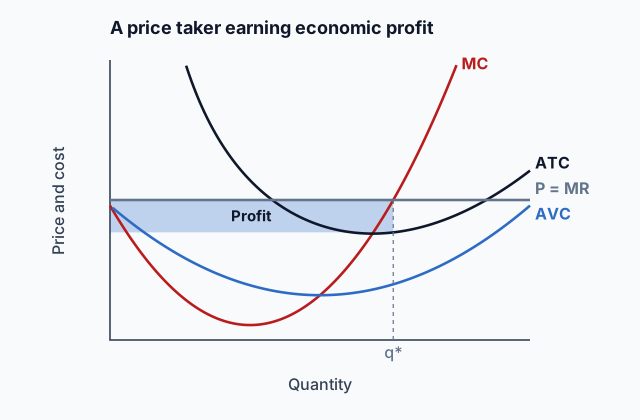
The test P ≥ AVC gives every firm a lowest price it will produce at. On a graph it is the bottom of the AVC curve, where MC crosses AVC, and it is called the shutdown point.
- Price above minimum AVC: produce where MR = MC.
- Price below minimum AVC: no output brings in enough to pay its variable cost, so produce nothing.
That makes the part of the MC curve above minimum AVC the firm's short-run supply curve: at each price, it produces where MC equals that price.
From a table, work out AVC = TVC ÷ q at each output and take the smallest. Leave the fixed cost out. The bottom of ATC is a different price, the break-even price, where the firm covers all of its costs. A price between the two bottoms means a loss that the firm still accepts in the short run.
Quick check · Calculate
A firm in a perfectly competitive market has a fixed cost of $40. Its total variable cost is $30 for 1 unit, $50 for 2 units, $66 for 3 units, $92 for 4 units and $130 for 5 units. What is the lowest price, in dollars, at which the firm will produce rather than shut down in the short run?
2c. Entry and exit in the long run
In the long run every input can change, so nothing is fixed: leases run out and machines can be sold. A firm can now do what it could not do in the short run and exit, leaving the market. New firms can enter it.
- Economic profit (P above ATC) means owners earn more here than in their next-best use, so new firms enter.
- Expected economic losses (P below ATC, with no recovery in sight) mean owners can do better elsewhere, so firms exit.
- Zero economic profit (P = ATC) means owners earn just what they could earn elsewhere, so no one enters or leaves.
Entry adds sellers: market supply shifts right and the price falls. Exit removes them: market supply shifts left and the price rises. Entry or exit goes on until the price reaches the lowest point of ATC, where economic profit is zero.
All of this assumes no barriers to entry or exit. If a law caps the number of sellers, profit cannot draw new firms in, and the price stays up.
Quick check · Sort it
Each card describes the firms in a different market. Tap a card, then tap what happens to the number of firms in that market in the long run.
Firms enter
Firms leave
No entry or exit
Part 3 Watch it done A frame shop at $10 a frame
Follow each step, then finish the last one yourself.
A firm makes picture frames in a perfectly competitive market and can sell as many as it wants at $10 a frame. Its fixed cost is $60 a day. The marginal cost of each frame is $12 for the 1st, $8 for the 2nd, $6 for the 3rd, $8 for the 4th, $12 for the 5th and $18 for the 6th. Should the firm produce in the short run, and what is its economic profit at its best choice?
Predict first
Before the steps: will this firm produce frames or shut down in the short run?
Step 1 · Find the output if it operates
MR is the $10 price. The 1st frame costs $12, but marginal cost then falls. Following it up its rising part, the 2nd, 3rd and 4th frames each cost $10 or less, and the 5th costs $12, more than it brings in. If the firm operates, it makes 4 frames.
Step 2 · Compare TR with TVC
TR = 10 × 4 = $40. TVC = 12 + 8 + 6 + 8 = $34. Revenue covers the variable cost, so the firm operates. (Per unit: AVC = 34 ÷ 4 = $8.50, below the $10 price.)
Why this step?
Why compare revenue with variable cost and leave the $60 fixed cost out?
The $60 is owed whether the firm makes frames or not, so it cannot change which choice is better. Only the costs the firm escapes by shutting down, its variable costs, belong in the comparison.
Your step · Calculate
A picture-frame firm sells at $10 a frame and produces 4 frames a day. Its fixed cost is $60 a day, and its total variable cost for 4 frames is $34. What is its economic profit, in dollars a day? Give a loss as a negative number.
dollars
The firm keeps producing and loses $54 a day, which beats losing $60. If the price stays at $10, that is only a short-run answer: once its fixed commitments end, the firm can leave the market and lose nothing.
Part 4 Try it Decide, then draw the long run
Before each lab check, say whether firms enter or leave, which way market supply shifts, and whether the price rises or falls.
Part 5 Explain it Answer a short free-response question
Nothing you type leaves this page. Draw the graph on paper, then compare it with the model.
Free response is 33.35% of the exam score. This one is shaped like Question 2, Short.
Free-response practice · Question 2 style
Ashby Mills is a typical firm in the perfectly competitive market for flour. At the current market price, Ashby earns an economic loss but continues to produce in the short run. (a) Draw a correctly labeled graph for Ashby showing its MC, ATC and AVC curves and the market price, labeled P. Label Ashby's profit-maximizing output q. (b) On your graph, shade the area that shows Ashby's economic loss. (c) Explain* why Ashby continues to produce in the short run even though it earns a loss. (d) If the price stays at P, what will happen to the number of firms in the flour market in the long run? Explain.
Model answer
(a) Price and cost on the vertical axis and quantity on the horizontal axis. MC rises through the lowest points of AVC and ATC. The horizontal line P = MR lies below the lowest point of ATC and above the lowest point of AVC, and q* is where it meets MC. (b) The rectangle between ATC and P, from the vertical axis out to q. (c) At q the price is above AVC, so total revenue pays all of the variable cost and part of the fixed cost. Shutting down would leave the whole fixed cost as the loss, which is larger. (d) The number of firms decreases. Firms expect losses at P, and in the long run, when no cost is fixed, they leave for markets where they can earn at least a normal profit.
Ashby Mills takes a loss but keeps producing
The price line P = MR sits between the lowest point of AVC and the lowest point of ATC. Ashby produces q*, where MC meets the price, and the shaded rectangle between P and ATC is its loss.
Score your own answer. This is a self-check, not a grade. Tick each point your answer makes.
Part 6 Check yourself A pottery studio's cost table
The case questions can all be answered from this table.
A pottery studio sells mugs in a perfectly competitive market, where the price is $16 a mug. Its fixed cost is $40 a day. The table shows its total cost at each daily output.
| Mugs a day | Total cost |
|---|---|
| 0 | $40 |
| 1 | $54 |
| 2 | $64 |
| 3 | $72 |
| 4 | $82 |
| 5 | $96 |
| 6 | $116 |
| 7 | $144 |
Case question 1 · Calculate
At the price of $16 a mug, what is the studio's economic profit at its best choice in the short run, in dollars a day? Give a loss as a negative number.
Case question 2 · Multiple choice
Suppose the market price of a mug falls to $10. What is the studio's best choice in the short run?
Case question 3 · Fill the statement
Suppose the market price is $16 a mug and every studio in the market has this cost table. Tap a blank, then tap a word or phrase.
In the long run, studios will the market, and the market price of a mug will .
The rest stand on their own and do not use the case.
Check yourself · Spot the error
A firm in a perfectly competitive market sells at $9 a unit. At 200 units, where MR = MC, its ATC is $11 and its AVC is $8. A student decided what the firm should do in the short run. Tap the first line with a mistake.
Check yourself · Select all
In a perfectly competitive market with no barriers to entry or exit, firms earn economic losses at the current price and expect that to continue. Which two will happen in the long run? Select two.
Select 2 answers, then check.
Check yourself · Match
A firm in a perfectly competitive market faces one of four prices. Tap a price, then tap what the firm does now and what happens over time.
Part 7 Keep it Keep it
From 3.5 Profit Maximization · Calculate
A firm can sell as many units as it wants at $10 each. The marginal cost of its 1st unit is $8, 2nd $6, 3rd $7, 4th $9, 5th $12 and 6th $15. How many units should it produce to maximize its profit?
From 3.3 Long-Run Production Costs · Multiple choice
A bakery pays $3,000 a month in rent under a lease that ends in two years. It is planning how big to be over the next ten years, long enough to change all of its inputs. In that plan, how should the bakery treat the rent?
In three lines
- In the short run a firm operates if TR is at least TVC, or P is at least AVC, and otherwise shuts down and loses only its fixed cost.
- The lowest point of AVC is the shutdown point; the lowest point of ATC is the break-even price.
- In the long run, with no barriers, economic profit draws firms in and expected losses push them out, moving the market price.
Exam strategy for this topic
- Section I, Multiple Choice: 60 questions in 70 minutes.
- Section II, Free Response: 3 questions in 60 minutes.
- This lesson's Explain it is shaped like free-response question 2, Short.
- A four-function calculator is allowed on both sections of the exam.
When a question asks whether a firm keeps producing, compare the price with AVC at the output where MR = MC and say so in those words. When it asks about the number of firms, compare the price with ATC and name the long run. Keep the two tests apart in your answer.
Questions students ask
Why would a firm ever produce at a loss?
In the short run its fixed cost is owed either way. If revenue covers the variable cost, producing pays part of the fixed cost too, so the loss is smaller than the fixed cost it would lose by shutting down.
What is the difference between shutting down and exiting?
Shutting down is a short-run choice to produce zero output while the firm still owes its fixed cost. Exiting is a long-run choice to leave the market, once no cost is fixed, so the firm no longer owes anything.
Can I use total revenue and total variable cost instead of P and AVC?
Yes. Comparing TR with TVC is the same test as comparing P with AVC, because both sides of P ≥ AVC are just TR ≥ TVC divided by output. Use whichever the question gives you.
What happens exactly at the shutdown point?
At a price equal to minimum AVC, revenue just pays the variable cost, so producing and shutting down give the same loss, the fixed cost. Any price below it means shut down.
Do firms leave whenever they earn less than an accounting profit?
No. Firms respond to economic profit, which subtracts what owners could earn elsewhere. A firm can show an accounting profit and still have an economic loss, and that loss is what pushes it out in the long run.
Course alignment, for teachers
AP Microeconomics topic 3.6, Unit 3: Production, Cost, and the Perfect Competition Model.
- Skill 2.A: Using economic concepts, principles, or models, explain how a specific economic outcome occurs or what action should be taken in order to achieve a specific economic outcome.
This lesson maps all 2 essential knowledge statements of the topic to the part that teaches each one: 2 are checked by a scored question. The map is in the lesson file.