Unit 4 · Topic 4.1 · about 30 minutes · 7 parts · 11 scored checks, 1 of them multiple choice, plus 2 from earlier lessons
AP Microeconomics 4.1: Introduction to Imperfectly Competitive Markets
Unit 4: 15 to 22% of the multiple-choice section
What you'll be able to do
- Define, using graphs where they help, the characteristics of imperfectly competitive markets, the barriers to entry that sustain them, and why they are inefficient.
Key vocabulary
| Term | What it means | The exam trap |
|---|---|---|
| Imperfect competition | Any market in which firms have some control over the price, so they are not price takers. | Students take it to mean a market with only one firm. It covers markets with a few firms and with many firms too. |
| Monopoly | A market with a single seller of a product that has no close substitutes. | Students use the word for any big firm. A large firm with rivals is not a monopoly. |
| Oligopoly | A market with a few large sellers, each of which must consider what the others do. | Students mix it up with monopoly. Count the sellers before you name the market. |
| Monopolistic competition | A market with many sellers, each selling a product that differs a little from the others'. | The name sounds like monopoly, but these markets have many firms, and entry is easy. |
| Monopsony | A market in which a single buyer purchases a factor of production, such as labor. | Students list it with the sellers. Check whether the firm is selling a product or buying a factor. |
| Marginal revenue (MR) | The change in total revenue from selling one more unit. | Students use the price of the last unit as its marginal revenue. Work it out from the change in total revenue. |
| Barrier to entry | Anything that keeps a new firm from starting to sell in a market, such as a very large start-up cost. | Students treat any market with few firms as protected. Ask what would actually stop a new firm from starting. |
| Allocative inefficiency | An outcome where the quantity produced is not the one that makes total surplus as large as it can be. | Students confuse it with a firm wasting inputs. It is about how much of the good is produced. |
 Tap to open the picture full size
Part 1 Think first A patent on a new pill
Make a guess first. Even a wrong guess helps the answer stick.
Predict first
Nuvia Labs holds the patent on a new allergy pill. Each pill costs it $2 to make, and it charges $40. Other drug companies know how to make the same pill. While the patent lasts, what will most likely happen to the price of the pill?
In short. An imperfectly competitive market is one where firms are not price takers: each has some say over the price it charges.
- The structures differ in how many firms sell and in whether their products differ, and one structure is about buyers rather than sellers.
- Facing a downward-sloping demand curve changes how a firm's revenue grows as it sells more.
- This lesson asks what keeps new firms from starting to sell, and how efficient these markets are.
Part 2 Learn it Four ideas, with a check after each
2a. Four kinds of imperfect competition
In a perfectly competitive market, many firms sell identical products and each takes the market price. Any market where that fails, so firms have some say over price, is imperfectly competitive. There are four kinds.
- Monopoly: one seller of a product with no close substitutes, such as a town's only water company.
- Oligopoly: a few large sellers, each watching what the others do, such as the handful of airlines on a country's routes.
- Monopolistic competition: many sellers, each with a product a little different from the rest, such as a city's coffee shops.
- Monopsony: one buyer of a factor of production, such as a mine that is the only employer for a hundred miles.
The first three are product markets, where firms sell goods and services. Monopsony is in a factor market, where firms buy labor, land or capital. Count the firms, then ask whether their products differ and whether they are selling or buying.
Quick check · Sort it
Each card describes a market. Tap a card, then tap the kind of imperfect competition it is.
Monopoly
Oligopoly
Monopolistic competition
Monopsony
2b. To sell more, lower the price
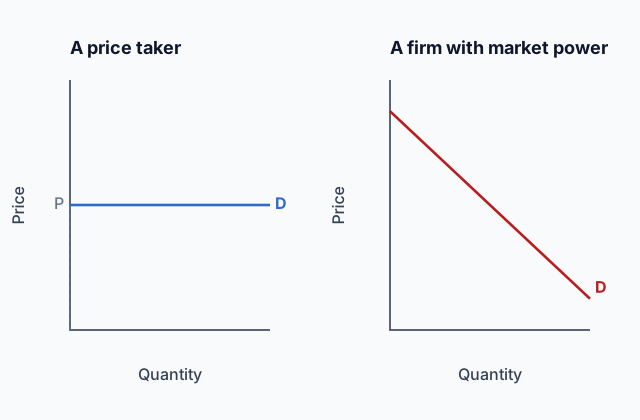
A price taker can sell as much as it wants at the market price. A firm in an imperfectly competitive product market faces a downward-sloping demand curve instead. With everything else held constant, the only way it can sell one more unit is to lower its price, and when it charges everyone the same price, the lower price applies to every unit it sells, not just the new one.
That changes marginal revenue (MR), the change in total revenue from selling one more unit.
A bakery sells 10 cakes a day at $20 each, so its total revenue is $200. To sell 11 it must charge $19, and 11 × $19 = $209. The 11th cake brings in $19, but the bakery also gives up $1 on each of the 10 cakes it could have sold at $20. Its marginal revenue is $209 − $200 = $9.
Work MR out as the change in total revenue: price times quantity at each output, then the difference.
Quick check · Calculate
A town's only bike shop can rent 4 bikes a day at $30 each, or 5 bikes a day at $27 each. What is the marginal revenue of the 5th bike, in dollars?
2c. Price above marginal cost
In Unit 3, a perfectly competitive market ends up where price equals marginal cost, which is allocatively efficient: every unit a buyer values at more than it costs to make gets made.
A firm that must lower its price to sell more has marginal revenue below its price, so it stops adding output sooner, and at the output it chooses its price is greater than its marginal cost. Buyers respond to that higher price, and some go without.
A cinema charges $15 a ticket. Letting one more person into a half-empty show costs it about $1 in cleaning. A student who would pay $8 stays home. Seating the student would cost $1 and give the student something worth $8, a gain of $7 that nobody gets.
Whenever P > MC at the output a market reaches, some units worth more to buyers than they cost are not made. The market is inefficient, and too little is produced.
Quick check · Decide and justify
At the output a firm chooses, it charges $9 a unit, and its marginal cost is $4 a unit. Compared with the allocatively efficient output, how much does this market produce?
Which reason supports your choice?
2d. Barriers to entry
In Unit 3, economic profit drew new firms in until it was gone. That only works when new firms can actually start selling. A barrier to entry is anything that stops them, and there are three main kinds.
- High fixed or start-up costs: a new chip maker needs a factory costing billions before it sells one chip.
- Legal barriers: a patent, a license only a few firms get, or a government grant of the only right to serve an area.
- Exclusive ownership of a key resource: one company owns every mine of an ore the product needs.
With a barrier in place, a firm's profit does not draw rivals in, so the profit can last for years. Barriers are what sustain monopoly, oligopoly and the other imperfectly competitive structures. A market where anyone can start for the price of a small license has no real barrier, however few firms it has today.
Quick check · Match
Tap a situation, then tap what it does to new firms that want to enter.
Part 3 Watch it done Ferry tickets to an island
Follow each step, then finish the last one yourself.
Pellmore Ferry is the only ferry to an island. It can sell 100 trips a day at $10 a trip, 120 at $9, 140 at $8 or 160 at $7, and it charges every rider the same price. What is its marginal revenue per trip as it lowers its price one dollar at a time?
Predict first
Before the steps: when Pellmore cuts its price from $10 to $9, is its extra revenue for each of the 20 new trips more than $9, equal to $9 or less than $9?
Step 1 · Total revenue at each price
Total revenue is price times quantity: 100 × $10 = $1,000, 120 × $9 = $1,080, 140 × $8 = $1,120 and 160 × $7 = $1,120.
Step 2 · From 100 trips to 120
Total revenue rises by $1,080 − $1,000 = $80 for 20 more trips, so marginal revenue is $80 ÷ 20 = $4 a trip, far below the $9 price.
Why this step?
Why is marginal revenue so far below the $9 price?
The 20 new trips bring in 20 × $9 = $180, but the $1 price cut also applies to the 100 trips Pellmore could have sold at $10. That costs $100, so revenue rises by only $80.
Your step · Calculate
A ferry can sell 120 trips a day at $9 a trip or 140 trips a day at $8 a trip, charging every rider the same price. What is its marginal revenue per trip for the 20 extra trips, in dollars?
dollars
Each price cut adds less: $4, then $2 a trip, and from 140 trips to 160 total revenue does not rise at all, so marginal revenue is $0. A firm facing downward-sloping demand always earns less on one more unit than the price it sells it for.
Part 4 Try it Find the flaw in an argument
A student wrote this about a cable company. Read every line before you pick one.
Try it · Spot the error
Vela Cable is the only cable company in a town, protected by a city franchise. A student reasoned about its prices. Tap the first line with a mistake.
Part 5 Explain it Answer a short free-response question
Nothing you type leaves this page. Write your answer, then compare it with the model.
Free response is 33.35% of the exam score. This one is shaped like Question 3, Short.
Free-response practice · Question 3 style
Ardent Rail is the only railroad between two cities, because the government grants a license to one railroad only. (a) Identify the kind of barrier to entry that protects Ardent. (b) Ardent can sell 10,000 tickets a week at $50 each or 11,000 tickets a week at $48 each. Calculate its marginal revenue per ticket for the extra 1,000 tickets. Show your work. (c) At the output Ardent chooses, its price is greater than its marginal cost. Explain why that output is not allocatively efficient.
Model answer
(a) A legal barrier to entry: the government's license. (b) Total revenue is 10,000 × $50 = $500,000 at $50 and 11,000 × $48 = $528,000 at $48. It rises by $28,000 for 1,000 tickets, so marginal revenue is $28,000 ÷ 1,000 = $28 a ticket. (c) Price shows what riders value one more trip at, and it is greater than what one more trip costs Ardent. Some riders value a trip at more than its marginal cost but do not travel at Ardent's price, so too few trips are made and total surplus is less than it could be.
Score your own answer. This is a self-check, not a grade. Tick each point your answer makes.
Part 6 Check yourself The valley's only internet provider
The case questions can all be answered from this table.
Ridgeline Net is the only internet provider in a mountain valley, and it charges every household the same monthly price. The table shows how many households sign up at each price. Its marginal cost is $10 per household a month.
| Monthly price | Households |
|---|---|
| $60 | 200 |
| $50 | 300 |
| $40 | 400 |
| $30 | 500 |
Case question 1 · Calculate
If Ridgeline lowers its price from $50 to $40 a month, what is its marginal revenue per extra household, in dollars a month?
Case question 2 · Multiple choice
Suppose Ridgeline charges $40 a month and serves 400 households. Which statement about this outcome is true?
Case question 3 · Fill the statement
Any rival would have to run cable past every home in the valley before it could sign up a single household. Tap a blank, then tap a word or phrase.
That cost is a barrier from , so Ridgeline's economic profit .
The rest stand on their own and do not use the case.
Check yourself · Select all
Which two of these markets are imperfectly competitive? Select two.
Select 2 answers, then check.
Check yourself · Decide and justify
A theater charges $60 a seat for a show that is only half full. Seating one more person costs it $3. A student would pay $25 for a seat but not $60. Is this market's outcome efficient for that seat?
Which reason supports your choice?
Part 7 Keep it Keep it
From 3.7 Perfect Competition · Calculate
A wheat farm is one of thousands selling identical wheat, and the market price is $6 a bushel. The farm raises its output from 4,000 to 4,500 bushels, and nothing else in the market changes. By how many dollars does the farm's total revenue rise?
From 3.5 Profit Maximization · Calculate
A firm's total revenue is $60 when it sells 3 units and $76 when it sells 4 units. Its total cost is $50 at 3 units and $62 at 4 units. By how many dollars does producing and selling the 4th unit change the firm's profit? Give a negative number if profit falls.
In three lines
- Monopoly, oligopoly and monopolistic competition are imperfectly competitive product markets; monopsony is one buyer in a factor market.
- A firm that faces downward-sloping demand must lower its price to sell more, so its marginal revenue is below its price, and it ends up with price above marginal cost.
- Barriers to entry, such as high start-up costs, legal barriers and ownership of a key resource, keep rivals out and let these markets last.
Exam strategy for this topic
- Section I, Multiple Choice: 60 questions in 70 minutes.
- Section II, Free Response: 3 questions in 60 minutes.
- This lesson's Explain it is shaped like free-response question 3, Short.
- A four-function calculator is allowed on both sections of the exam.
When a question says a firm must lower its price to sell more, work out marginal revenue from the change in total revenue, never from the price. When it asks whether an outcome is efficient, compare price with marginal cost at that output and say which is larger.
Questions students ask
Is every large company a monopoly?
No. A monopoly is the only seller of a product with no close substitutes. A large firm with rivals, or one of a few big sellers, is part of an oligopoly or another structure.
Why is marginal revenue less than price for a monopoly?
To sell one more unit it must lower its price, and the lower price applies to every unit it sells. The new unit adds its price, but the firm gives up some revenue on all the others, so revenue rises by less than the price.
What does it mean that price is greater than marginal cost?
Price is what buyers value the last unit at, and marginal cost is what one more unit costs to make. When price is higher, some units that buyers value above their cost are not made, so the market produces too little and is inefficient.
Why is monopsony on this list if it is not a seller?
Imperfect competition can be on either side of a market. A monopsony is a single buyer, usually of labor, so it has power over the price it pays, as a monopoly has over the price it charges.
Do barriers to entry last forever?
Not always. A patent runs out, a license can be opened to others, and a new technology can make a start-up cost smaller. While a barrier lasts, it lets a firm keep a profit that would otherwise draw rivals in.
Course alignment, for teachers
AP Microeconomics topic 4.1, Unit 4: Imperfect Competition.
- Skill 1.D: Describe the similarities, differences, and limitations of economic concepts, principles, or models.
This lesson maps all 4 essential knowledge statements of the topic to the part that teaches each one: 4 are checked by a scored question. The map is in the lesson file.