Unit 4 · Topic 4.2 · about 30 minutes · 7 parts · 10 scored checks, 1 of them multiple choice, plus 2 from earlier lessons
AP Microeconomics 4.2: Monopoly
Unit 4: 15 to 22% of the multiple-choice section
What you'll be able to do
- Explain and calculate, using a graph or a table, a monopoly's profit-maximizing output and price, its profit, consumer surplus and deadweight loss, and why its price above marginal cost makes its output inefficient.
Key vocabulary
| Term | What it means | The exam trap |
|---|---|---|
| Monopoly | A market with a single seller of a product that has no close substitutes. | Students assume a monopoly can charge any price and sell the same amount. It still faces a downward-sloping demand curve. |
| Profit-maximizing rule | Produce the quantity at which marginal revenue equals marginal cost. | The rule gives a quantity, not a price. Students often stop at the height where the two curves cross. |
| Market power | A firm's ability to raise its price without losing all of its buyers. | Market power is limited by demand: a higher price still loses some buyers. |
| Consumer surplus | The difference between what buyers are willing to pay for the units they buy and what they actually pay, added up over those units. | On a monopoly graph it is measured from the monopoly's price, not from marginal cost. |
| Deadweight loss | The total surplus lost when the quantity traded is not the efficient one. | Students draw it on the wrong side of the quantity sold. It covers units that are not made. |
| Natural monopoly | A market where one firm's long-run economies of scale run through the whole of demand. | Students picture a giant company. A small town's only water system can be one too. |
| Economies of scale | A fall in long-run average total cost as a firm's output grows. | Students mix it up with marginal cost falling. It is about average total cost in the long run. |
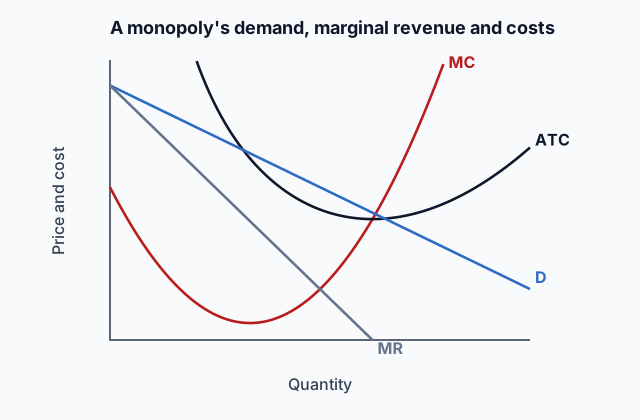 Tap to open the picture full size
Part 1 Think first The only bridge across the river
Make a guess first. Even a wrong guess helps the answer stick.
Predict first
Ashgrove Bridge Company owns the only toll bridge across a wide river, and letting one more car cross costs it almost nothing. At a toll of $4, 10,000 cars cross a day. At $6, 6,000 cross, and at $8, 3,000 cross. Which toll brings in the most money?
In short. A monopoly is the only seller in its market, and it chooses both how much to produce and what price to charge.
- Its choice uses the comparison every firm makes, marginal revenue against marginal cost, with one more step to find the price.
- The lesson measures what that choice does to buyers, to the firm and to total surplus.
- Some monopolies last for reasons other than a law or a patent, and the lesson shows one.
Part 2 Learn it Four ideas, with a check after each
2a. Why a monopoly lasts
A monopoly is the only seller of a product with no close substitutes. In Unit 3, economic profit drew new firms into a market until it was gone. A monopoly can earn a profit year after year only because something keeps rivals out: a monopoly exists because of barriers to entry.
- A patent or a government grant of the only license is a legal barrier.
- Owning every source of a key resource leaves rivals nothing to make the product from.
- A huge start-up cost means a rival must spend a fortune before its first sale.
Take the barrier away and the profit becomes an invitation. A firm that is the only seller today, in a market anyone could enter cheaply, is a monopoly only until someone notices its profit.
Quick check · Sort it
Each card describes a firm that is now the only seller in its market and earns an economic profit. Tap a card, then tap what is likely to happen over the next few years.
It stays the only seller
Rivals start selling
2b. MR = MC, then the price on demand
A monopoly maximizes profit the way every firm does, by comparing marginal revenue with marginal cost. It finds its price in one more step.
- Quantity: produce every unit whose MR is at least its MC, and stop where MR = MC. Past that point a unit adds more to cost than to revenue.
- Price: charge the highest price at which that quantity sells, which is read on the demand curve straight above it.
A concert promoter can sell 1,000 tickets at $30, 2,000 at $27, 3,000 at $24, 4,000 at $21 or 5,000 at $18. Total revenue is $30,000, $54,000, $72,000, $84,000 and $90,000, so each extra 1,000 tickets adds $30,000, $24,000, $18,000, $12,000 and then $6,000. If each 1,000 tickets costs $10,000 to serve, the promoter sells 4,000 tickets (MR $12,000 is above MC) and stops before the 5th thousand (MR $6,000 is below it). It charges $21, the price at which 4,000 sell.
Because MR is below price, the price is greater than marginal cost: $21 a ticket against $10 a ticket.
Quick check · Calculate
A monopoly can sell 1 unit at $20, 2 units at $18 each, 3 at $16 each, 4 at $14 each or 5 at $12 each. Its marginal cost is $6 for every unit. What price maximizes its profit, in dollars?
2c. Profit, consumer surplus and deadweight loss
On a monopoly graph, three areas tell who gains and what is lost. Take demand P = 20 − Q and a constant marginal cost of $4, which is also average total cost. MR = MC at Q = 8, and the price on demand there is $12.
- Profit is the rectangle between price and ATC, out to the quantity: (12 − 4) × 8 = $64.
- Consumer surplus is the triangle between demand and price: ½ × (20 − 12) × 8 = $32.
- Deadweight loss is the triangle between demand and MC, from the monopoly's quantity to the quantity where demand meets MC, here 16: ½ × (12 − 4) × (16 − 8) = $32.
In a competitive market, 16 units would sell at $4. The monopoly makes 8 fewer, and those units, worth more to buyers than they cost, are the deadweight loss. Higher price and lower output are why the monopoly's output is inefficient.
A monopoly with a constant marginal cost of $4
Demand P = 20 − Q. MR meets MC at 8 units, the price on demand there is $12, and demand meets MC at 16 units. Profit is the rectangle, consumer surplus the triangle above it, and deadweight loss the triangle from 8 to 16 units.
Quick check · Calculate
A monopoly sells 40 units at $30 each. Its marginal cost is a constant $10 a unit. Demand is a straight line, and at a price of $10 buyers would purchase 80 units. What is the deadweight loss of the monopoly's choice, in dollars?
2d. Natural monopoly
Some monopolies come from costs rather than laws. A natural monopoly exists when one firm's long-run economies of scale run through the whole of the effective demand for its product: its average total cost is still falling at every quantity buyers would ever purchase.
Piped water is the classic case. Laying pipes under every street costs a fortune; delivering one more gallon through them costs almost nothing. The more gallons one system delivers, the lower its cost per gallon. Two companies, each with its own pipes and half the customers, would each sit higher on the falling ATC curve, so one firm supplies the market at the lowest cost.
On the graph, ATC slopes down across the whole demand curve, and MC lies below ATC. That is why a natural monopoly needs no patent or license to stay the only seller: a smaller rival would always have higher costs.
Quick check · Decide and justify
A city's electric grid cost $500 million to build, and sending one more kilowatt-hour through it costs very little. Average total cost falls at every quantity the city would ever use. Would two companies, each with its own grid, supply the city at a lower average total cost than one?
Which reason supports your choice?
Part 3 Watch it done A gas company's best price
Follow each step, then finish the last one yourself.
Brookfield Gas is the only gas supplier in a valley. It can sell 1 unit at $50, 2 units at $45 each, 3 at $40 each, 4 at $35 each or 5 at $30 each. The marginal cost of each unit is $12, $14, $18, $24 and $32, and its fixed cost is $20. What output and price maximize its profit, and what is that profit?
Predict first
Before the steps: which price will Brookfield charge?
Step 1 · Total and marginal revenue
Total revenue is $50, $90, $120, $140 and $150, so marginal revenue is $50, $40, $30, $20 and $10.
Step 2 · Where MR meets MC
Unit by unit: MR $50 vs MC $12, $40 vs $14, $30 vs $18, all worth making. The 4th unit's MR is $20 and its MC is $24, so it would lose money. Brookfield sells 3 units and charges the price on demand for 3: $40.
Why this step?
Why charge $40, not the $18 marginal cost of the 3rd unit or its $30 marginal revenue?
MR = MC only tells Brookfield how many units to sell. At 3 units buyers will pay $40 each, so charging less would give away revenue without selling any more.
Your step · Calculate
A monopoly sells 3 units at $40 each. The marginal cost of its 1st, 2nd and 3rd units is $12, $14 and $18, and its fixed cost is $20. What is its profit, in dollars?
dollars
Brookfield earns $56 by selling 3 units at $40. Its price is more than twice the $18 cost of the last unit, which is the gap between P and MC that makes a monopoly's output inefficient.
Part 4 Try it Work it from a table, then draw it
Before each lab check, say which curve the price is read on, and whether the price is above or below MC at your point.
Part 5 Explain it Answer a long free-response question
Nothing you type leaves this page. Draw the graph on paper, then compare it with the model.
Free response is 33.35% of the exam score. This one is shaped like Question 1, Long.
Free-response practice · Question 1 style
Harlow Rail is the only railroad between two cities and earns an economic profit. (a) Draw a correctly labeled graph for Harlow showing its demand, marginal revenue, marginal cost and average total cost curves. Label its profit-maximizing quantity Qm and price Pm. (b) On your graph, shade Harlow's economic profit. (c) On your graph, shade the deadweight loss. (d) Is Harlow's output allocatively efficient? Explain using price and marginal cost. (e) Explain why Harlow's economic profit is not competed away in the long run.
Model answer
(a) Price and cost on the vertical axis and quantity on the horizontal axis. Demand slopes down, and MR starts at the same price and lies below it. MC and ATC are U-shaped, with MC rising through the lowest point of ATC. Qm is where MR meets MC, and Pm is on demand straight above Qm. (b) The rectangle between Pm and ATC, from the vertical axis out to Qm. (c) The triangle between demand and MC, from Qm out to where demand meets MC. (d) No. At Qm the price is greater than marginal cost, so buyers value more units at more than they cost to make, and Harlow produces less than the efficient quantity. (e) A barrier to entry, such as the cost of building a rival line or a license only Harlow holds, keeps new firms out, so the profit does not draw in rivals who would lower it.
Harlow Rail's profit and deadweight loss
Qm is where MR meets MC, and Pm is on demand straight above it. Profit is the rectangle between Pm and ATC out to Qm. Deadweight loss is the triangle between demand and MC from Qm to where demand meets MC.
Score your own answer. This is a self-check, not a grade. Tick each point your answer makes.
Part 6 Check yourself The only ski school on the mountain
The case questions can all be answered from this table.
Sable Peak is the only ski school on a mountain and charges every skier the same price for a private lesson. The table shows the price at which each number of lessons a day sells, and its total cost of giving them. Its fixed cost is $40 a day.
| Lessons a day | Price per lesson | Total cost |
|---|---|---|
| 1 | $60 | $70 |
| 2 | $55 | $95 |
| 3 | $50 | $120 |
| 4 | $45 | $152 |
| 5 | $40 | $185 |
Case question 1 · Calculate
What price per lesson maximizes Sable Peak's profit, in dollars?
Case question 2 · Calculate
At its profit-maximizing price and output, what is Sable Peak's economic profit, in dollars a day?
Case question 3 · Multiple choice
At its profit-maximizing output, how does Sable Peak's price compare with its marginal cost, and what does that mean?
The rest stand on their own and do not use the case.
Check yourself · Select all
Which two statements describe a natural monopoly? Select two.
Select 2 answers, then check.
Check yourself · Put it in order
Put the steps a monopoly takes to choose its output and price in order. Tap them from first to last.
Part 7 Keep it Keep it
From 4.1 Introduction to Imperfectly Competitive Markets · Calculate
A town's only bike shop can rent 4 bikes a day at $30 each, or 5 bikes a day at $27 each. What is the marginal revenue of the 5th bike, in dollars?
From 3.6 Firms’ Short-Run Decisions to Produce and Long-Run Decisions to Enter or Exit a Market · Decide and justify
A bakery sells bread in a perfectly competitive market at $3 a loaf. At its profit-maximizing output of 300 loaves a day, its average total cost is $4 and its average variable cost is $2.50. What should the bakery do in the short run?
Which reason supports your choice?
In three lines
- A monopoly exists because barriers to entry keep rivals out, or, in a natural monopoly, because one firm's ATC falls across all of demand.
- It produces where MR = MC and charges the price on demand above that quantity, so its price is greater than marginal cost.
- Its output is below the efficient quantity: profit is the rectangle between price and ATC, and deadweight loss is the triangle between demand and MC beyond it.
Exam strategy for this topic
- Section I, Multiple Choice: 60 questions in 70 minutes.
- Section II, Free Response: 3 questions in 60 minutes.
- This lesson's Explain it is shaped like free-response question 1, Long.
- A four-function calculator is allowed on both sections of the exam.
On a monopoly graph, always label the quantity where MR = MC and the price on demand above it. When a question asks about efficiency, say that price is greater than marginal cost at that quantity, and shade deadweight loss from that quantity out to where demand meets MC.
Questions students ask
Does a monopoly always earn a profit?
No. It earns a profit only if its price is above ATC at the quantity where MR = MC. If demand is weak or costs are high, a monopoly can take a loss, and like any firm it shuts down in the short run if price falls below AVC.
Why does a monopoly not charge the highest price anyone will pay?
At a very high price it sells very few units. It picks the quantity where MR = MC, which balances a higher price against fewer sales, and charges the highest price at which that quantity sells.
Why is a monopoly's output inefficient?
At its chosen quantity, the price is greater than marginal cost. Some buyers value more units at more than they cost to make, but those units are not produced, and that lost surplus is the deadweight loss.
How do I find deadweight loss on a monopoly graph?
Shade the triangle between demand and MC from the monopoly's quantity out to the quantity where demand meets MC. With a straight demand curve and a constant MC, it is half of the price-minus-MC gap times the gap in quantity.
What makes a natural monopoly different from other monopolies?
Most monopolies last because of a barrier such as a patent or a license. A natural monopoly lasts because of its costs: its ATC falls across all of demand, so any smaller rival would have higher costs.
Course alignment, for teachers
AP Microeconomics topic 4.2, Unit 4: Imperfect Competition.
- Skill 4.B: Demonstrate your understanding of a specific economic situation on an accurately labeled graph or visual.
This lesson maps all 3 essential knowledge statements of the topic to the part that teaches each one: 3 are checked by a scored question. The map is in the lesson file.