Unit 4 · Topic 4.3 · about 30 minutes · 7 parts · 10 scored checks, 1 of them multiple choice, plus 2 from earlier lessons
AP Microeconomics 4.3: Price Discrimination
Unit 4: 15 to 22% of the multiple-choice section
What you'll be able to do
- Explain and calculate, using a graph or a table, how price discrimination changes a firm's output, profit, consumer surplus and deadweight loss, including the outcome of perfect price discrimination.
Key vocabulary
| Term | What it means | The exam trap |
|---|---|---|
| Price discrimination | Charging different buyers different prices for the same product, when the difference is not explained by a difference in cost. | Students forget the conditions. A firm also needs a way to sort buyers and to stop resale. |
| Willingness to pay | The most a buyer would pay for a unit of a good. | It is not the price the buyer actually pays. Consumer surplus is the gap between the two. |
| Market power | A firm's ability to raise its price without losing all of its buyers. | Students think market power lets a firm charge any price. A higher price still loses some buyers. |
| Resale | A buyer selling a good on to someone else after buying it. | Students skip it when checking whether a firm can charge two prices. Ask who could buy low and sell high. |
| Perfect price discrimination | Charging every buyer exactly the most that buyer is willing to pay. | Students read perfect as fair. Here it means complete: each buyer has a price of their own. |
| Consumer surplus | The difference between what buyers are willing to pay for the units they buy and what they actually pay, added up over those units. | Students measure it from marginal cost. It is measured from the price buyers actually pay. |
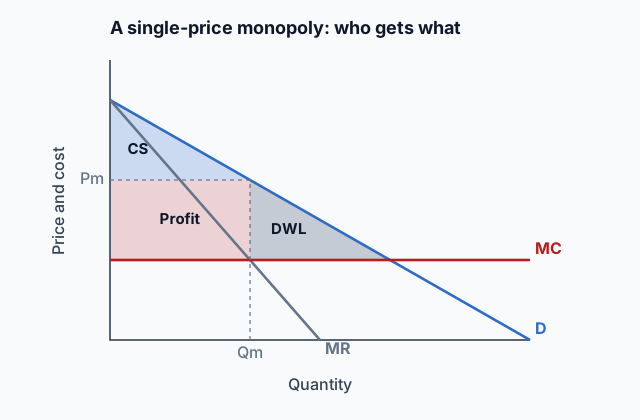 Tap to open the picture full size
Part 1 Think first Two prices for one movie
Make a guess first. Even a wrong guess helps the answer stick.
Predict first
A town's only cinema charges $14 a ticket, and its theater is often half empty. Almost no students come at $14. It starts selling $7 tickets to anyone with a student ID, while everyone else still pays $14. Filling an empty seat costs it almost nothing. What happens to the cinema's profit?
In short. Price discrimination is charging different buyers different prices for the same product, when the difference does not come from a difference in cost.
- A firm can do it only under certain conditions, which the lesson names.
- It changes how much the firm sells and who keeps the surplus.
- The extreme case, a different price for every buyer, has an outcome of its own.
Part 2 Learn it Three ideas, with a check after each
2a. What it takes
Price discrimination is charging different buyers different prices for the same product, when the gap is not explained by a gap in cost. A cinema's student discount, an airline's higher fare for a trip booked the day before, and software sold cheaper to schools are all examples.
A firm can price discriminate only under certain conditions:
- Market power. It must face a downward-sloping demand curve. A price taker charging some buyers more would lose them to rivals selling at the market price.
- Telling buyers apart. It needs a way to sort buyers by how much they are willing to pay, such as age, student ID, or how early they book.
- Stopping resale. Buyers who pay the low price must not be able to resell to those charged the high price, or the high price would never be paid.
When all three hold, the firm can sell to buyers it would lose at a single price without lowering the price everyone else pays.
Quick check · Decide and justify
A wheat farm is one of thousands selling identical wheat at the market price. It wants to charge restaurants $2 more a bushel than it charges bakeries. Can it price discriminate this way?
Which reason supports your choice?
2b. Why it raises profit
A single-price firm faces a hard choice: to sell to buyers who value the good less, it must lower the price for everyone. Price discrimination removes that choice. It can sell to the low-value buyers at a lower price while the high-value buyers keep paying more.
A museum charges adults $20, and 300 come a day. Each visitor costs it $2 in staff and cleaning. Another 200 students would come at $8, but not at $20.
- One price of $20: profit from visitors is (20 − 2) × 300 = $5,400.
- Adults $20, students $8: add (8 − 2) × 200 = $1,200, for $6,600 in all.
The extra $1,200 comes from visits that were not happening before. A firm can also raise the price for buyers who were paying less than they would pay, which captures their consumer surplus as profit. Either way, a firm with market power price discriminates to increase its profit.
Quick check · Calculate
A theater sells 400 tickets at $30, and each ticket costs it $5 to serve. By checking student IDs, it can also sell 150 tickets to students at $12 without changing the price anyone else pays. By how much does its profit rise, in dollars?
2c. Perfect price discrimination
Perfect price discrimination is the extreme case: the monopolist charges every buyer exactly what that buyer is willing to pay.
Then selling one more unit never means cutting the price on others, so the marginal revenue of each unit is its own price. The demand curve becomes the firm's MR curve, and the firm keeps selling until price equals marginal cost, the same quantity a competitive market would reach.
Take demand P = 20 − Q and a constant marginal cost of $4. A single price gives 8 units at $12, profit of $64, consumer surplus of $32 and deadweight loss of $32. With perfect price discrimination:
- Quantity: 16 units, where demand meets MC.
- Consumer surplus: $0, since every buyer pays their full willingness to pay.
- Deadweight loss: $0, since every unit worth more than it costs is made.
- Profit: all of the surplus, ½ × (20 − 4) × 16 = $128.
The outcome is efficient, but all of the economic surplus goes to the firm.
Quick check · Calculate
A monopoly faces the demand curve P = 30 − Q and has a constant marginal cost of $6. If it practices perfect price discrimination, how many units does it sell?
Part 3 Watch it done One price, or every buyer's own price
Follow each step, then finish the last one yourself.
A monopoly faces the demand curve P = 24 − 2Q and has a constant marginal cost of $4, with no fixed cost. Compare its output and profit with a single price and with perfect price discrimination.
Predict first
Before the steps: with perfect price discrimination, will the monopoly sell more units than with a single price, fewer, or the same number?
Step 1 · One price
MR = 24 − 4Q. Setting MR = MC: 24 − 4Q = 4, so Q = 5, and the price on demand is 24 − 2 × 5 = $14. Profit is (14 − 4) × 5 = $50, consumer surplus is ½ × (24 − 14) × 5 = $25, and deadweight loss is ½ × (14 − 4) × (10 − 5) = $25.
Step 2 · Every buyer's own price
Now each unit's marginal revenue is its own price, so the firm sells until price equals MC: 24 − 2Q = 4, so Q = 10. Consumer surplus and deadweight loss are both $0.
Why this step?
Why does the firm now sell units it left unsold before?
With one price, selling the 6th unit meant cutting the price on the first 5, so its MR fell below MC. When each buyer pays their own price, the 6th unit adds its full price to revenue, which is above the $4 it costs.
Your step · Calculate
A monopoly faces the demand curve P = 24 − 2Q and has a constant marginal cost of $4 and no fixed cost. If it practices perfect price discrimination, what is its profit, in dollars?
dollars
Perfect price discrimination doubles the output, from 5 units to 10, and the profit, from $50 to $100. The extra $50 is the $25 of consumer surplus the firm takes and the $25 of deadweight loss that is no longer lost.
Part 4 Try it Spot the price discrimination
Try it · Sort it
Each card describes how a seller prices. Tap a card, then tap whether it is price discrimination.
Price discrimination
Not price discrimination
Part 5 Explain it Answer a short free-response question
Nothing you type leaves this page. Draw the graph on paper, then compare it with the model.
Free response is 33.35% of the exam score. This one is shaped like Question 2, Short.
Free-response practice · Question 2 style
Sonder Links is the only golf course in a remote town, and it charges every golfer the same price. (a) Identify one condition, other than having market power, that Sonder must meet to charge different golfers different prices. (b) Suppose Sonder can perfectly price discriminate. Draw a correctly labeled graph showing its demand and a constant marginal cost. Label the quantity it sells Qpd and shade its profit. (c) Compared with a single price, what happens to consumer surplus and to deadweight loss? Explain.
Model answer
(a) Sonder must be able to sort golfers by how much they are willing to pay, or it must be able to stop golfers who pay a low price from reselling to those charged a high price. (b) Price on the vertical axis and quantity on the horizontal axis, a downward-sloping demand curve and a horizontal MC line. Qpd is where demand meets MC, and profit is the whole triangle between demand and MC out to Qpd. (c) Consumer surplus falls to zero, because each golfer pays the most they are willing to pay. Deadweight loss falls to zero, because Sonder now sells every round a golfer values above its marginal cost, the same quantity a competitive market would reach.
Perfect price discrimination at Sonder Links
Qpd is where demand meets MC. Every golfer pays the most they are willing to pay, so the whole area between demand and MC out to Qpd is profit, and nothing is left as consumer surplus or deadweight loss.
Score your own answer. This is a self-check, not a grade. Tick each point your answer makes.
Part 6 Check yourself Three kinds of rail traveler
The case questions can all be answered from this table.
Dalton Rail runs the only train between two cities. Its riders fall into three groups, and everyone in a group will pay the same most for a ticket. Each ticket costs Dalton $10 to provide, and it has no fixed cost.
| Group | Riders | Most each will pay |
|---|---|---|
| Business travelers | 100 | $80 |
| Tourists | 200 | $30 |
| Students | 100 | $15 |
Case question 1 · Calculate
If Dalton must charge every rider the same price, what is the most profit it can earn, in dollars?
Case question 2 · Calculate
Suppose Dalton can charge each group the most its riders will pay and can stop riders from reselling tickets. What is its profit, in dollars?
Case question 3 · Multiple choice
Compare charging each group the most it will pay with the best single price. What happens to deadweight loss, and to the consumer surplus of the tourists and students?
The rest stand on their own and do not use the case.
Check yourself · Spot the error
A student explained what perfect price discrimination does. Tap the first line with a mistake.
Check yourself · Match
Tap each outcome, then tap where it is found or who gets it.
Part 7 Keep it Keep it
From 4.2 Monopoly · Sort it
Each card describes a firm that is now the only seller in its market and earns an economic profit. Tap a card, then tap what is likely to happen over the next few years.
It stays the only seller
Rivals start selling
From 3.7 Perfect Competition · Calculate
In the perfectly competitive market for pecans, buyers want 9,000 pounds a week at $4 a pound, 8,000 at $5 and 7,000 at $6, and sellers offer 6,000 at $4, 8,000 at $5 and 10,000 at $6. One small farm grows pecans in 100-pound batches, and its marginal cost per pound is $3.00 for the 1st batch, $3.50 for the 2nd, $4.25 for the 3rd, $4.80 for the 4th, $5.40 for the 5th and $6.20 for the 6th. How many batches does the farm produce each week to maximize profit?
In three lines
- A firm with market power can price discriminate when it can sort buyers by willingness to pay and stop resale, and it does so to increase its profit.
- Charging lower-value buyers less lets it sell to them without cutting the price for everyone else.
- With perfect price discrimination it produces where price equals marginal cost, takes all of the surplus, and leaves no deadweight loss.
Exam strategy for this topic
- Section I, Multiple Choice: 60 questions in 70 minutes.
- Section II, Free Response: 3 questions in 60 minutes.
- This lesson's Explain it is shaped like free-response question 2, Short.
- A four-function calculator is allowed on both sections of the exam.
When a question describes perfect price discrimination, state three results in words: the quantity is where demand meets MC (or where P = MC), consumer surplus is zero, and deadweight loss is zero, because the firm captures all of the surplus as profit.
Questions students ask
Is price discrimination illegal?
In economics it is a description, not a crime. Student discounts, senior tickets and early-booking fares are everyday examples. The lesson asks how it changes output and surplus, not whether it is allowed.
Why can't a perfectly competitive firm price discriminate?
It takes the market price. A buyer charged more would buy from one of the many rivals selling the same product at the market price, so the firm has no power to charge two prices.
Why is perfect price discrimination efficient if the firm keeps all the surplus?
Efficiency is about the quantity, not who gains. The firm sells every unit buyers value above its marginal cost, the same quantity as a competitive market, so total surplus is as large as it can be. It all goes to the firm.
Does price discrimination always help the buyers who pay less?
Buyers who would not have bought at a single price get to buy, but they may gain little or nothing. Under perfect price discrimination every buyer pays their full willingness to pay, so no buyer keeps any surplus.
What is the marginal revenue curve under perfect price discrimination?
It is the demand curve itself. Each extra unit is sold at its own price, and no other unit's price falls, so each unit adds its full price to revenue.
Course alignment, for teachers
AP Microeconomics topic 4.3, Unit 4: Imperfect Competition.
- Skill 4.C: Demonstrate the effect of a change in an economic situation on an accurately labeled graph or visual.
This lesson maps all 2 essential knowledge statements of the topic to the part that teaches each one: 2 are checked by a scored question. The map is in the lesson file.