Unit 4 · Topic 4.4 · about 30 minutes · 7 parts · 9 scored checks, 1 of them multiple choice, plus 2 from earlier lessons
AP Microeconomics 4.4: Monopolistic Competition
Unit 4: 15 to 22% of the multiple-choice section
What you'll be able to do
- Explain and calculate, using a graph or a table, a monopolistically competitive firm's output, price and profit in the short run and the long run, and how its long-run outcome compares with perfect competition.
Key vocabulary
| Term | What it means | The exam trap |
|---|---|---|
| Monopolistic competition | A market with many firms selling differentiated products, with free entry and exit. | The name sounds like monopoly, but there are many firms and no barriers to entry. |
| Differentiated product | A product that buyers see as a little different from its rivals', by quality, style, location or brand. | The difference only has to be real to buyers. Two nearly identical products with different brands count. |
| Advertising | Paid messages that tell buyers about a product. | Students think only large firms advertise. Small firms with many rivals often do too. |
| Excess capacity | The gap between the output that would minimize a firm's average total cost and the output it actually produces. | Students measure it from the wrong starting quantity. Check which two quantities the definition compares. |
| Allocative inefficiency | An outcome where the quantity produced is not the one that makes total surplus as large as it can be. | Zero profit does not rule it out. Check price against marginal cost. |
| Free entry and exit | The absence of barriers, so firms can start selling in a market or leave it as they choose. | Students think it works only in perfect competition. Any market without barriers has it. |
 Tap to open the picture full size
Part 1 Think first A ramen shop that started a trend
Make a guess first. Even a wrong guess helps the answer stick.
Predict first
The first ramen shop in a neighborhood earns far more than its owners could earn anywhere else. Over the next two years, ten more ramen shops open nearby, each with its own broth and style, and anyone can open one. What most likely happens to the first shop's economic profit?
In short. Monopolistic competition is a market with many firms, each selling a product that differs a little from the others', and with free entry and exit.
- Each firm has a little control over its own price, because its product is not quite like any other.
- The short run and the long run look different, and the lesson follows a firm from one to the other.
- The lesson compares the long-run result with perfect competition on cost and on efficiency.
Part 2 Learn it Three ideas, with a check after each
2a. Many firms, different products
In monopolistic competition, many firms sell differentiated products: each one differs a little from the rest, by recipe, location, style or service. Cafés, hair salons, clothing brands and gyms are typical.
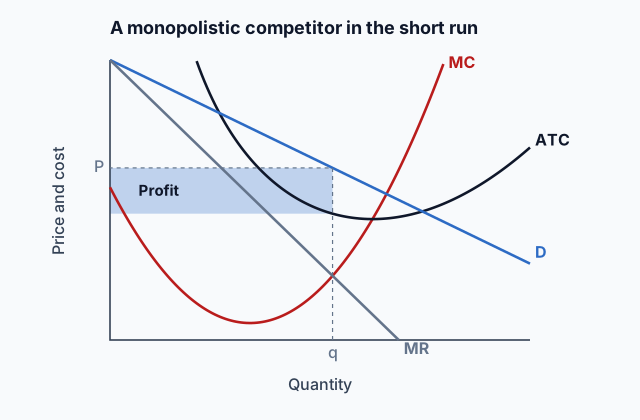
Because no rival sells exactly the same thing, each firm faces a downward-sloping demand curve for its own product. Raise the price and some buyers switch to rivals, but not all. So each firm picks its output where MR = MC and charges the price on its demand curve, as a monopoly does.
Firms here typically advertise to differentiate their product: to make buyers see it as different and better, so more of them choose it and fewer switch when its price goes up.
In the short run, a firm may earn a positive, negative or zero economic profit, depending on where its price sits against its ATC at the quantity it chooses.
Quick check · Decide and justify
Kinfolk Coffee is one of 60 cafés in a city, and anyone may open a new one. It runs ads about its single-origin beans and its late hours. What is it mainly trying to do with these ads?
Which reason supports your choice?
2b. Entry and exit in the long run
Monopolistic competition has free entry and exit, as perfect competition does.
- Profit draws firms in. Each new firm sells its own version of the product and wins some of the existing firms' buyers. Each firm's demand curve, and its MR curve with it, shifts left.
- Losses push firms out. Their buyers go to the firms that stay, so each remaining firm's demand and MR shift right.
Entry or exit goes on until economic profit is zero. On the graph, that is where the firm's demand curve just touches its ATC curve: at the quantity where MR = MC, the price equals ATC.
So in the long run, free entry and exit drive economic profit to zero, just as in perfect competition. The difference is where that happens on the ATC curve, which is the next idea.
Quick check · Put it in order
Hair salons in a city are in monopolistic competition, and each now earns an economic profit. Put what happens next in order. Tap the events from first to last.
2c. Excess capacity and price above marginal cost
In perfect competition, the long run ends at the lowest point of ATC, where P = MC = minimum ATC. Monopolistic competition ends somewhere else.
Because each firm's demand slopes down, it can only touch ATC on ATC's downward-sloping part, to the left of its lowest point. Two results follow.
- Excess capacity. The firm's output is smaller than the output that would minimize ATC. Each firm could produce more at a lower cost per unit, but buyers are spread across many firms.
- Allocative inefficiency. The firm still produces where MR = MC, and its price is on demand above that, so price is greater than marginal cost. Some buyers value more units at above their cost, and those units are not made.
A city with many half-empty gyms, each charging more than the cost of one more member, shows both. In exchange, buyers get variety: many slightly different products to choose from.
Quick check · Fill the statement
A firm in monopolistic competition is in long-run equilibrium. Tap a blank, then tap a word or phrase.
It produces quantity that minimizes its average total cost, and its price is its marginal cost.
Part 3 Watch it done A bakery from the short run to the long run
Follow each step, then finish the last one yourself.
Mira's Bakery is one of many bakeries in a city, each with its own cupcakes, and anyone may open one. At its profit-maximizing output, Mira sells 200 cupcakes a day at $5, where its ATC is $3.50. In the long run, after other bakeries respond, Mira sells 150 cupcakes a day at $4.20. Mira's ATC would be lowest, $3.20, at 240 cupcakes a day. What happens to Mira's profit and output?
Predict first
Before the steps: in the long run, will Mira produce at the lowest point of its ATC?
Step 1 · The short run
Profit is (P − ATC) × q = (5 − 3.50) × 200 = $300 a day, an economic profit. With free entry, that draws new bakeries in.
Step 2 · The long run
Each new bakery takes some of Mira's buyers, so Mira's demand and MR shift left. Entry stops when profit is zero: at 150 cupcakes, the price of $4.20 equals Mira's ATC, so economic profit is $0.
Why this step?
Why does Mira still charge more than its marginal cost in the long run?
Its cupcakes are still its own, so it still faces a downward-sloping demand curve with MR below price. It produces where MR = MC, and the price on demand there is above MC.
Your step · Calculate
In long-run equilibrium, a bakery in monopolistic competition sells 150 cupcakes a day at $4.20, which equals its ATC. Its ATC would be lowest, $3.20, at 240 cupcakes a day. How large is its excess capacity, in cupcakes a day?
cupcakes a day
Mira ends the long run with zero economic profit, producing 90 cupcakes a day fewer than the quantity that would minimize its ATC, at a price above its marginal cost.
Part 4 Try it Draw the long run
Before each lab check, say whether firms enter or leave, which way the firm's demand shifts, and where on ATC its demand will end up.
Part 5 Explain it Answer a short free-response question
Nothing you type leaves this page. Draw the graph on paper, then compare it with the model.
Free response is 33.35% of the exam score. This one is shaped like Question 2, Short.
Free-response practice · Question 2 style
Corvo Pizza is one of many pizzerias in a city, each with its own recipes, and anyone may open a pizzeria. (a) Corvo earns an economic profit in the short run. Explain what happens to Corvo's demand curve in the long run, and why. (b) Draw a correctly labeled graph showing Corvo in long-run equilibrium, with its demand, marginal revenue, marginal cost and average total cost curves. Label its quantity Q and price P. (c) On your graph, label the quantity Qmin at which Corvo's ATC would be lowest. (d) In long-run equilibrium, is Corvo's output allocatively efficient? Explain.
Model answer
(a) The profit draws new pizzerias in. Each takes some of Corvo's customers, so Corvo's demand (and its MR) shifts left until its economic profit is zero. (b) Price and cost on the vertical axis and quantity on the horizontal axis. Demand slopes down and just touches ATC to the left of ATC's lowest point. MR lies below demand and meets MC at Q, and P is on demand above Q, where it equals ATC. (c) Qmin, at the lowest point of ATC, is to the right of Q. (d) No. At Q, price is greater than marginal cost, so some customers value more pizzas at more than they cost to make, and those pizzas are not made.
Corvo Pizza in long-run equilibrium
Demand just touches ATC at Q, where MR meets MC, so P equals ATC and economic profit is zero. Q is left of Qmin, the quantity at the lowest point of ATC, and P is above MC at Q.
Score your own answer. This is a self-check, not a grade. Tick each point your answer makes.
Part 6 Check yourself One café among many
The case questions can all be answered from this information.
Luma Café is one of many cafés in a city, each with its own drinks, and anyone may open a café. Entry and exit do not change any café's costs.
| Measure | Value |
|---|---|
| Cups sold a day | 300 |
| Price per cup | $5.00 |
| Average total cost at 300 cups | $4.20 |
| Marginal cost at 300 cups | $3.10 |
| Lowest possible ATC | $3.80, at 450 cups |
Case question 1 · Calculate
What is Luma's economic profit today, in dollars a day?
Case question 2 · Multiple choice
What will most likely happen in this market in the long run?
Case question 3 · Select all
Which two will be true of Luma once the market reaches long-run equilibrium? Select two.
Select 2 answers, then check.
The rest stand on their own and do not use the case.
Check yourself · Sort it
Each card describes a market in long-run equilibrium. Tap a card, then tap which market structure it is true of.
Perfect competition only
Monopolistic competition only
Both
Check yourself · Spot the error
A student explained the long run for restaurants in monopolistic competition. Tap the first line with a mistake.
Part 7 Keep it Keep it
From 4.3 Price Discrimination · Decide and justify
A wheat farm is one of thousands selling identical wheat at the market price. It wants to charge restaurants $2 more a bushel than it charges bakeries. Can it price discriminate this way?
Which reason supports your choice?
From 4.1 Introduction to Imperfectly Competitive Markets · Decide and justify
At the output a firm chooses, it charges $9 a unit, and its marginal cost is $4 a unit. Compared with the allocatively efficient output, how much does this market produce?
Which reason supports your choice?
In three lines
- Many firms sell differentiated products, often advertised to set them apart, and each faces downward-sloping demand, so it can earn a profit, a loss or zero in the short run.
- Free entry and exit shift each firm's demand until it just touches ATC, so long-run economic profit is zero.
- That point is left of the lowest point of ATC, so there is excess capacity, and price is above marginal cost, so output is allocatively inefficient.
Exam strategy for this topic
- Section I, Multiple Choice: 60 questions in 70 minutes.
- Section II, Free Response: 3 questions in 60 minutes.
- This lesson's Explain it is shaped like free-response question 2, Short.
- A four-function calculator is allowed on both sections of the exam.
When you draw a monopolistically competitive firm in the long run, draw demand just touching ATC to the left of ATC's lowest point, with MR meeting MC at that same quantity. Then say both results in words: zero economic profit with excess capacity, and price above marginal cost.
Questions students ask
How is monopolistic competition different from perfect competition?
Both have many firms and free entry and exit, so both end with zero economic profit. But here each product differs, so each firm faces downward-sloping demand, charges more than marginal cost, and ends with excess capacity.
How is monopolistic competition different from monopoly?
A monopoly is protected by barriers to entry and can keep a profit in the long run. A monopolistically competitive firm has a downward-sloping demand curve too, but entry is free, so its long-run profit is zero.
Why does the firm's demand curve touch ATC to the left of ATC's lowest point?
Demand slopes down, and a downward-sloping line can only just touch a U-shaped curve where that curve is also sloping down. That part of ATC is to the left of its lowest point.
Is excess capacity a bad thing for buyers?
It means each firm's cost per unit is higher than it could be. In exchange, buyers get variety, many slightly different products. Economists see the higher cost as the price of that variety.
Can a firm in monopolistic competition take a loss?
In the short run, yes, if its price is below ATC at the quantity where MR = MC. In the long run some firms leave, the remaining firms' demand shifts right, and economic profit returns to zero.
Course alignment, for teachers
AP Microeconomics topic 4.4, Unit 4: Imperfect Competition.
- Skill 4.B: Demonstrate your understanding of a specific economic situation on an accurately labeled graph or visual.
This lesson maps the one essential knowledge statement of the topic to the part that teaches each one: 1 is checked by a scored question. The map is in the lesson file.