Unit 4 · Topic 4.5 · about 30 minutes · 7 parts · 11 scored checks, 1 of them multiple choice, plus 2 from earlier lessons
AP Microeconomics 4.5: Oligopoly and Game Theory
Unit 4: 15 to 22% of the multiple-choice section
What you'll be able to do
- Define, explain and calculate, using payoff matrices, oligopoly behavior, dominant strategies and Nash equilibrium in simple two-player games, and the incentive needed to change a player's dominant strategy.
Key vocabulary
| Term | What it means | The exam trap |
|---|---|---|
| Oligopoly | A market with a few firms, high barriers to entry, and firms whose choices affect each other's profits. | Students count only two firms as an oligopoly. Two is a duopoly, one kind of oligopoly, and a few more firms count too. |
| Collusion | An agreement among firms to limit output or raise prices instead of competing. | Students think collusion needs a written contract. A spoken agreement to limit output or raise prices counts. |
| Cartel | A group of firms that formally agrees to act together, often by setting output or prices. | A cartel is a formal agreement. A few firms that happen to charge similar prices are not a cartel. |
| Game | A situation in which players take actions and each player's payoff depends on its own choice and on the choices of the others. | Students think it must be a contest for fun. Any interdependent choice, such as two firms setting prices, is a game. |
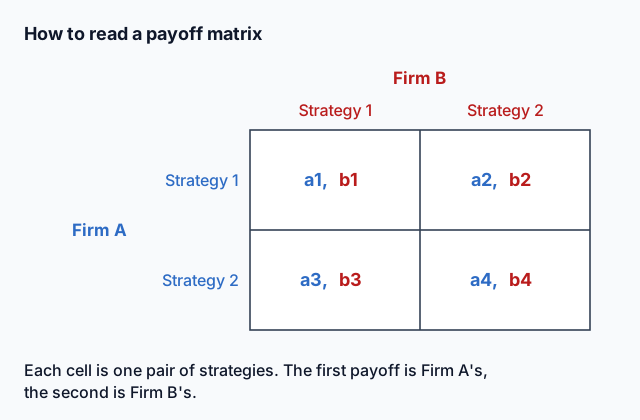
| Payoff matrix | A table showing the payoff each player gets for every combination of strategies, one player on the rows and the other on the columns. | Each cell has two numbers. Check which player's payoff comes first before you read one. |
| Dominant strategy | An action that gives a player a higher payoff whatever the other player does. | Students test it against only one of the other player's actions. Test it against each one. |
| Nash equilibrium | A set of actions in which no player can raise its payoff by changing only its own action, given the others' actions. | Students check only one player. Neither player may have a better move on its own. |
| Prisoner's dilemma | A game in which each player's dominant strategy leads to an outcome worse for both than if they had cooperated. | Students think the players lack information. They know every payoff; the problem is each player's own incentive. |
 Tap to open the picture full size
Part 1 Think first Two gas stations at a crossroads
Make a guess first. Even a wrong guess helps the answer stick.
Predict first
Two gas stations face each other at a remote crossroads, and no other station is nearby. If both charge a high price, each earns a good profit. If one cuts its price, it takes most of the other's drivers. The owners cannot sign a binding deal. What most likely happens to their prices?
In short. An oligopoly is a market with a few firms whose choices affect each other's profits, and game theory is a way to predict what such firms choose.
- A payoff matrix shows what each player earns for every pair of choices.
- The lesson defines a dominant strategy and a Nash equilibrium, and shows how to find each in a matrix.
- It compares the oligopoly outcome with monopoly and with perfect competition.
Part 2 Learn it Four ideas, with a check after each
2a. A few firms, watching each other
An oligopoly is a market with a few firms and high barriers to entry, such as airlines, wireless carriers or soft drinks. Because there are so few firms, they act interdependently: what one firm earns depends on what the others do. A fare cut by one airline changes how many seats every other airline sells.
Like a monopoly, an oligopoly is inefficient: firms charge prices above marginal cost.
The firms have an incentive to collude: to agree to limit their output and raise their prices, so that together they earn the profit a single monopoly would. A group of firms that makes such an agreement formally is a cartel. OPEC, a group of oil-exporting countries that sets output targets, is the best-known example.
Quick check · Select all
Which two statements describe an oligopoly? Select two.
Select 2 answers, then check.
2b. Games, strategies and the payoff matrix
A game is any situation in which several players take actions and each player's payoff depends on its own choice and on the choices of the others. Firms in an oligopoly are in a game.
A strategy is a complete plan of actions for playing the game. In the games here, each of two players picks one of two actions, such as a high price or a low price.
The normal form of a game is a payoff matrix: one player's actions label the rows, the other's label the columns, and each cell shows the payoffs for that pair of strategies, the row player's first.
Take two bakeries, Alto (rows) and Brio (columns), each choosing a high or a low price. If both choose high, each earns $50. If both choose low, each earns $30. If one chooses low and the other high, the low-price bakery earns $70 and the high-price one earns $10. The cell for Alto high, Brio low reads $10, $70: Alto's payoff first.
| Brio: High price | Brio: Low price | |
|---|---|---|
| Alto: High price | $50, $50 | $10, $70 |
| Alto: Low price | $70, $10 | $30, $30 |
Quick check · Calculate
Two firms, Corin and Dace, each choose a high or a low price. If both choose high, each earns $40. If both choose low, each earns $25. If one chooses low and the other high, the low-price firm earns $60 and the high-price firm earns $15. If Corin chooses low and Dace chooses high, what is Dace's payoff, in dollars?
2c. Dominant strategies and Nash equilibrium
A player has a dominant strategy when one action gives it a higher payoff whatever the other player does. To check, take each of the other player's actions in turn and ask which action is better against it.
In the Alto and Brio game: if Brio chooses high, Alto earns $50 with high and $70 with low; if Brio chooses low, Alto earns $10 with high and $30 with low. Low is better both times, so low is Alto's dominant strategy. The game is the same for Brio, so low is Brio's dominant strategy too.
A Nash equilibrium is a pair of actions in which no player can raise its payoff by changing only its own action, given what the other does. To find one, check each cell: would either player rather switch? Here (low, low) is a Nash equilibrium: from $30, either bakery switching to high alone would drop to $10.
A player does not need a dominant strategy for a game to have a Nash equilibrium, and a game can have more than one.
Quick check · Decide and justify
Firms Ess and Tor each choose to advertise or not. Ess's payoffs: if Tor advertises, $8 from advertising and $6 from not; if Tor does not, $12 from advertising and $10 from not. Does Ess have a dominant strategy?
Which reason supports your choice?
2d. The prisoner's dilemma and the oligopoly outcome
In the Alto and Brio game, both bakeries would earn more at (high, high), $50 each, than at the Nash equilibrium (low, low), $30 each. Yet each has a dominant strategy to choose low. A game like this, where each player's own best choice leaves both worse off than cooperating, is a prisoner's dilemma.
It is why oligopolists have difficulty reaching the monopoly outcome. Even after firms agree to keep prices high, each gains by cheating, and an agreement no one can enforce tends to break down. Still, oligopoly prices are generally higher, and quantities lower, than in perfect competition.
An outside incentive can change a dominant strategy. Suppose a fine of F is charged on any low price. For Alto, high beats low against Brio's high when 50 > 70 − F, and against Brio's low when 10 > 30 − F. Both hold when F > $20, so any fine above $20 makes high Alto's dominant strategy.
Quick check · Calculate
Two firms, Ula and Vey, each choose a high or a low price. Ula's payoffs: if Vey chooses high, $90 from high and $120 from low; if Vey chooses low, $40 from high and $55 from low. A trade group will fine Ula a fixed amount whenever Ula chooses low. Any fine larger than how many dollars would make the high price Ula's dominant strategy?
Part 3 Watch it done One firm with a dominant strategy, one without
Follow each step, then finish the last one yourself.
Cora and Dex are the only two sports drink makers in a country. Each chooses to advertise or not, and payoffs are in millions of dollars, Cora's first. Both advertise: $8, $6. Cora advertises, Dex does not: $12, $4. Cora does not, Dex advertises: $6, $9. Neither advertises: $10, $10. Find each firm's dominant strategy, if it has one, and the Nash equilibrium.
Predict first
Before the steps: will the Nash equilibrium be the cell where neither firm advertises, the one with the largest total payoff?
Step 1 · Cora's choice
If Dex advertises, Cora earns $8 by advertising and $6 by not. If Dex does not, Cora earns $12 by advertising and $10 by not. Advertising is better both times, so advertising is Cora's dominant strategy.
Step 2 · Dex's choice
If Cora advertises, Dex earns $6 by advertising and $4 by not, so it advertises. If Cora does not, Dex earns $9 by advertising and $10 by not, so it does not. Dex's best choice depends on Cora's, so Dex has no dominant strategy.
Why this step?
Why can we still predict what Dex does?
Dex can expect Cora to play her dominant strategy and advertise. Against that, Dex's best response is to advertise too.
Your step · Calculate
Cora and Dex each choose to advertise or not, with payoffs in millions of dollars, Cora's first. Both advertise: $8, $6. Cora advertises, Dex does not: $12, $4. Cora does not, Dex advertises: $6, $9. Neither advertises: $10, $10. What is Dex's payoff in the Nash equilibrium, in millions of dollars?
millions of dollars
The Nash equilibrium is (advertise, advertise), at $8 million and $6 million. Both firms would earn more if neither advertised, but Cora would always switch to advertising from there, so that cell cannot last.
Part 4 Try it Test every cell
Try it · Sort it
Ace and Bolt are the only two coffee chains in a city, and each chooses to open a new store downtown or not. Payoffs in millions of dollars, Ace's first: both open, $2 and $1; only Ace opens, $5 and $3; only Bolt opens, $3 and $4; neither opens, $4 and $2. Tap each pair of choices, then tap whether it is a Nash equilibrium.
Nash equilibrium
Not a Nash equilibrium
Draw this game's payoff matrix on paper, with Ace on the rows, and mark each cell you sorted as a Nash equilibrium. Then check: does either chain have a dominant strategy?
Part 5 Explain it Answer a short free-response question
Nothing you type leaves this page. Draw the payoff matrix on paper, then compare it with the model.
Free response is 33.35% of the exam score. This one is shaped like Question 3, Short.
Free-response practice · Question 3 style
Riva and Sol are the only two cement makers in a region. Each chooses a high price or a low price. If both choose high, each earns $60 million. If both choose low, each earns $40 million. If one chooses low and the other high, the low-price firm earns $80 million and the high-price firm earns $20 million. (a) Draw a correctly labeled payoff matrix with Riva's strategies on the rows and Sol's on the columns. (b) Identify Riva's dominant strategy, if it has one. Explain. (c) Identify the Nash equilibrium. (d) The two firms agree to charge high prices. Explain why the agreement is hard to keep. (e) Calculate the smallest amount of a subsidy, paid to Riva whenever it charges the high price, above which the high price becomes Riva's dominant strategy.
Model answer
(a) Rows are Riva's high and low prices, columns are Sol's, and each cell gives Riva's payoff first: (high, high) $60, $60; (high, low) $20, $80; (low, high) $80, $20; (low, low) $40, $40. (b) Low price. If Sol chooses high, Riva earns $80 with low against $60 with high; if Sol chooses low, $40 with low against $20 with high. Low is better either way. (c) Both choose low: (low, low), $40 million each. (d) Each firm earns more by cutting its price whatever the other does, so each is tempted to cheat on the agreement, and without a way to enforce it, the agreement breaks down. (e) High beats low when 60 + S > 80 and when 20 + S > 40, so S must be more than $20 million.
Riva and Sol's payoff matrix
Payoffs in millions of dollars, Riva's first. The shaded cell, both low, is the Nash equilibrium: low is each firm's dominant strategy.
Score your own answer. This is a self-check, not a grade. Tick each point your answer makes.
Part 6 Check yourself Two airlines on one route
The case questions can all be answered from this payoff matrix.
Kestrel Air and Larkspur Air are the only airlines flying between two islands. Each chooses to hold its fares or cut them. The matrix shows weekly profits in thousands of dollars, Kestrel's first.
| Larkspur: Hold fares | Larkspur: Cut fares | |
|---|---|---|
| Kestrel: Hold fares | $90, $70 | $30, $100 |
| Kestrel: Cut fares | $110, $40 | $50, $60 |
Case question 1 · Multiple choice
What is the Nash equilibrium of this game?
Case question 2 · Calculate
Larkspur's island government offers it a fixed weekly subsidy whenever it holds its fares. Any subsidy larger than how many thousand dollars would make holding fares Larkspur's dominant strategy?
Case question 3 · Fill the statement
Use the matrix with no subsidy. Tap a blank, then tap a word or amount.
Together the airlines would earn the most if both , but each has a dominant strategy to , so they end up earning thousand in all.
The rest stand on their own and do not use the case.
Check yourself · Rank it
The same good could be sold in three kinds of market, with the same demand and costs. Rank them by the price buyers pay.
Highest price first
Give each one a place, 1 for first. Give two the same place if they are equal.
Your ranking: none yet
Check yourself · Spot the error
Two firms each choose to advertise or not. If both advertise, each earns $3 million. If neither does, each earns $5 million. If only one advertises, it earns $6 million and the other earns $2 million. A student analyzed the game. Tap the first line with a mistake.
Part 7 Keep it Keep it
From 4.4 Monopolistic Competition · Put it in order
Hair salons in a city are in monopolistic competition, and each now earns an economic profit. Put what happens next in order. Tap the events from first to last.
From 4.2 Monopoly · Calculate
A monopoly can sell 1 unit at $20, 2 units at $18 each, 3 at $16 each, 4 at $14 each or 5 at $12 each. Its marginal cost is $6 for every unit. What price maximizes its profit, in dollars?
In three lines
- An oligopoly has a few interdependent firms behind high barriers to entry, and they have an incentive to collude and form cartels.
- A payoff matrix shows each pair of strategies; a dominant strategy is best whatever the other player does, and a Nash equilibrium is a cell no player can improve on by switching alone.
- Like players in a prisoner's dilemma, oligopolists find it hard to reach the monopoly outcome, but their prices are still generally higher and quantities lower than in perfect competition.
Exam strategy for this topic
- Section I, Multiple Choice: 60 questions in 70 minutes.
- Section II, Free Response: 3 questions in 60 minutes.
- This lesson's Explain it is shaped like free-response question 3, Short.
- A four-function calculator is allowed on both sections of the exam.
In a payoff matrix question, write each player's comparison out in full: against each of the other player's actions, which action pays more? That gives the dominant strategy, if any. Then test the cell you predict: could either player do better by switching alone? For an incentive question, add the fine or subsidy to the right cells and make the inequality hold against both of the other player's actions.
Questions students ask
Is a Nash equilibrium always the best outcome for the players?
No. It is only a cell where neither player can do better by switching alone. In a prisoner's dilemma, both players would be better off in another cell that neither can reach on its own.
Can a game have a Nash equilibrium if no player has a dominant strategy?
Yes. Test each cell: if neither player can raise its payoff by changing only its own action, the cell is a Nash equilibrium. A game can even have two, like the coffee chains in Try it.
Why don't firms in an oligopoly just keep to their agreement?
Each firm earns more by cheating whatever the others do, and an agreement to fix prices usually cannot be enforced. So each is tempted to cut its price or raise its output, and the agreement tends to break down.
How do I find the fine or subsidy that changes a dominant strategy?
Add the subsidy to the payoffs of the action you want to make dominant, or subtract the fine from the other action. The new payoffs must beat the old ones against each of the other player's actions, so the incentive has to exceed the larger of the two gaps.
Do I need games with three players or three choices?
No. The course uses games with two players, each choosing one of two actions, shown in a payoff matrix. Larger games and games played in turns are beyond the course.
Beyond the AP Exam
College Board sets this limit on what the AP Exam asks about this topic. Anything past it is not on the exam.
Dominant strategies and Nash equilibrium with more than two players or more than two actions per player, mixed-strategy equilibria, extensive form games, and normal form games with more than two players or more than two actions per player are beyond the scope of the course and the AP Exam.
Course alignment, for teachers
AP Microeconomics topic 4.5, Unit 4: Imperfect Competition.
- Skill 2.C: Interpret a specific economic outcome using quantitative data or calculations.
This lesson maps all 7 essential knowledge statements of the topic to the part that teaches each one: 7 are checked by a scored question. The map is in the lesson file.