Unit 5 · Topic 5.2 · about 30 minutes · 7 parts · 9 scored checks, 2 of them multiple choice, plus 2 from earlier lessons
AP Microeconomics 5.2: Changes in Factor Demand and Factor Supply
Unit 5: 10 to 13% of the multiple-choice section
What you'll be able to do
- Explain, using a graph, how changes in the determinants of labor demand and labor supply shift those curves, and determine the effect of each shift on the equilibrium wage and quantity of labor.
Key vocabulary
| Term | What it means | The exam trap |
|---|---|---|
| Labor demand | The quantities of labor firms want to hire at each wage, other things constant. | Students draw it sloping up because firms "want more" when pay is higher. Firms want fewer workers as the wage rises. |
| Labor supply | The quantities of labor people are willing to offer at each wage, other things constant. | It is not the number of people looking for work today. It shows how much labor would be offered at every wage. |
| Change in labor demand | A shift of the whole labor demand curve, caused by something other than the wage. | Students move the curve up or down. Draw an increase as a shift right and a decrease as a shift left. |
| Change in labor supply | A shift of the whole labor supply curve, caused by something other than the wage. | An increase in supply is drawn to the right, which also sits lower on the graph. Name it by the move right. |
| Productivity | How much output a worker produces in a given amount of time. | It is measured per worker. Total output can rise because a firm hires more workers even when each worker produces no more than before. |
| Equilibrium wage | The wage at which the quantity of labor demanded equals the quantity of labor supplied. | It is set by both curves together. Reading a wage off one curve alone gives a point that is not an equilibrium. |
 Tap to open the picture full size
Part 1 Think first A pickleball craze
Make a guess first. Even a wrong guess helps the answer stick.
Predict first
Pickleball becomes a craze, and the price of pickleball paddles doubles. Paddle factories are the main employers of the region's paddle workers, whose skills other factories do not use. What most likely happens to the wages of paddle workers?
In short. Labor demand and labor supply shift when the conditions behind them change, and the market moves to a new wage and level of employment.
- The lesson starts with what moves labor demand, then what moves labor supply.
- Each kind of shift moves the wage and employment in its own pattern.
- Every new outcome is read where the moved curve crosses the curve that stayed.
Part 2 Learn it Three ideas, with a check after each
2a. What shifts labor demand
A firm's demand for labor is its marginal revenue product, and for a firm that takes its price, MRP = MP × P. So two things move labor demand:
- The price of the output. When the price of new homes rises, each carpenter's work is worth more to a builder. Builders want more carpenters at every wage: labor demand shifts right. A lower output price shifts it left.
- The productivity of the worker. Better tools or better methods raise each worker's marginal product, so MRP rises at every number of workers, and labor demand shifts right. Anything that makes workers less productive shifts it left.
A change in the wage is different. It does not shift labor demand; it moves firms along it to a different quantity of labor demanded.
Quick check · Decide and justify
Clinics in a city adopt new software that lets each nurse care for more patients an hour. The price of a visit does not change, and the clinics can fill every extra appointment at that price. What happens to the clinics' demand for nurses?
Which reason supports your choice?
2b. What shifts labor supply
Labor supply moves when something changes how many people are willing to work at each wage. College Board names these:
- Immigration. More people arriving to work shifts supply right.
- Education and training. More people trained for a job shifts the supply for that job right.
- Working conditions. A safer or more pleasant job draws more people at each wage (right); a worse one, fewer (left).
- Age distribution. More people of working age shifts supply right; a wave of retirements shifts it left.
- Other options. Better pay in other jobs a worker could do draws people away: supply shifts left.
- Preferences for leisure. If people come to want more free time, supply shifts left.
- Cultural expectations. If more people are expected, and able, to take paid work, supply shifts right.
Training that adds more people to a job shifts that job's supply. Again, a change in the wage itself is a move along labor supply, not a shift.
Quick check · Sort it
Each card is a change in a city's market for bakers. Tap a card, then tap the curve it shifts.
Labor demand
Labor supply
2c. The new wage and employment
After a shift, the market settles where the new curve crosses the one that did not move.
| Shift | Wage | Quantity of labor |
|---|---|---|
| Labor demand right | Rises | Rises |
| Labor demand left | Falls | Falls |
| Labor supply right | Falls | Rises |
| Labor supply left | Rises | Falls |
A demand shift moves the wage and employment the same way. A supply shift moves them in opposite ways.
When many workers retire from welding, supply shifts left. At the old wage, firms want more welders than are willing to work, a shortage, so the wage rises until the two match again, with fewer welders working.
Quick check · Fill the statement
Many people move into a region looking for work on farms. Tap a blank, then tap a word or phrase.
In the region's market for farmworkers, labor supply shifts , the equilibrium wage , and the quantity of farm labor employed .
Part 3 Watch it done New nursing schools open
Follow each step, then finish the last one yourself.
A state opens three new nursing schools, and their graduates join the state's market for nurses. Nothing changes about what hospitals charge or how much each nurse can do. What happens in the market for nurses?
Step 1 · Whose choices changed?
The graduates are workers: more people are now trained and willing to work as nurses. This is a change in labor supply.
Step 2 · Which way does it shift?
More nurses are willing to work at every wage, so labor supply shifts right.
Why this step?
Why does labor demand stay where it is?
Labor demand depends on each nurse's MRP: what a nurse adds to output and the price of that output. Neither changed, so hospitals want the same number of nurses at each wage as before.
Your step · Multiple choice
A state opens new nursing schools, and their graduates join the state's market for nurses, so the supply of nurses increases. Labor demand does not change. What happens to the equilibrium wage of nurses and the number of nurses employed?
The new graduates lower the wage of nurses and raise the number of nurses working: a supply shift moves the two in opposite directions.
Part 4 Try it Draw the shift
Before each lab check, say whose choices the change affects, firms' or workers', and whether the wage will rise or fall.
Part 5 Explain it Answer a short free-response question
Nothing you type leaves this page. Draw the graph on paper, then compare it with the model.
Free response is 33.35% of the exam score. This one is shaped like Question 2, Short.
Free-response practice · Question 2 style
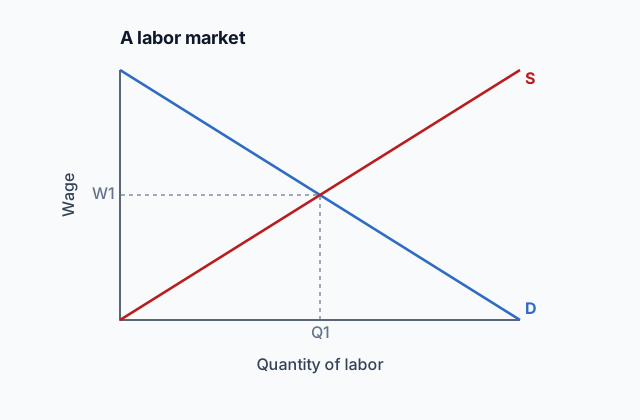
The market for truck drivers in Corvia is perfectly competitive and in equilibrium. (a) Draw a correctly labeled graph of the market for truck drivers, and label the equilibrium wage W1 and quantity of drivers Q1. (b) Online shopping grows, and the price trucking firms receive for hauling each load rises. On your graph, show the effect on the market for truck drivers, and label the new wage W2 and quantity Q2. (c) Separately, suppose instead that new rules require shorter shifts and better rest stops, making long-haul driving safer and more pleasant. Explain what happens to the equilibrium wage of truck drivers, compared with W1.
Model answer
(a) The wage is on the vertical axis and the quantity of labor on the horizontal axis. Labor demand D slopes down and labor supply S slopes up, crossing at W1 and Q1. (b) Each driver's loads are now worth more, so each driver's MRP rises and labor demand shifts right, to D2. W2 is above W1 and Q2 is to the right of Q1. (c) The wage falls below W1. Better working conditions make more people willing to drive at every wage, so labor supply shifts right, and at W1 there would be a surplus of drivers.
The market for truck drivers
A higher price for each load raises every driver's MRP, so labor demand shifts right from D1 to D2. The wage rises from W1 to W2 and employment from Q1 to Q2.
Score your own answer. This is a self-check, not a grade. Tick each point your answer makes.
Part 6 Check yourself Welders and new ships
The case questions can all be answered from this information.
The market for welders in Tarsa is perfectly competitive. The table shows how many welders shipyards want to hire, and how many people want to work as welders, at each hourly wage. Then the price of new ships rises sharply, and at every wage shipyards want 1,000 more welders than before. Nothing changes on the workers' side.
| Wage per hour | Welders demanded | Welders supplied |
|---|---|---|
| $24 | 6,000 | 4,000 |
| $26 | 5,500 | 4,500 |
| $28 | 5,000 | 5,000 |
| $30 | 4,500 | 5,500 |
| $32 | 4,000 | 6,000 |
Case question 1 · Calculate
After the price of ships rises, what is the new equilibrium wage for welders, in dollars per hour?
Case question 2 · Calculate
After the price of ships rises, how many welders are employed at the new equilibrium?
Case question 3 · Multiple choice
Why do shipyards want more welders at every wage after the price of ships rises?
The rest stand on their own and do not use the case.
Check yourself · Spot the error
A student explained what happens when new jobs open in a town. Tap the first line with a mistake.
Check yourself · Select all
Which two changes would shift the supply of welders to the left? Select two.
Select 2 answers, then check.
Part 7 Keep it Keep it
From 5.1 Introduction to Factor Markets · Calculate
A car wash charges $9 a wash, a price it cannot change. With 2 workers it washes 30 cars a day; with 3 workers, 38 cars a day. What is the marginal revenue product of the third worker, in dollars a day?
From 4.4 Monopolistic Competition · Decide and justify
Kinfolk Coffee is one of 60 cafés in a city, and anyone may open a new one. It runs ads about its single-origin beans and its late hours. What is it mainly trying to do with these ads?
Which reason supports your choice?
In three lines
- Labor demand shifts with the output price and workers' productivity, because both change MRP.
- Labor supply shifts with immigration, education, working conditions, age distribution, other options, preferences for leisure and cultural expectations.
- Demand shifts move the wage and employment the same way; supply shifts move them in opposite ways. A change in the wage is a move along a curve.
Exam strategy for this topic
- Section I, Multiple Choice: 60 questions in 70 minutes.
- Section II, Free Response: 3 questions in 60 minutes.
- This lesson's Explain it is shaped like free-response question 2, Short.
- A four-function calculator is allowed on both sections of the exam.
For any change in a labor market, say first whose choices changed. A change in the output price or in productivity moves labor demand; immigration, education, working conditions, age distribution, other options, leisure and cultural expectations move labor supply. Then show the new wage and quantity where the moved curve crosses the one that stayed.
Questions students ask
What is the difference between a change in labor demand and a change in the quantity of labor demanded?
A change in labor demand is a shift of the whole curve, caused by the output price or productivity. A change in the quantity demanded is a move along the curve, caused by a change in the wage.
Why does a higher product price raise the demand for workers?
A worker's MRP is the worker's marginal product times the price of the output. A higher price makes each worker's output worth more, so firms want more workers at every wage.
Does immigration lower wages?
In the model, more people willing to work in a labor market shifts its supply right, which lowers the equilibrium wage and raises employment in that market, other things constant.
What happens to the wage if labor demand and labor supply both shift?
Work out each shift on its own. If they push the wage the same way, it moves that way; if they push it opposite ways, the change in the wage depends on which shift is larger.
Course alignment, for teachers
AP Microeconomics topic 5.2, Unit 5: Factor Markets.
- Skill 3.B: Determine the effect(s) of one or more changes on other economic markets.
This lesson maps all 2 essential knowledge statements of the topic to the part that teaches each one: 2 are checked by a scored question. The map is in the lesson file.