Unit 5 · Topic 5.3 · about 30 minutes · 7 parts · 9 scored checks, 1 of them multiple choice, plus 2 from earlier lessons
AP Microeconomics 5.3: Profit-Maximizing Behavior in Perfectly Competitive Factor Markets
Unit 5: 10 to 13% of the multiple-choice section
What you'll be able to do
- Explain and calculate, using a graph or a table, how a firm that hires labor in a perfectly competitive market chooses how many workers to hire, and how a firm combines labor and capital at the lowest cost.
Key vocabulary
| Term | What it means | The exam trap |
|---|---|---|
| Perfectly competitive labor market | A labor market with many firms hiring the same kind of labor and many workers offering it. | The many firms can be in different industries. A warehouse and a hospital can hire from the same market for security guards. |
| Market wage | The wage set where market labor demand meets market labor supply. | One firm's MRP curve is not market labor demand. Market demand adds up the labor every firm wants at each wage. |
| Marginal factor cost (MFC) | The change in a firm's total labor cost from hiring one more worker. It is also called marginal resource cost (MRC). | It is a cost of hiring, not of producing, so it is not the marginal cost of the firm's product. |
| Value of the marginal product (VMP) | A worker's marginal product times the price of the output. | The value is the output's market value, not the worker's pay. A worker's VMP and wage are separate numbers. |
| Least-cost rule | Spend on inputs so that the marginal product of labor divided by the wage equals the marginal product of capital divided by its price. | Meeting the rule does not mean the firm produces the profit-maximizing amount. It only means that amount is made at the lowest cost. |
 Tap to open the picture full size
Part 1 Think first The biggest hospital in town
Make a guess first. Even a wrong guess helps the answer stick.
Predict first
Mercy General is the largest hospital in a big city, but it hires nurses from the same city market as 40 other hospitals and clinics, which all pay about $45 an hour. Mercy decides to pay its nurses $40 an hour instead. What most likely happens?
In short. This lesson is about one firm that hires in a perfectly competitive labor market, and how it decides how many workers to hire.
- The market wage is set where market labor demand meets market labor supply.
- The lesson shows how the firm decides when to stop hiring, using marginal revenue product.
- It ends with how a firm splits its spending between labor and capital at the lowest cost.
Part 2 Learn it Three ideas, with a check after each
2a. A firm that takes the market wage
In a perfectly competitive labor market, many firms hire the same kind of labor and many workers offer it. The wage is set by the whole market, where market labor demand meets market labor supply.
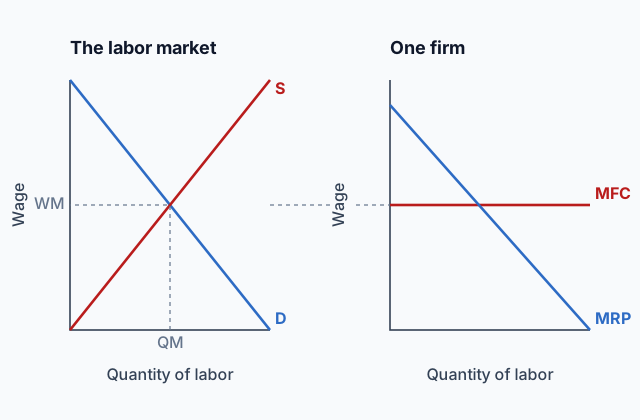
Each firm is too small a part of that market to change the wage. It can hire as many workers as it wants at the market wage, and none at all for less. So the firm faces a horizontal labor supply at the market wage. Every worker it adds costs exactly that wage, so its marginal factor cost (MFC), the change in total labor cost from one more worker, equals the wage.
On a graph, draw the labor market beside the firm, and carry the market wage across as the firm's horizontal MFC line.
A firm can take the wage in its labor market even if it has market power where it sells. A drug company with a patent is a monopoly in its product market, yet it may hire lab technicians from a market with thousands of employers.
Quick check · Decide and justify
Skyway is one of only two airlines that fly its routes. It hires baggage handlers in a city labor market where hundreds of employers hire the same kind of worker. Is Skyway a wage taker in the market for baggage handlers?
Which reason supports your choice?
2b. Hire until MRP equals the wage
A wage taker keeps hiring as long as the next worker's marginal revenue product is greater than the market wage: that worker adds more to revenue than to cost, so profit rises. It stops where MRP = MFC = the wage. On the graph, that is where the MRP curve meets the horizontal MFC line.
MRP is the change in total revenue divided by the change in labor, which also equals marginal product times marginal revenue: MRP = MP × MR.
- A firm that also sells in a perfectly competitive output market gets the market price for every unit, so MR = P, and its MRP equals the value of the marginal product: VMP = MP × P.
- A firm that must cut its price to sell more has MR below P, so its MRP is below MP × P. Use the change in total revenue, not MP × P.
A mill pays $90 a day. Its fifth worker's MRP is $110 and its sixth worker's is $85. It hires the fifth (profit rises by $20) and stops before the sixth (profit would fall by $5).
Quick check · Calculate
A tomato farm sells tomatoes at $5 a crate, a price it cannot change, and hires workers at the market wage of $120 a day. With 1, 2, 3, 4 and 5 workers it picks 40, 74, 102, 124 and 140 crates a day. How many workers does it hire to maximize profit?
2c. Labor and capital at the lowest cost
Firms use more than one input. To make any amount of output at the lowest cost, a firm spends so that the last dollar on each input adds the same marginal product:
$$\frac{MP_{labor}}{\text{wage}} = \frac{MP_{capital}}{\text{price of capital}}$$
If a dollar spent on labor adds more output than a dollar spent on capital, the firm should shift spending toward labor, and the other way around. As it does, labor's marginal product falls and capital's rises, until the last dollar on each adds the same amount.
A bakery pays $20 an hour for a baker, whose last hour adds 60 rolls: 3 rolls a dollar. It rents ovens at $40 an hour, and its last oven hour adds 100 rolls: 2.5 rolls a dollar. Moving a dollar from ovens to bakers adds rolls at no extra cost, so the bakery should use more bakers and fewer ovens.
Quick check · Decide and justify
A print shop pays workers $20 an hour and rents printers for $50 an hour. The last worker hour adds 100 pages, and the last printer hour adds 300 pages. To print the same number of pages at a lower cost, what should the shop do?
Which reason supports your choice?
Part 3 Watch it done How many pickers a farm hires
Follow each step, then finish the last one yourself.
Bramble Farm sells blueberries at $4 a pint, a price set in a perfectly competitive market, and hires pickers in a perfectly competitive labor market at $100 a day. With 1, 2, 3, 4 and 5 pickers it picks 40, 76, 106, 130 and 148 pints a day. How many pickers does it hire?
Predict first
Before the steps: will Bramble hire a fourth picker, who adds $96 a day to revenue?
Step 1 · Marginal product
Subtract each total from the next: the pickers add 40, 36, 30, 24 and 18 pints a day.
Step 2 · Marginal revenue product
Bramble sells at the market price, so MR = P = $4, and MRP equals the value of the marginal product: $160, $144, $120, $96 and $72.
Step 3 · Compare with the wage
Each picker costs $100, the MFC. The first three add more than $100 to revenue. The fourth adds only $96, so Bramble hires 3 pickers.
Why this step?
Why not hire the fourth picker, who still adds $96 to revenue?
The fourth picker costs $100 a day and adds $96, so hiring her would lower profit by $4.
Your step · Calculate
A blueberry farm sells blueberries at $4 a pint, a price it cannot change, and hires pickers at the market wage. With 1, 2, 3, 4 and 5 pickers it picks 40, 76, 106, 130 and 148 pints a day. The market wage falls from $100 to $80 a day. How many pickers does the farm hire to maximize profit?
pickers
When the market wage falls from $100 to $80, Bramble moves down its MRP curve and hires one more picker. A lower wage raises the quantity of labor it demands.
Part 4 Try it Draw the firm's graph
Before each lab check, say whether the change happens in the whole labor market (the wage line moves) or only in what each worker adds to this firm's revenue (MRP moves).
Part 5 Explain it Answer a short free-response question
Nothing you type leaves this page. Draw the graphs on paper, then compare them with the model.
Free response is 33.35% of the exam score. This one is shaped like Question 2, Short.
Free-response practice · Question 2 style
Bicycle assemblers are hired in a perfectly competitive labor market, and Rollo Bikes is one of many firms that hire them. (a) Draw correctly labeled side-by-side graphs of the labor market for bicycle assemblers and of Rollo. Label the market wage WM and the number of assemblers Rollo hires QF. (b) Rollo alone buys new tools that let each of its assemblers build more bicycles a day, and the market wage does not change. On Rollo's graph, show the effect and label the new number of assemblers QF2. (c) Explain why Rollo does not hire more assemblers than QF2.
Model answer
(a) Labor market: the wage on the vertical axis and the quantity of labor on the horizontal axis, with labor demand D sloping down and labor supply S sloping up, crossing at WM. Rollo: the same axes, a horizontal line at WM labeled MFC (Rollo's labor supply), and a downward-sloping MRP curve; QF is where MRP meets MFC. (b) Each assembler adds more bicycles, so Rollo's MRP shifts right, to MRP2, which meets MFC at QF2, to the right of QF. The market wage stays at WM. (c) Past QF2, each added assembler's MRP is below the wage, so that assembler would add more to Rollo's costs than to its revenue and lower its profit.
The labor market for bicycle assemblers
Market labor demand and supply set the wage WM.
Rollo Bikes
Rollo takes the market wage, its horizontal MFC. New tools shift its MRP right from MRP1 to MRP2, so it hires QF2 instead of QF, at the same wage.
Score your own answer. This is a self-check, not a grade. Tick each point your answer makes.
Part 6 Check yourself A patented mower and its assemblers
The case questions can all be answered from this information.
Tiller Robotics is the only seller of a patented robot mower, so to sell more mowers a day it must lower its price. It hires assemblers in a perfectly competitive labor market at the market wage of $150 a day.
| Assemblers | Mowers a day | Price per mower | Total revenue a day |
|---|---|---|---|
| 1 | 10 | $50 | $500 |
| 2 | 18 | $48 | $864 |
| 3 | 24 | $46 | $1,104 |
| 4 | 28 | $44 | $1,232 |
| 5 | 30 | $42 | $1,260 |
Case question 1 · Calculate
What is the marginal revenue product of the third assembler, in dollars a day?
Case question 2 · Calculate
How many assemblers does Tiller hire to maximize profit?
Case question 3 · Multiple choice
Why is each assembler's marginal revenue product, after the first, less than the assembler's marginal product times the price of a mower?
The rest stand on their own and do not use the case.
Check yourself · Put it in order
A firm that takes the market wage has a table of total output for each number of workers. Put the steps it takes to decide how many workers to hire in order. Tap the steps from first to last.
Check yourself · Fill the statement
A café pays baristas $15 an hour, and its last barista hour adds 45 drinks. It rents espresso machines for $30 an hour, and its last machine hour adds 60 drinks. Tap a blank, then tap a number or word.
The last dollar spent on baristas adds drinks, and the last dollar spent on machines adds . To make the same drinks at a lower cost, the café should use more .
Part 7 Keep it Keep it
From 5.2 Changes in Factor Demand and Factor Supply · Decide and justify
Clinics in a city adopt new software that lets each nurse care for more patients an hour. The price of a visit does not change, and the clinics can fill every extra appointment at that price. What happens to the clinics' demand for nurses?
Which reason supports your choice?
From 4.5 Oligopoly and Game Theory · Calculate
Two firms, Corin and Dace, each choose a high or a low price. If both choose high, each earns $40. If both choose low, each earns $25. If one chooses low and the other high, the low-price firm earns $60 and the high-price firm earns $15. If Corin chooses low and Dace chooses high, what is Dace's payoff, in dollars?
In three lines
- In a perfectly competitive labor market the market sets the wage, and each firm takes it as its horizontal MFC, even a firm with market power where it sells.
- A firm hires as long as MRP is greater than the wage and stops where MRP = MFC; MRP = MP × MR, which equals VMP = MP × P only when the firm sells at a market price.
- At the lowest cost, the last dollar on each input adds the same output: MP of labor ÷ wage = MP of capital ÷ its price.
Exam strategy for this topic
- Section I, Multiple Choice: 60 questions in 70 minutes.
- Section II, Free Response: 3 questions in 60 minutes.
- This lesson's Explain it is shaped like free-response question 2, Short.
- A four-function calculator is allowed on both sections of the exam.
When a question asks how many workers a firm hires, find MRP for each worker and hire while MRP is at least the wage. If the firm must cut its price to sell more, take MRP from the change in total revenue, not MP × P. Draw a wage taker as side-by-side graphs: the labor market setting the wage, and the firm with a horizontal MFC at that wage.
Questions students ask
Why is the firm's labor supply curve horizontal?
In a perfectly competitive labor market the firm is a tiny part of the market. It can hire as many workers as it wants at the market wage, and none for less, so it faces a horizontal labor supply at that wage, which is also its MFC.
What is the difference between MRP and VMP?
MRP is marginal product times marginal revenue; VMP is marginal product times price. They are equal for a firm that sells in a perfectly competitive output market, where MR = P. For a firm with market power, MR is below P, so MRP is below VMP.
Can a monopoly be a wage taker?
Yes. Market power where a firm sells is separate from its place in the labor market. A firm can be the only seller of its product and still hire from a labor market with many employers.
What does the least-cost rule say?
To make any amount of output at the lowest cost, spend so that the last dollar on each input adds the same marginal product: MP of labor ÷ wage = MP of capital ÷ price of capital.
Does a firm hire the worker whose MRP exactly equals the wage?
That worker adds as much to revenue as to cost, so profit is the same either way. By the rule MRP = MFC, count that worker as hired.
Course alignment, for teachers
AP Microeconomics topic 5.3, Unit 5: Factor Markets.
- Skill 2.C: Interpret a specific economic outcome using quantitative data or calculations.
This lesson maps all 4 essential knowledge statements of the topic to the part that teaches each one: 4 are checked by a scored question. The map is in the lesson file.