Unit 5 · Topic 5.1 · about 30 minutes · 7 parts · 11 scored checks, 1 of them multiple choice, plus 2 from earlier lessons
AP Microeconomics 5.1: Introduction to Factor Markets
Unit 5: 10 to 13% of the multiple-choice section
What you'll be able to do
- Describe how factor markets work and what a firm's decision to hire depends on, explain why the quantity of labor demanded falls and the quantity supplied rises as the wage rises, and calculate marginal revenue product and marginal resource cost from a table.
Key vocabulary
| Term | What it means | The exam trap |
|---|---|---|
| Factor market | A market for the services of labor, capital or land, the inputs used to make goods and services. | Students picture a building where workers are bought and sold. Every place firms hire workers or rent equipment or land counts, online job boards included. |
| Factors of production | The inputs to production: labor (people's work), capital (machines, tools and buildings) and land (natural resources). | Land is not only farmland. It is every natural resource, from oil in the ground to fish in the sea. |
| Factor price | The payment for the use of a factor of production for a period of time. | It pays for the use of a factor, not to own it, so a wage is not the price of a worker. |
| Derived demand | Demand for a factor that comes from the demand for the goods and services it helps make. | Students think it applies only to labor. Capital and land are demanded for what they help make too. |
| Marginal product of labor | The change in total output from hiring one more worker. | Marginal product can fall while total output still rises. Total output falls only when marginal product drops below zero. |
| Marginal revenue product (MRP) | The change in a firm's total revenue from hiring one more unit of a factor. | A worker added to a crowded kitchen can add nothing, or even lower output, so MRP can be zero or negative. |
| Marginal resource cost (MRC) | The change in a firm's total cost from hiring one more unit of a factor. It is also called marginal factor cost (MFC). | It is counted per worker hired, not per unit of output, so do not compare it with a product's marginal cost. |
 Tap to open the picture full size
Part 1 Think first A taco truck thinks about a second worker
Make a guess first. Even a wrong guess helps the answer stick.
Predict first
Dana runs a taco truck by herself. She is thinking about hiring a helper for $120 a day. Which piece of information would help her most in deciding?
In short. A factor market is a market for the services of labor, capital and land, the inputs firms use to make goods and services.
- Each of the three factors has its own price.
- The lesson shows how to measure what one more worker adds to a firm's revenue and to its costs.
- It ends with why the labor demand and labor supply curves slope the ways they do.
Part 2 Learn it Three ideas, with a check after each
2a. Factor markets and factor prices
In a product market, households buy goods and services from firms. In a factor market the roles turn around: households and the owners of resources sell the services of the factors of production, and firms buy them.
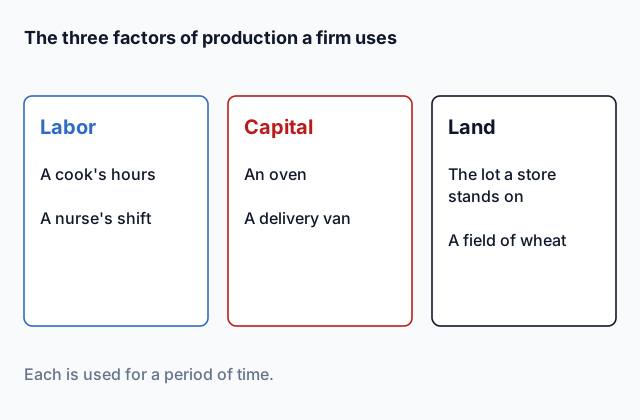
There are three factors, and each has its own price:
- Labor (people's work) earns a wage.
- Capital (machines, tools and buildings) earns interest.
- Land (natural resources) earns rent.
Factors respond to their prices. A higher wage in one job draws workers toward it; a higher rent draws land into that use.
A firm's demand for a factor is a derived demand: it comes from the demand for what the factor helps make. A pizzeria hires cooks because people buy pizza. So whether a firm hires depends on three things: how much the factor produces, the price the firm gets for that output, and what the factor costs.
Quick check · Fill the statement
A farm grows corn. Tap a blank, then tap a word.
The farm pays a landowner for the use of a field and pays its workers . In these factor markets the farm is the .
2b. What one more worker adds
To decide whether to hire one more worker, a firm compares what that worker adds to its revenue with what the worker adds to its costs.
- Marginal product of labor (MP) is the change in total output from one more worker.
- Marginal revenue product (MRP) is the change in total revenue from one more worker. It is MP times the marginal revenue of each unit of output. A firm that sells at a market price it cannot change gets that price for each extra unit, so its MRP = MP × P.
- Marginal resource cost (MRC) is the change in total cost from one more worker. A firm that can hire as many workers as it wants at the market wage adds exactly that wage to its costs with each hire, so its MRC equals the wage.
A juice stand sells cups at $3. Its second worker raises output from 20 to 36 cups an hour, so MP = 16 cups and MRP = 16 × $3 = $48 an hour. If the wage is $15 an hour, that worker adds $48 to revenue and $15 to cost.
Quick check · Calculate
A car wash charges $9 a wash, a price it cannot change. With 2 workers it washes 30 cars a day; with 3 workers, 38 cars a day. What is the marginal revenue product of the third worker, in dollars a day?
2c. Why labor demand slopes down and labor supply slopes up
With its equipment fixed, past some point each added worker adds less output than the one before: diminishing marginal returns. So each added worker's MRP is lower than the last one's.
At a high wage, only the first few workers add enough to revenue to cover it. At a lower wage, more workers do. So, other things constant, the quantity of labor demanded falls as the wage rises and rises as the wage falls. Labor demand slopes down.
On the other side, a higher wage makes work pay more compared with everything else a person could do with the time. More people take jobs, and some work more hours. So the quantity of labor supplied rises as the wage rises. Labor supply slopes up.
The market wage settles where the two curves cross. A change in the wage moves firms and workers along their curves; it does not move the curves.
A labor market
The quantity of labor demanded falls as the wage rises, and the quantity supplied rises. The wage settles at W*, where they cross.
Quick check · Decide and justify
The wage for warehouse workers in a city rises from $18 to $20 an hour, and nothing else changes. What happens to the quantity of warehouse workers that firms want to hire?
Which reason supports your choice?
Part 3 Watch it done MRP and MRC at a smoothie shop
Follow each step, then finish the last one yourself.
Sol's Smoothies sells smoothies for $4 each, a price it cannot change. With 1, 2, 3 and 4 workers on a shift, it makes 30, 55, 75 and 90 smoothies. It can hire as many workers as it wants at $60 a shift. Find each worker's marginal product, marginal revenue product and marginal resource cost.
Step 1 · Marginal product
Subtract each total from the next one: the four workers add 30, 25, 20 and 15 smoothies.
Step 2 · Marginal revenue product
Each smoothie adds $4 to revenue, so MRP = MP × $4. The first three workers' MRPs are $120, $100 and $80 a shift.
Step 3 · Marginal resource cost
Every worker costs the same $60 a shift however many Sol hires, so each hire adds $60 to labor cost. MRC = $60 for every worker.
Why this step?
Why does each added worker add fewer smoothies than the one before?
The blenders and counter space stay the same. Each added worker has less equipment to work with, so marginal product falls: diminishing marginal returns.
Your step · Calculate
A smoothie shop sells smoothies for $4 each, a price it cannot change. With 3 workers on a shift it makes 75 smoothies; with 4 workers, 90. What is the marginal revenue product of the fourth worker, in dollars a shift?
dollars a shift
Sol's fourth worker adds $60 to revenue and $60 to cost. 5.3 Profit-Maximizing Behavior in Perfectly Competitive Factor Markets uses these two numbers to decide how many workers a firm like Sol's hires.
Part 4 Try it Name the factor payment
Try it · Sort it
Each card is a payment. Tap a card, then tap what kind of payment it is.
Wage
Rent
Interest
Not a factor payment
Part 5 Explain it Answer a short free-response question
Nothing you type leaves this page. Write your answer, then compare it with the model.
Free response is 33.35% of the exam score. This one is shaped like Question 3, Short.
Free-response practice · Question 3 style
Kiri's Kayaks sells guided kayak trips to tourists for $30 a trip, a price set in a competitive market. It hires guides in a labor market where it can hire as many as it wants at $150 a day. With 3 guides it runs 40 trips a day; with 4 guides, 46 trips. (a) Identify whether Kiri's buys guides' labor in a product market or a factor market. (b) Calculate the marginal revenue product of the fourth guide. Show your work. (c) Identify the marginal resource cost of the fourth guide. (d) Explain why Kiri's demand for guides depends on the price of a kayak trip.
Model answer
(a) A factor market: Kiri's buys the services of labor, an input it uses to provide trips. (b) The fourth guide adds 46 − 40 = 6 trips a day, and each trip adds $30 to revenue, so MRP = 6 × $30 = $180 a day. (c) $150 a day. Kiri's can hire every guide at the market wage, so one more guide adds $150 to its labor cost. (d) A guide is worth to Kiri's the revenue from the trips the guide makes possible: the guide's marginal product times the price of a trip. A higher trip price makes each guide's extra trips worth more, so at the $150 wage more guides add at least $150 to revenue, and Kiri's wants more guides at every wage. A lower price does the reverse.
Score your own answer. This is a self-check, not a grade. Tick each point your answer makes.
Part 6 Check yourself A lawn service hires
The case questions can all be answered from this information.
Greenway Lawns mows lawns for $40 each, a price it cannot change. It can hire as many workers as it wants at $100 a day, all its workers are equally skilled, and it has the same mowers and trucks however many it hires.
| Workers | Lawns mowed a day |
|---|---|
| 1 | 6 |
| 2 | 11 |
| 3 | 15 |
| 4 | 18 |
Case question 1 · Calculate
What is the marginal revenue product of the fourth worker, in dollars a day?
Case question 2 · Multiple choice
Why is the fourth worker's marginal revenue product lower than the second worker's?
Case question 3 · Calculate
What is the marginal resource cost of the third worker, in dollars a day?
The rest stand on their own and do not use the case.
Check yourself · Spot the error
A student explained why a firm's labor demand curve slopes down. Tap the first line with a mistake.
Check yourself · Select all
Which two statements are true of a labor market, other things constant? Select two.
Select 2 answers, then check.
Check yourself · Decide and justify
Farmland at the edge of a growing city now rents for far more as parking for a new stadium than it earns growing corn. What will most likely happen to how that land is used?
Which reason supports your choice?
Part 7 Keep it Keep it
From 4.5 Oligopoly and Game Theory · Select all
Which two statements describe an oligopoly? Select two.
Select 2 answers, then check.
From 4.3 Price Discrimination · Calculate
A theater sells 400 tickets at $30, and each ticket costs it $5 to serve. By checking student IDs, it can also sell 150 tickets to students at $12 without changing the price anyone else pays. By how much does its profit rise, in dollars?
In three lines
- In factor markets firms buy the services of labor, capital and land, paying wages, interest and rent, and their demand for a factor comes from the demand for what it helps make.
- MRP is the change in total revenue from one more worker (MP × P for a firm that takes its price), and MRC is the change in total cost.
- Diminishing marginal returns make MRP fall, so labor demand slopes down; a higher wage draws more labor, so labor supply slopes up.
Exam strategy for this topic
- Section I, Multiple Choice: 60 questions in 70 minutes.
- Section II, Free Response: 3 questions in 60 minutes.
- This lesson's Explain it is shaped like free-response question 3, Short.
- A four-function calculator is allowed on both sections of the exam.
When a question gives total output for each number of workers, find marginal product first, then multiply by the output price to get MRP. On a labor market graph, put the wage on the vertical axis and the quantity of labor on the horizontal axis, and label the curves D and S.
Questions students ask
What is the difference between a product market and a factor market?
In a product market, firms sell goods and services and households buy them. In a factor market the roles reverse: households and resource owners sell the services of labor, capital and land, and firms buy them.
Why is the demand for labor called a derived demand?
Firms want workers only because buyers want what the workers make. The demand for labor is derived from the demand for the product, so it depends on the product's price as well as on how much each worker produces.
How do you calculate marginal revenue product?
Take the change in total revenue when one more worker is hired. For a firm that sells at a price it cannot change, that is the worker's marginal product times the price: MRP = MP × P.
Why does the labor demand curve slope down?
With other inputs fixed, each added worker adds less output than the one before (diminishing marginal returns), so MRP falls. At a lower wage, more workers add enough to revenue to be worth hiring.
Is marginal resource cost the same as the wage?
It is when a firm can hire as many workers as it wants at the market wage, because each hire then adds exactly that wage to cost. A firm that must raise its wage to hire more has a marginal resource cost above the wage, which 5.4 takes up.
Course alignment, for teachers
AP Microeconomics topic 5.1, Unit 5: Factor Markets.
- Skill 1.A: Describe economic concepts, principles, or models.
This lesson maps all 2 essential knowledge statements of the topic to the part that teaches each one: 2 are checked by a scored question. The map is in the lesson file.