Unit 5 · Topic 5.4 · about 30 minutes · 7 parts · 9 scored checks, 1 of them multiple choice, plus 2 from earlier lessons
AP Microeconomics 5.4: Monopsonistic Markets
Unit 5: 10 to 13% of the multiple-choice section
What you'll be able to do
- Explain and calculate, using a graph or a table, how a monopsony chooses how many workers to hire and what wage to pay, and why its marginal factor cost is greater than the wage.
Key vocabulary
| Term | What it means | The exam trap |
|---|---|---|
| Monopsony | A market with a single buyer, such as the only employer of a kind of labor in a town. | A monopoly is a single seller; a monopsony is a single buyer. A firm can be a monopsony where it hires and still sell in a competitive market. |
| Supply price of labor | The wage needed to get a given number of people to work, read from the labor supply curve. | It rises with the number hired even when every worker is equally skilled: a higher wage draws in people who would not work for less. |
| Total labor cost | The wage times the number of workers hired. | Here it counts wages only. Other costs of hiring, such as training, are left out of these models. |
| Marginal factor cost (MFC) | The change in a firm's total labor cost from hiring one more worker. It is also called marginal resource cost (MRC). | It is a cost of hiring, not of producing, so it is not the marginal cost curve of the firm's product. |
| Marginal revenue product (MRP) | The change in a firm's total revenue from hiring one more worker. | MRP falls as more workers are hired because each adds less output (and, for a firm that must cut its price, each unit adds less revenue), not because later workers are worse. |
 Tap to open the picture full size
Part 1 Think first The 101st miner
Make a guess first. Even a wrong guess helps the answer stick.
Predict first
Copper Ridge Mine is the only employer in a remote town, and it pays every miner the same wage. It employs 100 miners at $200 a day. To hire a 101st miner, it must raise the wage to $202 a day, for everyone. How much does hiring the 101st miner add to the mine's daily labor cost?
In short. A monopsony is a market with a single buyer. In a labor market it is the only employer, so it must raise the wage it pays to hire more workers.
- The lesson builds a monopsony's cost of one more worker from a table.
- It finds how many workers the firm hires and the wage it pays, on a table and on a graph.
- It ends by comparing the result with a competitive labor market.
Part 2 Learn it Three ideas, with a check after each
2a. One employer, and a rising wage
A monopsony is a market with a single buyer. In a labor market, it is the only employer, like a mill in a remote town.
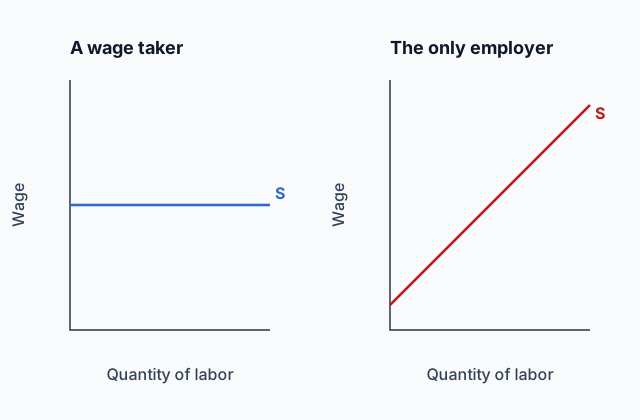
A wage taker can hire as many workers as it wants at one wage. A monopsony faces the whole upward-sloping market supply of labor: to hire more workers it must offer a higher wage, and it pays that wage to every worker, new and old.
So one more worker costs it the new worker's wage plus the raise given to every worker already there. That is its marginal factor cost (MFC), the change in total labor cost. After the first worker, MFC is greater than the wage, the supply price of labor.
| Workers | Wage on supply | Total labor cost | MFC |
|---|---|---|---|
| 1 | $8 | $8 | $8 |
| 2 | $10 | $20 | $12 |
| 3 | $12 | $36 | $16 |
The third worker is paid $12 but adds $16 to cost: $12 for the new worker and $2 more for each of the first two.
Quick check · Calculate
A town's only employer pays all its workers the same wage. It now pays 5 workers $18 an hour. To hire a sixth, it must pay $20 an hour to all six. What is the marginal factor cost of the sixth worker, in dollars an hour?
2b. Hire until MRP equals MFC, then pay the supply wage
A monopsony keeps hiring as long as the next worker's marginal revenue product is greater than the marginal factor cost: that worker adds more to revenue than to labor cost. It stops where MRP = MFC.
The wage is a separate step. The firm pays the lowest wage that brings that many workers, which is read on the supply curve at that quantity, not on MFC or MRP.
On a graph: find where MRP crosses MFC, go straight down to that quantity of labor, and read the wage where that quantity meets supply, below the crossing.
In a table: hire each worker whose MRP is at least the MFC, then pay the supply wage for that number of workers.
Quick check · Decide and justify
Basin Quarry is the only employer in a valley and pays all its workers the same wage. For its 30th worker, the marginal revenue product is $150 a day and the marginal factor cost is $170 a day. The wage it would pay all 30 workers is $120 a day. Should Basin Quarry hire the 30th worker?
Which reason supports your choice?
2c. Fewer workers and a lower wage
Compare the monopsony with a perfectly competitive labor market that has the same supply and the same MRP. Competition would push hiring to where supply meets MRP.
Because MFC lies above supply, MRP meets MFC at a smaller quantity. So the monopsony hires fewer workers than a competitive market would, and since it pays the wage on supply at that smaller quantity, it pays a lower wage.
On the graph, the wage is below the point where MRP meets MFC. A competitive firm, drawn with smooth curves, pays a wage equal to MRP at the quantity it hires; a monopsony pays less than that.
A monopsony and a competitive market compared
The monopsony hires QM, where MRP meets MFC, and pays WM on supply below that point. A competitive market would reach QC and WC, where supply meets MRP.
Quick check · Fill the statement
A town's only employer faces the same labor supply and MRP that a perfectly competitive labor market would have. Tap a blank, then tap a word or phrase.
Compared with the competitive market, the monopsony hires workers and pays a wage.
Part 3 Watch it done How many miners Harlan hires
Follow each step, then finish the last one yourself.
Harlan Mine is the only employer in a valley and pays all its miners the same wage. To hire 1, 2, 3, 4 or 5 miners it must pay $40, $50, $60, $70 or $80 a day. The five miners' marginal revenue products are $150, $130, $110, $90 and $70 a day. How many miners does Harlan hire, and what wage does it pay?
Predict first
Before the steps: will Harlan hire a fourth miner, whose $90 MRP is above the $70 wage it would need to pay?
Step 1 · Total labor cost and MFC
Total labor cost is the wage times the number of miners: $40, $100, $180, $280 and $400. Each change is the MFC: $40, $60, $80, $100 and $120.
Step 2 · Compare MRP with MFC
The first three miners add more to revenue than to cost ($150 > $40, $130 > $60, $110 > $80). The fourth adds $90 but costs $100. Harlan hires 3 miners.
Why this step?
Why not hire the fourth miner, whose $90 MRP is above the $70 wage Harlan would pay?
To hire a fourth, Harlan must pay $70 to the new miner and raise the other three from $60 to $70, so labor cost rises by $100, more than the $90 the fourth adds.
Your step · Calculate
Harlan Mine is the only employer in a valley and pays all its miners the same wage. To hire 1, 2, 3, 4 or 5 miners it must pay $40, $50, $60, $70 or $80 a day. The five miners' marginal revenue products are $150, $130, $110, $90 and $70 a day. What wage does Harlan pay to maximize profit, in dollars a day?
dollars a day
Harlan hires 3 miners at $60 a day. A competitive market with the same supply and MRP would hire the fourth too (its $90 MRP is above the $70 wage), so the monopsony hires fewer workers at a lower wage.
Part 4 Try it Draw the monopsony
Before each lab check, say where the firm's quantity comes from and which line the wage is read from.
Part 5 Explain it Answer a short free-response question
Nothing you type leaves this page. Draw the graph on paper, then compare it with the model.
Free response is 33.35% of the exam score. This one is shaped like Question 3, Short.
Free-response practice · Question 3 style
Copper Ridge Mine is the only employer in a remote town, and it pays all its miners the same wage. (a) Draw a correctly labeled graph of the town's labor market for miners, showing the labor supply curve, Copper Ridge's marginal factor cost curve and its marginal revenue product curve. Label the number of miners Copper Ridge hires QM and the wage it pays WM. (b) Explain why the marginal factor cost curve lies above the labor supply curve. (c) On your graph, label the number of miners QC and the wage WC that a perfectly competitive labor market with the same supply and MRP would reach.
Model answer
(a) The wage is on the vertical axis and the quantity of labor on the horizontal axis. Labor supply S slopes up, MFC slopes up more steeply above it from the same starting wage, and MRP slopes down. QM is where MRP meets MFC, and WM is on S straight below that crossing. (b) To hire one more miner, Copper Ridge must raise the wage, and it pays the higher wage to every miner it already employs. So one more miner adds the new wage plus all those raises to labor cost, more than the wage itself. (c) QC and WC are where S meets MRP, to the right of QM and above WM.
Copper Ridge Mine as a monopsony
Copper Ridge hires QM, where MRP meets MFC, and pays WM on supply. A competitive market would reach QC and WC, where supply meets MRP.
Score your own answer. This is a self-check, not a grade. Tick each point your answer makes.
Part 6 Check yourself The only mill in town
The case questions can all be answered from this information.
Ridgeline Mill is the only employer in a remote town, and it pays all its workers the same wage. The table shows the wage it must pay to hire each number of workers, and each worker's marginal revenue product.
| Workers | Wage needed per hour | MRP of that worker per hour |
|---|---|---|
| 1 | $30 | $110 |
| 2 | $35 | $95 |
| 3 | $40 | $80 |
| 4 | $45 | $65 |
| 5 | $50 | $56 |
| 6 | $55 | $40 |
Case question 1 · Calculate
What is the marginal factor cost of the fifth worker, in dollars per hour?
Case question 2 · Calculate
How many workers does Ridgeline hire to maximize profit?
Case question 3 · Multiple choice
What wage does Ridgeline pay when it maximizes profit?
The rest stand on their own and do not use the case.
Check yourself · Sort it
Each card describes how a firm hires labor. Tap a card, then tap the kind of labor market it is true of.
Perfectly competitive labor market only
Monopsony only
Both
Check yourself · Spot the error
A student explained how a town's only mill sets its wage. Tap the first line with a mistake.
Part 7 Keep it Keep it
From 5.3 Profit-Maximizing Behavior in Perfectly Competitive Factor Markets · Decide and justify
Skyway is one of only two airlines that fly its routes. It hires baggage handlers in a city labor market where hundreds of employers hire the same kind of worker. Is Skyway a wage taker in the market for baggage handlers?
Which reason supports your choice?
From 5.1 Introduction to Factor Markets · Fill the statement
A farm grows corn. Tap a blank, then tap a word.
The farm pays a landowner for the use of a field and pays its workers . In these factor markets the farm is the .
In three lines
- A monopsony is the only employer in a labor market, so it faces upward-sloping labor supply and must raise everyone's wage to hire more.
- Its marginal factor cost, the new worker's wage plus the raises for all the others, is greater than the wage.
- It hires where MRP = MFC and pays the wage on supply at that quantity: fewer workers and a lower wage than a competitive labor market.
Exam strategy for this topic
- Section I, Multiple Choice: 60 questions in 70 minutes.
- Section II, Free Response: 3 questions in 60 minutes.
- This lesson's Explain it is shaped like free-response question 3, Short.
- A four-function calculator is allowed on both sections of the exam.
On a monopsony graph, draw MFC above supply, starting from the same wage and rising twice as steeply when supply is a straight line. Find the quantity where MRP meets MFC, then drop straight down to supply for the wage. Say both results: fewer workers and a lower wage than a competitive labor market.
Questions students ask
What is a monopsony?
A market with only one buyer. In a labor market it is the only employer, such as a mill in a town with no other jobs. Because it faces the whole upward-sloping labor supply, it must raise the wage to hire more workers.
Why is marginal factor cost above the wage in a monopsony?
To hire one more worker, the firm must raise the wage, and it pays the higher wage to every worker it already employs. So one more worker adds the new wage plus all those raises to labor cost.
How do you find a monopsony's wage on a graph?
Find where MRP crosses MFC. That gives the quantity of labor. Then go straight down to the supply curve: the wage there is the lowest one that brings that many workers.
How does a monopsony compare with a competitive labor market?
With the same supply and MRP, a competitive market hires where supply meets MRP. The monopsony hires fewer workers and pays a lower wage, and on the graph its wage sits below the point where MRP meets MFC.
What is the difference between a monopoly and a monopsony?
A monopoly is the only seller in a product market; a monopsony is the only buyer in a factor market. Both have market power, and both end up with a smaller quantity than a competitive market would reach.
Course alignment, for teachers
AP Microeconomics topic 5.4, Unit 5: Factor Markets.
- Skill 2.A: Using economic concepts, principles, or models, explain how a specific economic outcome occurs or what action should be taken in order to achieve a specific economic outcome.
This lesson maps all 2 essential knowledge statements of the topic to the part that teaches each one: 2 are checked by a scored question. The map is in the lesson file.