Unit 6 · Topic 6.1 · about 30 minutes · 7 parts · 9 scored checks, 1 of them multiple choice, plus 2 from earlier lessons
AP Microeconomics 6.1: Socially Efficient and Inefficient Market Outcomes
Unit 6: 8 to 13% of the multiple-choice section
What you'll be able to do
- Define social efficiency, and explain with a graph why a perfectly competitive market with no outside costs or benefits allocates resources efficiently.
- Explain how rational people and firms, each weighing only their own benefits and costs, can reach a market outcome that is socially inefficient.
- Explain why imperfect markets end up away from the efficient quantity, and calculate, using a graph or table, the deadweight loss from producing a quantity that is not efficient.
Key vocabulary
| Term | What it means | The exam trap |
|---|---|---|
| Socially efficient quantity | The quantity at which the marginal benefit of the last unit equals the marginal cost of producing it, so total economic surplus is as large as it can be. | Efficient does not mean fair. A socially efficient outcome can still leave some people with much more surplus than others. |
| Total economic surplus | Consumer surplus plus producer surplus: the total net gain to everyone from the units traded. | When a tax is involved, its revenue still counts in total surplus; it moves from buyers and sellers to the government rather than vanishing. |
| Deadweight loss | The total economic surplus lost when the quantity produced is not the efficient one. | No one receives it. It is not a payment or a transfer to anyone; it is surplus that simply never exists. |
| Market power | A firm's ability to raise its price without losing all its buyers. | It is not only a monopoly's. Firms in oligopoly and monopolistic competition have some market power too. |
| Market failure | A market outcome in which the quantity produced is not the socially efficient quantity. | It does not mean the market stops working or that trade dries up. Trade goes on; only the quantity is wrong. |
 Tap to open the picture full size
Part 1 Think first The households nobody connects
Make a guess first. Even a wrong guess helps the answer stick.
Predict first
Lakeland Cable is the only cable company in a county, it charges every subscriber the same monthly price, and it sets that price to maximize its profit. It costs Lakeland $15 a month to serve each household, however many it serves. About 2,000 households that do not subscribe would each pay more than $15 a month, though less than its current price. Lakeland could sign them up, but it does not. What is the most likely reason?
In short. A market outcome is socially efficient when it produces the quantity that makes total economic surplus as large as it can be.
- The lesson finds that quantity by comparing marginal benefit with marginal cost, unit by unit.
- It shows when a market's own quantity matches it and when the market misses it.
- It ends by measuring what is lost when the wrong quantity is produced.
Part 2 Learn it Three ideas, with a check after each
2a. The efficient quantity: marginal benefit equals marginal cost
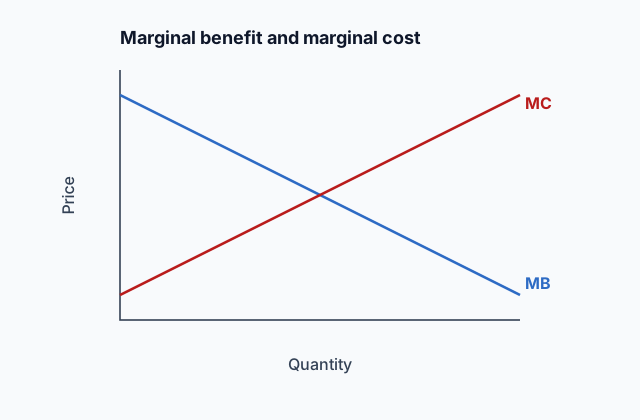
Every unit of a good gives someone a marginal benefit (MB), what the last unit is worth to the person who uses it, and takes a marginal cost (MC) to produce. A unit worth more than it costs adds the difference to society's total gain; a unit that costs more than it is worth takes the difference away.
So society gains from making each unit whose marginal benefit is greater than its marginal cost, and from no others. The socially efficient (optimal) quantity is where the marginal benefit of the last unit equals the marginal cost of producing it. There, total economic surplus, consumer surplus plus producer surplus, is as large as it can be.
Any other quantity loses some of that surplus. Too few units leave out units worth more than they cost; too many add units that cost more than they are worth. The surplus lost either way is the deadweight loss. With straight-line curves it is a triangle between MB and MC, from the quantity produced to the efficient quantity.
| Plot | Marginal benefit | Marginal cost |
|---|---|---|
| 1st | $90 | $30 |
| 2nd | $70 | $40 |
| 3rd | $50 | $55 |
The first two plots add $60 and $30 to total surplus. The third would take $5 away, so two plots is the efficient number here.
Quick check · Calculate
For units 1 to 6 of a good, the marginal benefits are $16, $14, $12, $10, $8 and $6, and the marginal costs are $4, $6, $8, $11, $14 and $17. How many units maximize total economic surplus?
2b. When the market's quantity is the efficient one
Buyers and sellers are rational: each compares their own marginal benefit with their own marginal cost. In a perfectly competitive market, buyers buy until their marginal benefit equals the price, and firms sell until their marginal cost equals the price. So at the market quantity, marginal benefit equals marginal cost.
That quantity is the socially efficient one only when all the benefits and costs fall on the buyers and sellers in the market, that is, when they are all internalized. Then the market maximizes total economic surplus with no one planning it.
Two things break the match.
- Market power. A firm that can raise its price without losing all its buyers, such as a monopoly, chooses a smaller quantity, where price is still above marginal cost. Rational, and profitable, but some units worth more than they cost go unmade.
- Costs or benefits that fall on others. If making or using a good harms or helps people outside the market, private choices leave that out. The market's quantity, where private marginal benefit equals private marginal cost, is then not the efficient one.
Quick check · Decide and justify
Dry cleaners in Clearwater sell in a perfectly competitive market. The solvent fumes from their machines make neighbors sick, a cost that no cleaner and no customer pays. Is the market quantity of dry cleaning the socially optimal quantity?
Which reason supports your choice?
2c. Where markets go wrong, and what a fix must do
A market whose equilibrium is not the efficient quantity is said to fail. The usual causes are these.
- Imperfect competition: monopoly, oligopoly and monopolistic competition all keep price above marginal cost.
- Externalities: a cost (negative) or benefit (positive) of producing or consuming a good that falls on people outside the market.
- Asymmetric information: one side of a trade knows something about the good that the other side cannot see.
- Public goods: goods no one can be kept from and that one more user does not use up, which markets produce too little of.
Governments respond, and they choose among policies by cost-benefit analysis: comparing what each policy gains, such as surplus recovered, with what it costs, such as enforcement or higher prices. The goal is not to stop a harm at any cost. A policy removes the inefficiency when it brings the market to the quantity where marginal social benefit equals marginal social cost, the benefit and cost to everyone, in the market or not. Topics 6.2 to 6.4 take externalities, public goods and policy in turn.
Quick check · Match
Each situation pulls a market away from the efficient quantity. Tap a situation, then tap its cause.
Part 3 Watch it done The surplus a cable monopoly leaves behind
Follow each step, then finish the last one yourself.
The marginal benefit of a county's cable service (its demand) is P = 20 − 0.5Q, and the marginal cost of serving subscribers is P = 2 + 0.5Q, with P in dollars a month and Q in thousands of subscribers. The county's only cable company, using its market power, serves 12 thousand subscribers. What is the deadweight loss of that choice?
Step 1 · Find the efficient quantity
Set marginal benefit equal to marginal cost: 20 − 0.5Q = 2 + 0.5Q, so Q = 18 thousand subscribers, at $11.
Step 2 · Find the gap at the quantity served
At 12 thousand subscribers, marginal benefit is 20 − 6 = $14 and marginal cost is 2 + 6 = $8. The 12,001st subscriber would be worth $6 more than it costs to serve.
Why this step?
Why is the deadweight loss a triangle that runs from 12 to 18, and not a rectangle?
The gap between MB and MC is $6 at 12 thousand subscribers and shrinks to $0 at 18 thousand, where the two curves meet. The lost surplus is the area between them over those units, which narrows to a point.
Your step · Calculate
A county's cable service has marginal benefit P = 20 − 0.5Q and marginal cost P = 2 + 0.5Q, with P in dollars a month and Q in thousands of subscribers. Its only cable company serves 12 thousand subscribers. What is the deadweight loss, in thousands of dollars a month?
thousand dollars a month
The company earns more by serving 12 thousand, but society loses $18 thousand a month of surplus on the subscribers it leaves out. That is the cost of market power in one number.
Part 4 Try it Move a market off its efficient quantity
Before each change, say whether the quantity will end up above or below the efficient quantity, and why that loses surplus either way.
Part 5 Explain it Answer a short free-response question
Nothing you type leaves this page. Write your answer, then compare it with the model.
Free response is 33.35% of the exam score. This one is shaped like Question 3, Short.
Free-response practice · Question 3 style
The market for fertilizer in a state is perfectly competitive and in equilibrium. (a) Assume every cost and benefit of fertilizer falls on its buyers and sellers. Is the market quantity the socially optimal quantity? Explain, using marginal benefit and marginal cost. (b) Now assume runoff from fertilizer harms lakes downstream, a cost no buyer or seller pays. Will the market quantity be greater than, less than or equal to the socially optimal quantity? Explain. (c) A state legislature wants a policy that removes the inefficiency in (b). Identify the condition the market quantity must meet under that policy.
Model answer
(a) Yes. Buyers buy until their marginal benefit equals the price, and sellers sell until their marginal cost equals the price, so at the market quantity marginal benefit equals marginal cost. With every cost and benefit falling on buyers and sellers, that is the quantity that maximizes total economic surplus. (b) Greater than. Sellers count only their private marginal cost, which leaves out the harm to the lakes, so they produce units whose full cost to society is greater than their benefit. (c) The quantity where marginal social benefit equals marginal social cost.
Score your own answer. This is a self-check, not a grade. Tick each point your answer makes.
Part 6 Check yourself The only bus line in town
The case questions can all be answered from this information.
Riverton has one bus company, which charges every rider the same fare. The table shows the marginal benefit of bus rides to riders and the marginal cost of providing them, at several quantities. Both are straight lines. The company provides 20 thousand rides a month.
| Rides a month (thousands) | Marginal benefit | Marginal cost |
|---|---|---|
| 10 | $7 | $3 |
| 20 | $6 | $4 |
| 30 | $5 | $5 |
| 40 | $4 | $6 |
| 50 | $3 | $7 |
| 60 | $2 | $8 |
Case question 1 · Multiple choice
How many rides a month maximize total economic surplus?
Case question 2 · Calculate
What is the deadweight loss of the company's choice of 20 thousand rides, in thousands of dollars a month?
Case question 3 · Fill the statement
Tap a blank, then tap a word or phrase.
The company stops at 20 thousand rides because, as the only seller, it has . At 20 thousand rides, marginal benefit is marginal cost.
The rest stand on their own and do not use the case.
Check yourself · Spot the error
A student explained when a market reaches the efficient quantity. Tap the first line with a mistake.
Check yourself · Select all
Waste from a chemical plant harms fishing downstream, and a town council wants to fix the inefficiency. Which two describe a sound way for the council to decide what to do? Pick two.
Select 2 answers, then check.
Part 7 Keep it Keep it
From 5.4 Monopsonistic Markets · Fill the statement
A town's only employer faces the same labor supply and MRP that a perfectly competitive labor market would have. Tap a blank, then tap a word or phrase.
Compared with the competitive market, the monopsony hires workers and pays a wage.
From 5.2 Changes in Factor Demand and Factor Supply · Fill the statement
Many people move into a region looking for work on farms. Tap a blank, then tap a word or phrase.
In the region's market for farmworkers, labor supply shifts , the equilibrium wage , and the quantity of farm labor employed .
In three lines
- The socially efficient quantity is where the marginal benefit of the last unit equals its marginal cost, which makes total economic surplus as large as it can be.
- A market reaches it only when every cost and benefit falls on its buyers and sellers; market power and costs or benefits to outsiders pull it away.
- Producing any other quantity creates deadweight loss, a triangle between MB and MC from the quantity produced to the efficient one.
Exam strategy for this topic
- Section I, Multiple Choice: 60 questions in 70 minutes.
- Section II, Free Response: 3 questions in 60 minutes.
- This lesson's Explain it is shaped like free-response question 3, Short.
- A four-function calculator is allowed on both sections of the exam.
When a question asks whether an outcome is efficient, compare marginal benefit with marginal cost at that quantity and say which is larger. On a graph, shade deadweight loss as the triangle between the benefit and cost curves, pointing to where they cross.
Questions students ask
What is social efficiency in economics?
An outcome is socially efficient when the quantity produced is the one where the marginal benefit of the last unit equals its marginal cost. At that quantity total economic surplus is as large as it can be.
Why is a perfectly competitive market efficient?
Buyers buy until their marginal benefit equals the price, and firms sell until their marginal cost equals the price, so at the market quantity marginal benefit equals marginal cost. That is efficient as long as every cost and benefit falls on the buyers and sellers.
What causes market failure?
The usual causes are market power (monopoly, oligopoly, monopolistic competition), externalities, asymmetric information and public goods. Each leaves the market's quantity away from where marginal social benefit equals marginal social cost.
How do you calculate deadweight loss?
With straight-line curves, find the gap between marginal benefit and marginal cost at the quantity produced, and the distance from that quantity to the efficient one. Deadweight loss is one half times the gap times the distance.
Is producing more than the efficient quantity also inefficient?
Yes. Units past the efficient quantity cost more to make than they are worth, so making them lowers total surplus. Too much and too little both create deadweight loss.
Course alignment, for teachers
AP Microeconomics topic 6.1, Unit 6: Market Failure and the Role of Government.
- Skill 2.A: Using economic concepts, principles, or models, explain how a specific economic outcome occurs or what action should be taken in order to achieve a specific economic outcome.
This lesson maps all 8 essential knowledge statements of the topic to the part that teaches each one: 8 are checked by a scored question. The map is in the lesson file.