Unit 6 · Topic 6.2 · about 30 minutes · 7 parts · 10 scored checks, 2 of them multiple choice, plus 2 from earlier lessons
AP Microeconomics 6.2: Externalities
Unit 6: 8 to 13% of the multiple-choice section
What you'll be able to do
- Define an externality, and explain with a graph how a market that responds only to private costs and benefits leaves out social costs or benefits.
- Explain with a graph how public policies such as taxes, subsidies, regulation, public provision and property rights address positive and negative externalities.
Key vocabulary
| Term | What it means | The exam trap |
|---|---|---|
| Externality | A cost or benefit of producing or consuming a good that falls on people who neither buy nor sell it. | A higher market price is not an externality. When buyers pay more, the effect runs through the market itself. |
| Marginal private cost (MPC) | The cost of one more unit to the seller who makes it; summed over sellers, the market supply curve. | Private does not mean privately owned. A city-run utility has a marginal private cost too. |
| Marginal social cost (MSC) | Marginal private cost plus the external cost of one more unit to everyone outside the market. | MSC is not what buyers pay or what sellers receive. Neither side of the market faces it unless a policy makes them. |
| Marginal social benefit (MSB) | Marginal private benefit plus the external benefit of one more unit to everyone outside the market. | It is not a price anyone pays. Buyers still pay a price read on the private benefit line, demand. |
| Property rights | Legal rights to own a resource, use it and keep others from using it. | They are not only about land and buildings. A right to clean air or a quiet street can be defined, owned and traded too. |
 Tap to open the picture full size
Part 1 Think first The hog farm upwind
Make a guess first. Even a wrong guess helps the answer stick.
Predict first
Harlan Hog Farm sells pork in a perfectly competitive market. The smell from its barns drifts over a town nearby, and today the farm pays nothing for it. Suppose a court rules that from now on the farm must pay the town a set amount for every hog it raises, to make up for the smell. Nothing else changes. How many hogs will the farm raise?
In short. An externality is a cost or benefit of producing or consuming a good that falls on people who neither buy nor sell it.
- The lesson adds those outside costs and benefits to the market's private curves.
- It finds the market quantity and the socially optimal quantity and compares them.
- It ends with the policies that can bring a market to the social optimum.
Part 2 Learn it Three ideas, with a check after each
2a. Costs and benefits outside the market
An externality is a cost or benefit of producing or consuming a good that falls on people outside the market, who neither buy nor sell it.
- A negative externality is a cost to them: a mill's waste in a river, a neighbor's noise.
- A positive externality is a benefit to them: a vaccinated person who does not spread a flu, bees that pollinate the next farm's trees.
Either kind can come from production (making the good) or from consumption (using it).
Rational buyers and sellers respond to private costs and benefits only, the ones that fall on them. So economists add the outside effect to each private curve:
- Marginal social cost (MSC) = marginal private cost (MPC) + the external cost of one more unit.
- Marginal social benefit (MSB) = marginal private benefit (MPB) + the external benefit of one more unit.
Why does no one bargain the problem away? Externalities arise where property rights are not well defined, as when no one owns the air, or where transaction costs are high, as when thousands of people are each harmed a little and organizing them costs more than it would recover.
Quick check · Sort it
Each card describes an effect on people outside a market. Tap a card, then tap the kind of externality it is.
Negative externality
Positive externality
2b. The market quantity and the socially optimal quantity
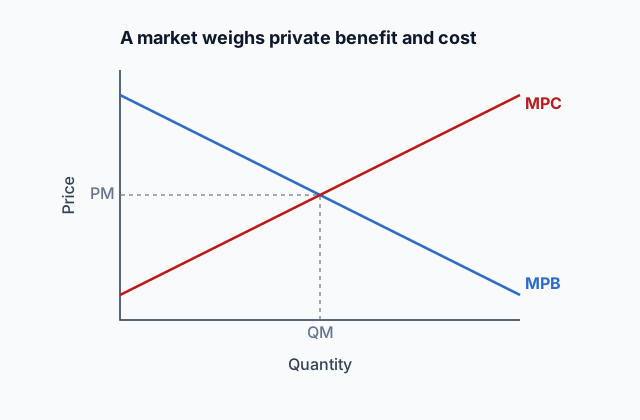
The market settles where MPB = MPC: the market quantity QM. The socially optimal quantity QS is where the marginal social benefit of the last unit equals its marginal social cost, MSB = MSC. There, total economic surplus, counting everyone, is as large as it can be.
- A negative externality puts MSC above MPC (from production) or MSB below MPB (from consumption). Either way QS is smaller than QM: the market overproduces.
- A positive externality puts MSC below MPC or MSB above MPB, so QS is larger than QM: the market underproduces.
The graph shows a negative production externality: MSC lies above MPC by the external cost, and no outside benefit, so MPB = MSB. The deadweight loss is the triangle between MSC and MSB over the units from QS to QM, units whose full cost is greater than their benefit.
A negative production externality
MSC lies above MPC by the external cost of each unit. The market reaches QM, where MPB meets MPC; the socially optimal quantity QS is where MSB meets MSC. The shaded triangle is the deadweight loss of the extra units.
Quick check · Calculate
In a perfectly competitive market for cement, marginal private benefit is P = 30 − 0.5Q and marginal private cost is P = 6 + 0.5Q, with P in dollars a ton and Q in thousands of tons. Dust from making each ton imposes an external cost of $4 on nearby residents, and there is no external benefit. What is the socially optimal quantity, in thousands of tons?
2c. Policies that close the gap
A policy fixes an externality when it brings the market to QS. The main tools:
- A per-unit tax on a good with a negative externality, equal to the external cost of a unit at QS, raises the sellers' cost to the social cost. A per-unit subsidy equal to the external benefit does the same for a positive externality.
- Environmental regulation: limits on what or how much a firm may emit.
- Public provision: the government supplies the good itself, as with free vaccination clinics.
- Assigning property rights: once someone owns the resource, whoever harms it must deal with the owner.
- Reassigning property rights through private deals: when few parties are involved, whoever holds the right can sell it. A polluter can pay the owner for the right to pollute, or the people harmed can pay a polluter who holds the right to cut back.
Private deals break down with a positive externality that no one can be kept from enjoying. Each person has a reason to free ride, to let others pay and enjoy the benefit anyway, so too little is paid for.
Quick check · Multiple choice
Steel mills in a perfectly competitive market send smoke over nearby towns, an external cost of $25 for every ton of steel at every quantity. Which per-unit tax on steel would move the market to the socially optimal quantity?
Part 3 Watch it done How many flu shots, and what is lost
Follow each step, then finish the last one yourself.
Flu shots in a county are sold in a perfectly competitive market. Marginal private benefit is P = 50 − Q and marginal private cost is P = 10 + Q, with P in dollars and Q in thousands of shots. Each shot also gives the people around the person who gets it an external benefit of $8, and there is no external cost. Find the market quantity, the socially optimal quantity and the deadweight loss of the market outcome.
Step 1 · The market quantity
Buyers and sellers weigh private benefit and cost: 50 − Q = 10 + Q, so QM = 20 thousand shots at $30.
Step 2 · The social benefit line and the optimum
MSB is MPB plus $8: P = 58 − Q. MSC is MPC. MSB = MSC where 58 − Q = 10 + Q, so QS = 24 thousand shots. The market makes 4 thousand too few.
Why this step?
Why is MPC also the marginal social cost here?
The shots have no external cost: every cost of making and giving them falls on the clinics. So the cost to society of one more shot is the clinics' own marginal cost.
Your step · Calculate
Flu shots in a county have marginal private benefit P = 50 − Q and marginal private cost P = 10 + Q, with P in dollars and Q in thousands of shots. Each shot gives an external benefit of $8 to others, and there is no external cost. The market makes 20 thousand shots; the socially optimal quantity is 24 thousand. What is the deadweight loss of the market outcome, in thousands of dollars?
thousand dollars
A subsidy of $8 a shot would lower what buyers pay for each shot by enough to reach 24 thousand, and recover that $16 thousand of surplus.
Part 4 Try it Draw the externality
Before each lab check, say whether the market produces too much or too little, and where the deadweight loss triangle sits.
Part 5 Explain it Answer a short free-response question
Nothing you type leaves this page. Draw the graph on paper, then compare it with the model.
Free response is 33.35% of the exam score. This one is shaped like Question 3, Short.
Free-response practice · Question 3 style
Poultry farms along Mill Creek sell chicken in a perfectly competitive market. Runoff from raising each pound of chicken fouls the creek for the swimmers and anglers downstream, a cost no farm pays. There is no external benefit. (a) Draw a correctly labeled graph of the chicken market showing the marginal private benefit, marginal private cost and marginal social cost curves. Label the market quantity QM and the socially optimal quantity QS. (b) On your graph, shade the deadweight loss of the market outcome. (c) Identify a per-unit policy that would bring the market to QS, and explain how it does so.
Model answer
(a) Price is on the vertical axis and quantity on the horizontal axis. MPB (= MSB) slopes down and MPC slopes up; MSC lies above MPC by the external cost. QM is where MPB meets MPC, and QS is where MSB meets MSC, to the left of QM. (b) The deadweight loss is the triangle between MSC and MSB from QS to QM. (c) A per-unit tax on chicken equal to the external cost of a pound. It raises each farm's cost of a pound to the full social cost, so the farms' supply moves up to MSC and the market produces QS.
The Mill Creek chicken market
MSC lies above MPC by the external cost of each pound. The market reaches QM; the socially optimal quantity is QS, where MSB meets MSC. The shaded triangle is the deadweight loss.
Score your own answer. This is a self-check, not a grade. Tick each point your answer makes.
Part 6 Check yourself Insulation in Marston
The case questions can all be answered from this information.
Contractors in Marston insulate homes in a perfectly competitive market. Each insulated home burns less heating oil, so its neighbors breathe less smoke, an external benefit of $10 a job, and there is no external cost. The table gives the marginal private benefit (MPB), marginal social benefit (MSB) and marginal private cost (MPC) at several quantities. All three are straight lines. The market does 30 thousand jobs a year.
| Jobs (thousands) | MPB | MSB | MPC |
|---|---|---|---|
| 25 | $45 | $55 | $35 |
| 30 | $40 | $50 | $40 |
| 35 | $35 | $45 | $45 |
| 40 | $30 | $40 | $50 |
Case question 1 · Calculate
What is the socially optimal number of insulation jobs, in thousands?
Case question 2 · Decide and justify
Marston's council wants the market to reach the socially optimal number of insulation jobs with a per-unit policy. Should it tax insulation jobs or subsidize them?
Which reason supports your choice?
Case question 3 · Calculate
What is the deadweight loss of the market outcome, in thousands of dollars?
The rest stand on their own and do not use the case.
Check yourself · Fill the statement
Tap a blank, then tap a word or phrase.
Every household on Elm Street would gain from a streetlight at the corner, and once it is up, no one on the street can be kept from its light. So each household has a reason to , and if the households must pay for it on their own, the light .
Check yourself · Match
Each action addresses an externality. Tap an action, then tap the kind of policy it is.
Check yourself · Multiple choice
Thousands of households downwind of a power plant each lose a little from its smoke. No law says who has the right to the air. Why don't the households simply pay the plant to cut its smoke?
Part 7 Keep it Keep it
From 6.1 Socially Efficient and Inefficient Market Outcomes · Calculate
For units 1 to 6 of a good, the marginal benefits are $16, $14, $12, $10, $8 and $6, and the marginal costs are $4, $6, $8, $11, $14 and $17. How many units maximize total economic surplus?
From 5.3 Profit-Maximizing Behavior in Perfectly Competitive Factor Markets · Decide and justify
A print shop pays workers $20 an hour and rents printers for $50 an hour. The last worker hour adds 100 pages, and the last printer hour adds 300 pages. To print the same number of pages at a lower cost, what should the shop do?
Which reason supports your choice?
In three lines
- An externality is a cost or benefit of producing or consuming a good that falls outside the market, because buyers and sellers respond only to their private costs and benefits.
- The market reaches QM, where MPB = MPC; the social optimum QS is where MSB = MSC, smaller than QM for a negative externality and larger for a positive one.
- A per-unit tax or subsidy equal to the external cost or benefit, regulation, public provision and property rights can each bring a market to QS.
Exam strategy for this topic
- Section I, Multiple Choice: 60 questions in 70 minutes.
- Section II, Free Response: 3 questions in 60 minutes.
- This lesson's Explain it is shaped like free-response question 3, Short.
- A four-function calculator is allowed on both sections of the exam.
On an externality graph, keep the private curves, draw the social curve as a separate line and label it MSC or MSB, and label both QM and QS. Shade deadweight loss between the social curves, from QS to QM, and name the per-unit tax or subsidy as equal to the external cost or benefit.
Questions students ask
What is an externality in economics?
A cost or benefit of producing or consuming a good that falls on people outside the market, who neither buy nor sell it. Pollution from a factory is a negative externality; the protection a flu shot gives others is a positive one.
Does a negative externality lead to too much or too little production?
Too much. The market counts only private costs, so it makes units whose full cost to society, private cost plus external cost, is greater than their benefit. A positive externality leads to too little.
What is the difference between MPC and MSC?
MPC is the cost of one more unit to the seller. MSC adds the external cost of that unit to everyone else. With no external cost, they are the same curve.
How big should a tax on a negative externality be?
Equal to the external cost of a unit at the socially optimal quantity. Then sellers face the full social cost, and the market produces where marginal social benefit equals marginal social cost.
Why don't people just bargain away externalities?
Bargaining needs well-defined property rights and low transaction costs. When no one owns the resource, or when many people are each affected a little, organizing a deal costs more than it would recover.
Course alignment, for teachers
AP Microeconomics topic 6.2, Unit 6: Market Failure and the Role of Government.
- Skill 4.B: Demonstrate your understanding of a specific economic situation on an accurately labeled graph or visual.
This lesson maps all 5 essential knowledge statements of the topic to the part that teaches each one: 5 are checked by a scored question. The map is in the lesson file.