Unit 6 · Topic 6.3 · about 30 minutes · 7 parts · 9 scored checks, 2 of them multiple choice, plus 2 from earlier lessons
AP Microeconomics 6.3: Public and Private Goods
Unit 6: 8 to 13% of the multiple-choice section
What you'll be able to do
- Define whether a good is rival, excludable, both or neither, and explain how those features shape what people, firms and governments do about the good.
Key vocabulary
| Term | What it means | The exam trap |
|---|---|---|
| Rival good | A good for which one person's use leaves less of it for others. | Rival has nothing to do with competition between firms. It is about whether using the good uses it up. |
| Excludable good | A good that people who do not pay can be kept from using. | It is not about who owns the good. A government's good can be excludable, and a private owner's good can be impossible to fence off. |
| Private good | A good that is both rival and excludable. | Private does not mean used alone. A pizza shared at a table is still rival and excludable. |
| Public good | A good that is both non-rival and non-excludable. | Non-rival does not mean it never wears out. A public good can still need upkeep over time; what matters is that one more user takes nothing from the others. |
| Free rider | A person who enjoys the benefit of a good without paying for it. | It is about getting a benefit, not getting a bargain. A shopper who buys at a discount is not a free rider. |
| Open-access resource | A resource that is rival but that no one can be kept from using. | Open access is about who may use a resource, not who owns it. Land a government owns can still be open to anyone. |
 Tap to open the picture full size
Part 1 Think first Fireworks for the whole town
Make a guess first. Even a wrong guess helps the answer stick.
Predict first
A company offers to put on Ridgefield's Fourth of July fireworks show if it can first sell $50,000 of tickets. The show will light up the sky over every yard in town. Ridgefield has 5,000 households, and every one of them says the show is worth at least $20 to it. Will the company sell enough tickets?
In short. Goods differ in two ways: whether one person's use leaves less for others, and whether people who do not pay can be kept from using it.
- The lesson sorts goods by those two questions.
- It shows how the answers change what people and firms choose to do.
- It ends with resources anyone may use, and what becomes of them.
Part 2 Learn it Three ideas, with a check after each
2a. Rival or not, excludable or not
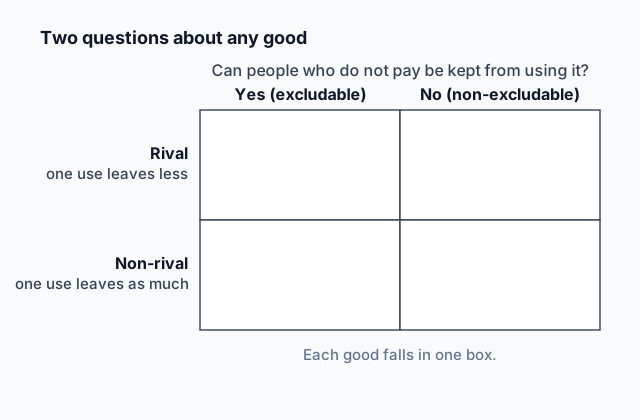
Two questions sort any good.
- Is it rival? A good is rival when one person's use leaves less for others: a sandwich one person eats is gone. It is non-rival when one more user takes nothing from the rest: one more viewer of a fireworks show leaves the show as bright for everyone else.
- Is it excludable? A good is excludable when people who do not pay can be kept from using it, by a fence, a ticket or a password. It is non-excludable when they cannot.
The answers name the kind of good.
- A private good is rival and excludable. Markets handle these well: sellers can charge, and each unit goes to one buyer.
- A public good is non-rival and non-excludable.
- A good that is rival but non-excludable, such as a resource anyone may take from, is an open-access resource (chunk 2c).
The fourth box, excludable but non-rival, holds goods like an uncrowded toll road: a gate can keep people out, but one more car takes nothing from the others.
Quick check · Sort it
Each card names a good. Tap a card, then tap the kind of good it is.
Private good
Public good
Open-access resource
2b. Free riders, and who provides public goods
Because a public good is non-excludable, a person can enjoy it without paying. A rational person's own payment barely changes how much of the good there is, so each has a reason to let others pay and use it anyway. That is the free rider problem.
With most people free riding, a firm that tries to sell a public good collects far less than the good is worth, even when its total value is far more than its cost. So private individuals and firms usually lack the incentive to produce public goods, and government is often the only producer. It pays with taxes, which no one can skip by choosing not to use the good. National defense, flood levees and lighthouses are classic cases.
Governments also produce some private goods and let people use them for free. A seat in a public school is excludable (a school can limit its seats to its district) and rival (a crowded class leaves less teacher time for each student), so schooling is a private good. Governments provide it free because they judge an educated population to be worth the cost.
Quick check · Decide and justify
A river town needs a flood levee that, once built, would protect every home behind it, whether or not the owner helped pay for it. A private firm offers to build it if enough homeowners pay in advance. Will the firm likely collect enough to build the levee?
Which reason supports your choice?
2c. Open-access resources
Some natural resources are, by their nature, non-excludable and rival: fish in open water, a pasture anyone may graze, groundwater any well may pump. These are open-access resources.
Each user weighs the benefit of taking one more unit against their own cost. What they take leaves less for everyone else, but that cost falls on the other users, so each one leaves it out. The result is that private individuals overconsume the resource: more is taken than is efficient, and it can run out altogether.
The fixes make the resource behave more like a private good: limit how much each user may take, sell a fixed number of permits, or assign the resource to an owner who can charge for it.
Quick check · Multiple choice
Anyone may fish in Crane Lake, and every fish caught is one fewer for everyone else. Why do the people who fish there take more fish than is efficient?
Part 3 Watch it done The road nobody paves
Follow each step, then finish the last one yourself.
Four hundred households live along a gravel county road. Paving it would cost $8,000, and each household values a paved road at $30. Once it is paved, none of them can be kept off it, and the road is never crowded. Will the households get the road paved on their own?
Step 1 · Classify the good
None of the 400 can be kept off the paved road, so for them it is non-excludable; one more car on an uncrowded road takes nothing from the others, so it is non-rival. For these households it is a public good.
Step 2 · Compare total value with cost
Together the households value paving at 400 × $30 = $12,000, more than the $8,000 it costs. Paving would add $4,000 to their total surplus.
Why this step?
If paving adds $4,000 to their total surplus, why might no household start the job, or get 400 neighbors to agree?
Each household gets the same paved road whether it pays or not, so each would rather someone else pay, and getting 400 households to agree on who pays what is costly. Any one household that paid alone would spend far more than the road is worth to it.
Your step · Calculate
Four hundred households share a gravel county road. Paving it would cost $8,000, and each household values a paved road at $30. Once paved, none of them can be kept off it. If one household pays the whole $8,000 by itself, what is that household's own net gain, in dollars? (Give a loss as a negative number.)
dollars
Paying alone loses $7,970, so no household starts, and with 400 of them a deal on who pays what is hard to strike: each can hold out and still use the road. The road can stay gravel even though paving is worth $4,000 more than it costs. A county that paves it and charges each household $20 in taxes leaves every household $10 better off.
Part 4 Try it A crowded free beach
Use the two questions on a good the lesson has not shown.
Try it · Decide and justify
Pine Lake's town beach is free and open to anyone. On summer weekends it is so crowded that each new visitor leaves less room on the sand for everyone else. Is the beach on those weekends a public good?
Which reason supports your choice?
Part 5 Explain it Answer a short free-response question
Nothing you type leaves this page. Write your answer, then compare it with the model.
Free response is 33.35% of the exam score. This one is shaped like Question 2, Short.
Free-response practice · Question 2 style
Valley County sprays for mosquitoes every summer, which lowers the number of mosquitoes over the whole county. (a) Is mosquito spraying a public good? Explain, using whether it is rival and whether it is excludable. (b) Explain why a private firm selling spraying to individual households would collect too little to spray the whole county. (c) Valley County also runs free public schools. Is a seat in a public school a public good? Explain.
Model answer
(a) Yes. Fewer mosquitoes for one household leaves no fewer benefits for the others, so it is non-rival, and a household that does not pay cannot be kept from the lower mosquito count, so it is non-excludable. (b) Every household gets the benefit whether or not it pays, so each has a reason to free ride on the others' payments. The firm collects far less than spraying is worth and would not spray the whole county. (c) No. A seat in a school is excludable, since the school can limit seats to students in its district, and rival, since one more student in a crowded class leaves less teacher time for the others. It is a private good that the county provides with free access.
Score your own answer. This is a self-check, not a grade. Tick each point your answer makes.
Part 6 Check yourself Four goods in Harbor Town
The case questions can all be answered from this information.
The table describes four goods in Harbor Town by the two questions that sort every good.
| Good | Can people who do not pay be kept from using it? | Does one person's use leave less for others? |
|---|---|---|
| The town's tornado warning siren | No | No |
| Sandwiches at a deli | Yes | Yes |
| Clams on a public beach where anyone may dig | No | Yes |
| A toll bridge that is never crowded | Yes | No |
Case question 1 · Multiple choice
Which good is a public good, so that a private firm would struggle to collect enough to provide it even if the town values it far above its cost?
Case question 2 · Fill the statement
Tap a blank, then tap a word or phrase.
The clams are , so the people who dig there take clams than is efficient.
The rest stand on their own and do not use the case.
Check yourself · Spot the error
A student explained why Harbor Town runs a free public school. Tap the first line with a mistake.
Check yourself · Select all
Anyone may fish Crane Lake, and its fish are being caught faster than they breed. Which two policies would cut the catch toward the efficient amount? Pick two.
Select 2 answers, then check.
Part 7 Keep it Keep it
From 6.2 Externalities · Sort it
Each card describes an effect on people outside a market. Tap a card, then tap the kind of externality it is.
Negative externality
Positive externality
From 5.4 Monopsonistic Markets · Calculate
A town's only employer pays all its workers the same wage. It now pays 5 workers $18 an hour. To hire a sixth, it must pay $20 an hour to all six. What is the marginal factor cost of the sixth worker, in dollars an hour?
In three lines
- A private good is rival and excludable; a public good is non-rival and non-excludable; a rival good no one can be kept from is an open-access resource.
- People can enjoy a public good without paying, so each has a reason to free ride, firms collect too little to provide it, and government usually does.
- Governments also provide some private goods, such as schooling, with free access, and open-access resources are overused unless use is limited.
Exam strategy for this topic
- Section I, Multiple Choice: 60 questions in 70 minutes.
- Section II, Free Response: 3 questions in 60 minutes.
- This lesson's Explain it is shaped like free-response question 2, Short.
- A four-function calculator is allowed on both sections of the exam.
When a question asks you to classify a good, answer both questions out loud: is it rival, and is it excludable? Then name the kind of good. If it asks why a market underprovides a public good, say that people can benefit without paying, so they free ride.
Questions students ask
What is the difference between a public good and a private good?
A private good is rival and excludable: one person's use leaves less for others, and non-payers can be kept out. A public good is non-rival and non-excludable. Who provides the good does not decide which it is.
What is the free rider problem?
When people can enjoy a good without paying, each has a reason to let others pay. With many free riders, a seller collects far less than the good is worth, so markets provide too little of public goods.
Why does the government provide public goods?
Because free riders keep private firms from collecting enough to provide them, even when they are worth more than they cost. Government can pay with taxes, which no one avoids by not using the good.
Is public education a public good?
No. A school seat is excludable and rival, so it is a private good. Governments sometimes provide private goods like schooling and allow free access to them.
What is an open-access resource?
A resource that is rival but non-excludable, such as fish in open water. Each user ignores what their use takes from others, so the resource is overconsumed.
Course alignment, for teachers
AP Microeconomics topic 6.3, Unit 6: Market Failure and the Role of Government.
- Skill 1.B: Identify an economic concept, principle, or model illustrated by an example.
This lesson maps all 4 essential knowledge statements of the topic to the part that teaches each one: 4 are checked by a scored question. The map is in the lesson file.