Unit 6 · Topic 6.4 · about 32 minutes · 7 parts · 10 scored checks, 1 of them multiple choice, plus 2 from earlier lessons
AP Microeconomics 6.4: The Effects of Government Intervention in Different Market Structures
Unit 6: 8 to 13% of the multiple-choice section
What you'll be able to do
- Define government policy interventions in imperfect markets, explain with graphs how they change outcomes in perfectly and imperfectly competitive markets, and calculate those changes from a graph or table.
Key vocabulary
| Term | What it means | The exam trap |
|---|---|---|
| Per-unit tax | A tax of a fixed amount on each unit sold. | Who the law says pays it, buyers or sellers, does not decide who bears it. The price elasticities of demand and supply do. |
| Lump-sum tax | A tax of a fixed total amount that does not change with how much a firm sells. | It can still drive a firm out of the market in the long run, if it turns the firm's profit into a loss. |
| Binding price ceiling | A legal maximum price set below the price the market would otherwise reach. | A ceiling above that price is not binding and changes nothing, however low it sounds. |
| Fair-return price | A regulated price set where a monopoly's demand meets its average total cost, so it earns zero economic profit. | Zero economic profit is still a normal profit: the owners earn what their money and time could earn elsewhere. |
| Antitrust policy | Government policy that tries to make markets more competitive. | It is aimed at market power, not at size alone. A large firm in a competitive market is not its target. |
 Tap to open the picture full size
Part 1 Think first A price cap on the gas company
Make a guess first. Even a wrong guess helps the answer stick.
Predict first
Bayview Gas is a town's only natural gas supplier. It charges $12 a unit, and its marginal cost is $4 a unit however much it sells. The state caps its price at $8 a unit, below what it charges now but above its marginal cost, and Bayview would still earn a profit at $8. Will Bayview now sell more gas, less gas or the same amount?
In short. The same government policy can change a market in different ways, depending on whether the market is competitive, a monopoly or a monopsony.
- The lesson compares price controls in competitive and imperfect markets.
- It works out how taxes and subsidies change a firm's choices.
- It ends with regulating monopolies and keeping markets competitive.
Part 2 Learn it Three ideas, with a check after each
2a. Price controls depend on the market structure
A binding price ceiling is set below the price the market would reach; a binding price floor, above it. What they do depends on who sets the price.
- Perfect competition. A binding ceiling causes a shortage and cuts the quantity traded; a binding floor causes a surplus. Both create deadweight loss, and more of it when supply and demand are more elastic.
- Monopoly or monopolistic competition. Under a ceiling below its price, the firm can sell each unit up to what buyers want at the ceiling for the ceiling price, so its MR is flat at the ceiling out to demand. It sells where MC meets that flat MR, or all buyers want at the ceiling if MC is lower there. A binding price floor above its price does the reverse: buyers want less, so it sells less. A ceiling between MC and the firm's price can raise its output; a ceiling set where demand meets MC brings it to the allocatively efficient quantity. This is price regulation of a monopoly.
- Monopsony. A minimum wage makes the employer's marginal factor cost flat at the minimum wage, out to labor supply. Set between the monopsony's wage and where supply meets MRP, it raises both the wage and the number hired.
Set too far, any control cuts the quantity again. A policy helps only when it answers the incentive behind the failure.
Quick check · Calculate
A monopoly faces demand P = 24 − Q, so its marginal revenue is MR = 24 − 2Q, and its marginal cost is $6 at every quantity. Unregulated, it sells 9 units at $15. A regulator sets a price ceiling of $10. How many units does the monopoly now sell?
2b. Per-unit and lump-sum taxes and subsidies
A per-unit tax adds the same amount to the cost of every unit, so it raises marginal cost. Any firm, competitive or not, then produces less where MC meets marginal revenue, and the price buyers pay rises. In a competitive market, the tax changes the price buyers pay, the price sellers keep, the quantity, consumer and producer surplus, deadweight loss and tax revenue, and how it splits between buyers and sellers depends on the price elasticities of demand and supply. A per-unit subsidy lowers marginal cost and works the other way.
A lump-sum tax or subsidy is a fixed total, the same however much the firm sells, such as a yearly license fee or a one-time grant. It changes the firm's fixed cost only. Marginal cost and marginal benefit stay where they were, so the profit-maximizing quantity and price do not change. Only the firm's profit moves, down for a tax and up for a subsidy.
Quick check · Sort it
Each card is a government policy aimed at a town's only cable company, which earns a profit after any of them and stays in business. Tap a card, then tap what it does to the price the company charges and the quantity it sells.
Changes its price and quantity
Leaves its price and quantity unchanged
2c. Regulating a natural monopoly, and antitrust
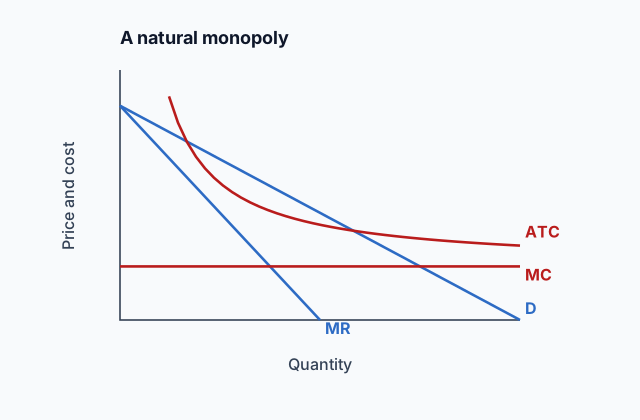
A natural monopoly's average total cost falls across all of demand, so one firm serves the market most cheaply. Left alone, it sets MR = MC and charges well above marginal cost. A regulator has two prices to choose from.
- The socially optimal price, where demand meets MC. Output is allocatively efficient. But ATC falls the whole way, so MC is below ATC, and at that price the firm takes a loss. To keep it producing there, the government must give a lump-sum subsidy equal to the loss. A lump-sum subsidy covers the loss without changing marginal cost, so the efficient quantity stays the firm's best choice.
- The fair-return price, where demand meets ATC. The firm earns zero economic profit and needs no subsidy, but price is still above MC, so output is below the efficient quantity, and some deadweight loss remains.
For markets that could be competitive, governments use antitrust policy to keep them so: blocking mergers that would create market power, breaking up monopolies, and banning firms from agreeing to fix prices.
Quick check · Calculate
A natural monopoly faces demand P = 20 − 0.1Q, with P in dollars and Q in thousands of units. Its marginal cost is $4 a unit at every quantity, and its fixed cost is $500 thousand. A regulator sets its price where demand meets marginal cost. What lump-sum subsidy, in thousands of dollars, does the firm need to break even?
Part 3 Watch it done A per-unit tax on a monopoly
Follow each step, then finish the last one yourself.
Orrin Water is a town's only water company. It faces demand P = 30 − Q, so its marginal revenue is MR = 30 − 2Q, and its marginal cost is $6 a unit at every quantity, with Q in thousands of units. The town adds a tax of $4 on every unit Orrin sells. Find the quantity and price before and after the tax.
Step 1 · Before the tax
MR = MC: 30 − 2Q = 6, so Q = 12 thousand units, and the price on demand is 30 − 12 = $18.
Step 2 · The tax raises marginal cost
Each unit now costs $6 + $4 = $10 to sell. MR = MC: 30 − 2Q = 10, so Q = 10 thousand units.
Why this step?
Why does Orrin not simply raise its price by the full $4 tax?
Demand slopes down, so any price rise costs Orrin buyers. It picks the quantity where MR equals its new MC and charges what buyers will pay for that quantity, which passes on only part of the tax.
Your step · Calculate
Orrin Water, a monopoly, faces demand P = 30 − Q, with marginal revenue MR = 30 − 2Q, and has a marginal cost of $6 at every quantity. Before any tax it sells 12 units at $18. The town then adds a tax of $4 on every unit Orrin sells. What price, in dollars, do buyers now pay?
dollars
Orrin sells 2 thousand fewer units, and buyers pay $2 more of the $4 tax; Orrin bears the other $2 a unit. A lump-sum fee of the same yearly total would have left the price at $18.
Part 4 Try it Regulate the natural monopoly
At each point, compare the price with ATC. Which outcome needs a subsidy, which earns zero economic profit, and which outcomes leave deadweight loss?
Part 5 Explain it Answer a long free-response question
Nothing you type leaves this page. Draw the graph on paper, then compare it with the model.
Free response is 33.35% of the exam score. This one is shaped like Question 1, Long.
Free-response practice · Question 1 style
Delta Water supplies a valley's water and is a natural monopoly: its average total cost falls at every quantity buyers would demand, and its marginal cost is constant. (a) Draw a correctly labeled graph for Delta showing its demand, marginal revenue, marginal cost and average total cost curves. Label its profit-maximizing quantity Qm and price Pm. (b) On your graph, label the allocatively efficient quantity Qe and price Pe. (c) At Qe and Pe, does Delta earn a profit, take a loss or earn zero economic profit? Explain. (d) A regulator requires Delta to charge Pe. Identify the kind of subsidy Delta needs to keep producing Qe, and explain why that kind of subsidy does not change the quantity Delta chooses. (e) On your graph, label the fair-return price Pf and quantity Qf.
Model answer
(a) Price and cost are on the vertical axis and quantity on the horizontal axis. Demand slopes down, MR slopes down twice as steeply below it, MC is horizontal, and ATC falls across the whole graph, above MC. Qm is where MR meets MC, and Pm is on demand straight above it. (b) Qe and Pe are where demand meets MC. (c) A loss. ATC falls at every quantity, so MC is below ATC, and at Pe = MC the price is below ATC. (d) A lump-sum subsidy equal to the loss. It changes Delta's fixed cost only, not its marginal cost, so producing where price equals MC is still its best choice. (e) Pf and Qf are where demand meets ATC, with Qf between Qm and Qe.
Delta Water, a natural monopoly
Delta maximizes profit at Qm and Pm. The allocatively efficient outcome is Qe and Pe, where demand meets MC, below ATC. The fair-return outcome is Qf and Pf, where demand meets ATC.
Score your own answer. This is a self-check, not a grade. Tick each point your answer makes.
Part 6 Check yourself A minimum wage at the only mill
The case questions can all be answered from this information.
Ridgeline Mill is the only employer in a remote town and pays all its workers the same wage. The table shows the wage it must offer to get each number of workers, and each worker's marginal revenue product. With no minimum wage, the mill hires 4 workers at $32 an hour. Under a minimum wage, the mill must pay every worker at least that wage, and it can hire as many workers as are willing to work at it.
| Workers | Wage needed per hour | MRP of that worker per hour |
|---|---|---|
| 1 | $20 | $80 |
| 2 | $24 | $70 |
| 3 | $28 | $56 |
| 4 | $32 | $46 |
| 5 | $36 | $38 |
| 6 | $40 | $30 |
Case question 1 · Calculate
The town sets a minimum wage of $36 an hour. How many workers does Ridgeline hire to maximize profit?
Case question 2 · Multiple choice
Compared with no minimum wage, what does the $36 minimum wage do at Ridgeline Mill?
Case question 3 · Decide and justify
Suppose the town instead sets a minimum wage of $50 an hour. Would Ridgeline hire more than the 4 workers it hires with no minimum wage?
Which reason supports your choice?
The rest stand on their own and do not use the case.
Check yourself · Select all
Which two of these are examples of antitrust policy? Pick two.
Select 2 answers, then check.
Check yourself · Spot the error
A student compared price ceilings in two markets. Tap the first line with a mistake.
Check yourself · Fill the statement
A per-unit tax is placed on sellers in a perfectly competitive market where demand is much less elastic than supply. Tap a blank, then tap a word or phrase.
Buyers bear of the tax, and the deadweight loss is than it would be if demand were very elastic.
Part 7 Keep it Keep it
From 6.3 Public and Private Goods · Sort it
Each card names a good. Tap a card, then tap the kind of good it is.
Private good
Public good
Open-access resource
From 6.1 Socially Efficient and Inefficient Market Outcomes · Decide and justify
Dry cleaners in Clearwater sell in a perfectly competitive market. The solvent fumes from their machines make neighbors sick, a cost that no cleaner and no customer pays. Is the market quantity of dry cleaning the socially optimal quantity?
Which reason supports your choice?
In three lines
- A binding price ceiling cuts output in a competitive market, but on a monopoly it makes MR flat at the ceiling and can raise output; a minimum wage can raise both the wage and hiring at a monopsony.
- A per-unit tax or subsidy changes marginal cost, and so price and quantity; a lump-sum one changes only fixed cost and profit.
- A natural monopoly regulated to P = MC needs a lump-sum subsidy; at the fair-return price P = ATC it needs none. Antitrust policy keeps other markets competitive.
Exam strategy for this topic
- Section I, Multiple Choice: 60 questions in 70 minutes.
- Section II, Free Response: 3 questions in 60 minutes.
- This lesson's Explain it is shaped like free-response question 1, Long.
- A four-function calculator is allowed on both sections of the exam.
Before you move any curve for a policy, ask whether it changes the cost of one more unit. A per-unit tax or subsidy moves MC; a lump-sum one moves only ATC. For a price ceiling on a monopoly, draw MR flat at the ceiling out to demand, and say whether quantity rises or falls.
Questions students ask
How does a price ceiling affect a monopoly?
A binding ceiling below the monopoly's price makes its marginal revenue equal to the ceiling for every unit buyers want at that price. If marginal cost is below the ceiling there, the monopoly sells more than before. A ceiling where demand meets MC brings it to the efficient quantity.
What is the difference between a lump-sum tax and a per-unit tax?
A per-unit tax adds to the cost of every unit, so it raises marginal cost and changes the price and quantity. A lump-sum tax is a fixed total, so it changes only fixed cost and profit.
Can a minimum wage increase employment?
In a monopsony, yes. A minimum wage between the monopsony's wage and the competitive wage makes the cost of one more worker equal to the minimum wage, so the firm hires more workers at a higher wage. Set too high, it cuts hiring.
Why does a regulated natural monopoly need a subsidy?
Its ATC falls across all of demand, so MC is below ATC. At the efficient price, P = MC, the price is below ATC and the firm takes a loss. A lump-sum subsidy covers the loss without changing its marginal cost.
What is antitrust policy?
Policy that tries to make markets more competitive, for example by blocking mergers that would create market power, breaking up monopolies and banning agreements to fix prices.
Beyond the AP Exam
College Board sets this limit on what the AP Exam asks about this topic. Anything past it is not on the exam.
A graph of inefficiency and policy due to collusion is beyond the scope of the course and the AP Exam.
Course alignment, for teachers
AP Microeconomics topic 6.4, Unit 6: Market Failure and the Role of Government.
- Skill 4.C: Demonstrate the effect of a change in an economic situation on an accurately labeled graph or visual.
This lesson maps all 7 essential knowledge statements of the topic to the part that teaches each one: 7 are checked by a scored question. The map is in the lesson file.