Unit 1 · Topic 1.10 · about 25 minutes · 7 parts · 11 scored checks, 1 of them multiple choice
Rational Functions and Holes
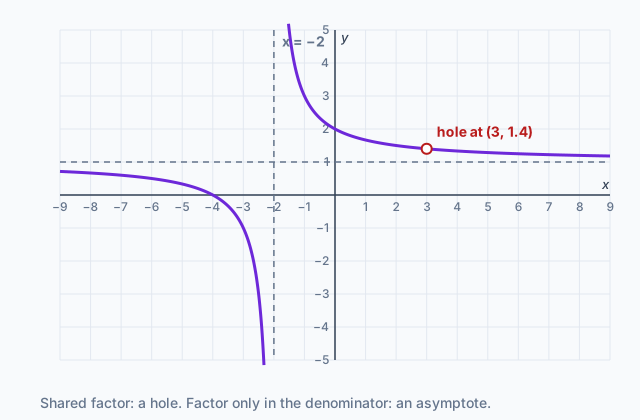 Tap to open the picture full size
Part 1 Think first
A line with a gap
Guess before you learn. A wrong guess still makes the answer stick.
Predict first
Let . For every input except 3, equals . What does the graph of look like at ?
In short. A hole is a single missing point on the graph of a rational function, where a zero of the denominator is cancelled completely by the numerator.
- If a real zero's multiplicity in the numerator is greater than or equal to its multiplicity in the denominator, the graph has a hole there instead of a vertical asymptote.
- The hole at sits at , where is the value the outputs approach as the inputs approach .
- In limit notation, , and the limits from the left and from the right are both .
Part 2 Learn it
Three short ideas, each checked as you go
2a. Hole or asymptote?
When is a zero of both the numerator and the denominator, compare multiplicities, as in 1.9.
- If the multiplicity of in the numerator is greater than or equal to its multiplicity in the denominator, every factor on the bottom cancels. The graph has a hole at .
- If the denominator has more, a factor is left on the bottom and the graph has a vertical asymptote at .
For the multiplicities are equal, 1 and 1, so there is a hole at . For the numerator has more, so there is a hole there too. The function is still not defined at , because the original denominator is zero.
Quick check · Sort it
No calculator. Tap a function, then what its graph has at .
A hole at x = 2
A vertical asymptote at x = 2
2b. Where exactly is the hole?
A hole has coordinates . The -coordinate is the cancelled zero, . The -coordinate is the value the outputs approach as the inputs get close to .
To find , cancel the common factors and evaluate what is left at . For , what is left is , and at that is 6. The hole is at .
The cancelled form is not the same function as : it has 3 in its domain and does not (1.1, equal functions need equal domains). It is only a tool for finding .
Quick check · Calculate
No calculator. The graph of has a hole at . What is the -coordinate of the hole?
2c. Holes in limit notation
If input values sufficiently close to give output values arbitrarily close to , the hole is at , and we write
Unlike at a vertical asymptote, the two sides agree: .
You can see this in a table. For : , , , . From both sides the outputs close in on 6, even though does not exist.
Quick check · Fill the statement
No calculator. A rational function has a hole at . Tap a blank, then tap an answer.
As approaches from either side, the outputs of approach , and is .
Part 3 Watch it done
A hole and an asymptote in one function
Watch each step, then do the last one yourself.
Find every hole and vertical asymptote of , and locate the hole.
Step 1 · Factor both
. The denominator is zero at and .
Step 2 · Classify each zero
At the factor appears once on top and once on the bottom, so it cancels completely: a hole. At the numerator is not zero: a vertical asymptote.
Why this step?
Why does the hole get a -coordinate, while the asymptote does not?
Near , after cancelling, the outputs approach a single number, so the missing point has a location. Near the denominator approaches zero with nothing to cancel it, so the outputs grow without bound and approach no number at all.
Your step · Calculate
No calculator. Finish it. What is the -coordinate of the hole? Give a decimal.
Part 4 Try it
Practice finding holes
Holes turn up where you might not expect them. In 1.2 you estimated a falling object's speed with average rates of change over shorter and shorter intervals. Written as a function of the interval's end, that average has a hole exactly at the moment you care about.
Try it · Calculate
No calculator. A ball rolls down a ramp and travels meters in seconds. Its average speed from 2 seconds to seconds is , which is not defined at . The graph of has a hole at . What is the hole's -coordinate, in meters per second?
Then practice on generated rational functions, each with a factor shared by the top and the bottom. Before you type, decide whether each zero of the denominator is a hole or an asymptote.
Part 5 Explain it
Write it the way the exam asks
Nothing you type leaves this page.
Free response is 37.5% of the exam score. This one is shaped like Question 1, Function Concepts.
Free-response practice · Question 1 style
Graphing calculator required. Let . Explain why the graph of has a hole at , and find its coordinates. Use limit notation.
Model answer
Factored, . The zero 2 has multiplicity 1 in the numerator and 1 in the denominator; since the numerator's multiplicity is greater than or equal to the denominator's, the factor cancels completely and there is a hole, not an asymptote. For , , which approaches as approaches 2. So , and the hole is at .
Score your own answer. This is a self-check, not a grade. Tick each point your answer makes.
Part 6 Check yourself
Finding a hole from a table
The two case questions use the same data. Answer them from the table.
The function is not defined at . The table gives its values close to 2.
| 1.9 | 6.9 |
|---|---|
| 1.99 | 6.99 |
| 2 | not defined |
| 2.01 | 7.01 |
| 2.1 | 7.1 |
Case question 1 · Calculate
No calculator. The graph of has a hole at . What is its -coordinate?
Case question 2 · Multiple choice
No calculator. Which statement describes near ?
The rest stand on their own and do not use the case.
Check yourself · Decide and justify
No calculator. Let . What does the graph of have at ?
Which reason supports your answer?
Check yourself · Spot the error
No calculator. A student locates the hole in the graph of . Tap the line with the mistake.
Part 7 Keep it
Bring back earlier ideas
Pulling an older idea back up is what makes it last.
From 1.9 Rational Functions and Vertical Asymptotes · Decide and justify
No calculator. Let . Does the graph of have a vertical asymptote at ?
Which reason supports your answer?
From 1.7 Rational Functions and End Behavior · Match
No calculator. Tap a function, then what its graph does at the ends.
In three lines
- A shared zero with multiplicity on top at least as great as on the bottom gives a hole, not an asymptote.
- Cancel the common factor and evaluate what is left at to find the hole's height .
- , from both sides, even though does not exist.
Vocabulary
- Hole
- A single missing point on a graph, at an input where a shared factor cancels completely from the denominator.
- Limit at a point
- means outputs get arbitrarily close to for inputs sufficiently close to , from both sides.
- Cancelled form
- The rational expression left after removing common factors; it matches everywhere except at the cancelled zero.
Course alignment, for teachers
AP Precalculus topic 1.10, Unit 1: Polynomial and Rational Functions.
- Skill 3.C: Support conclusions or choices with a logical rationale or appropriate data.
This lesson maps all 2 essential knowledge statements of the topic to the part that teaches each one: 2 are checked by a scored question. The map is in the lesson file.