Unit 1 · Topic 1.11 · about 30 minutes · 7 parts · 12 scored checks, 2 of them multiple choice
Equivalent Representations of Polynomial and Rational Expressions
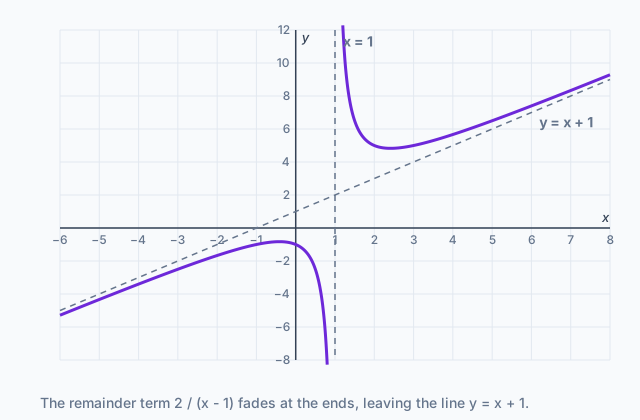 Tap to open the picture full size
Part 1 Think first
Same function, which form?
Guess before you learn. A wrong guess still makes the answer stick.
Predict first
and are the same function. You want to know where its graph crosses the -axis. Which form gets you there faster?
In short. The same polynomial or rational function can be written in several equivalent forms, and each form makes different features easy to read.
- Factored form shows real zeros, so it reveals -intercepts, asymptotes, holes, domain and range; standard form shows the leading term, so it reveals end behavior.
- Polynomial long division rewrites with the degree of less than the degree of , and the quotient gives a slant asymptote.
- The binomial theorem expands using one row of Pascal's triangle.
Part 2 Learn it
Four short ideas, each checked as you go
2a. Factored form and standard form
Factored form shows the real zeros directly. For a polynomial, that means the -intercepts. For a rational function, the factors of the numerator and the denominator together reveal the -intercepts, the vertical asymptotes, the holes, the domain, and often the range.
Standard form, with the terms written from the highest power down, shows the leading term, which reveals the end behavior. For a rational function in standard form, the two leading terms give the horizontal or slant asymptote right away (1.7). The constant term of a polynomial is its -intercept.
On the exam, a question often hands you one form and asks about a feature the other form shows. Rewriting is the first step.
Quick check · Sort it
No calculator. Tap a question about a polynomial or rational function, then the form that answers it most directly.
Factored form
Standard form
2b. Polynomial long division
Dividing polynomials works like long division of numbers. Divide the leading term, multiply back, subtract, bring down, repeat, until what is left has a smaller degree than the divisor.
If is divided by , the result is written
where is the quotient, is the remainder, and the degree of is less than the degree of . Dividing by :
- ; subtract to leave
- ; subtract to leave
- ; subtract to leave 9
So .
Quick check · Calculate
No calculator. Divide by using long division. What is the remainder?
2c. Slant asymptotes by division
Long division is how you find the equation of a slant asymptote. When the numerator's degree is exactly one more than the denominator's, divide:
As increases or decreases without bound, shrinks toward zero, so the graph gets close to the line . That line is the slant asymptote.
In 1.7 the quotient of the leading terms, , only told you the slope. Division gives the whole line, including where it crosses the -axis.
Quick check · Multiple choice
No calculator. What is the slant asymptote of the graph of ?
2d. The binomial theorem
Multiplying out by hand gets long fast. The binomial theorem expands using row of Pascal's triangle, where each entry is the sum of the two above it:
The row for is 1, 4, 6, 4, 1. The powers of count down from 4 while the powers of count up from 0. For the five terms are , , , and , so
The powers of are the step people skip.
Quick check · Calculate
No calculator. Row 5 of Pascal's triangle is 1, 5, 10, 10, 5, 1. What is the coefficient of in the expansion of ?
Part 3 Watch it done
Finding a slant asymptote
Watch each step, then do the last one yourself.
Rewrite with long division, and find its slant asymptote.
Step 1 · Fill the gap
Write the numerator as , so every power has a column.
Step 2 · First quotient term
. Subtract : what is left is .
Why this step?
Why write the at all?
Subtracting produces an term, and it needs a column to land in. Without the placeholder it is easy to subtract from the 1 instead and get the wrong remainder.
Your step · Calculate
No calculator. Finish it. What is the remainder?
Part 4 Try it
The form that answers the question
Try it · Decide and justify
No calculator. A theater's ticket revenue, in hundreds of dollars, at a price of dollars is . Two equivalent forms are the factored form, , and the vertex form, . The manager asks what price gives the most revenue. Which form answers that directly?
Which reason supports your answer?
Part 5 Explain it
Write it the way the exam asks
Nothing you type leaves this page.
Free response is 37.5% of the exam score. This one is shaped like Question 1, Function Concepts.
Free-response practice · Question 1 style
Graphing calculator required. Let . Use long division to rewrite as a polynomial plus a remainder over . Then explain how the result gives the equation of the slant asymptote of the graph of .
Model answer
Dividing: , and . Then , and . So . As increases or decreases without bound, gets arbitrarily close to 0, so the outputs of get close to . The slant asymptote is .
Score your own answer. This is a self-check, not a grade. Tick each point your answer makes.
Part 6 Check yourself
An open box, two ways
The two case questions use the same data. Answer them from the two forms.
A packaging student cuts a square of side inches from each corner of a 20 inch by 12 inch sheet of cardboard and folds up the sides to make an open box. Its volume, in cubic inches, can be written two ways.
| Form | |
|---|---|
| Factored | |
| Standard |
Case question 1 · Calculate
No calculator. The cut cannot be so large that a side of the box has no length. The domain of the model is . What is ?
Case question 2 · Multiple choice
No calculator. Which statement about the two forms is correct?
The rest stand on their own and do not use the case.
Check yourself · Spot the error
No calculator. A student expands with row 3 of Pascal's triangle, 1, 3, 3, 1. Tap the first line with a mistake.
Check yourself · Fill the statement
No calculator. Tap a blank, then tap a word.
When is divided by , , where is the , is the , and the degree of is the degree of .
Part 7 Keep it
Bring back earlier ideas
Pulling an older idea back up is what makes it last.
From 1.10 Rational Functions and Holes · Calculate
No calculator. The graph of has a hole at . What is the -coordinate of the hole?
From 1.4 Polynomial Functions and Rates of Change · Match
No calculator. Let . Tap a term, then the part of it names.
In three lines
- Factored form reveals zeros, intercepts, asymptotes, holes and domain; standard form reveals the leading term and end behavior.
- Long division writes with the degree of less than the degree of , and its quotient is the slant asymptote.
- The binomial theorem expands with row of Pascal's triangle.
Vocabulary
- Factored form
- A polynomial or rational function written as a product of factors, which shows its real zeros.
- Standard form
- A polynomial written from its highest power down, which shows its leading term.
- Polynomial long division
- Dividing by to get , with the degree of less than the degree of .
- Quotient and remainder
- The polynomial and the leftover from long division.
- Binomial theorem
- A rule for expanding using row of Pascal's triangle.
- Pascal's triangle
- A triangle of numbers in which each entry is the sum of the two above it; its rows give binomial coefficients.
Course alignment, for teachers
AP Precalculus topic 1.11, Unit 1: Polynomial and Rational Functions.
- Skill 1.B: Express functions, equations, or expressions in analytically equivalent forms that are useful in a given mathematical or applied context.
- Skill 3.B: Apply numerical results in a given mathematical or applied context.
This lesson maps all 6 essential knowledge statements of the topic to the part that teaches each one: 6 are checked by a scored question. The map is in the lesson file.