Unit 1 · Topic 1.9 · about 25 minutes · 7 parts · 11 scored checks, 2 of them multiple choice
Rational Functions and Vertical Asymptotes
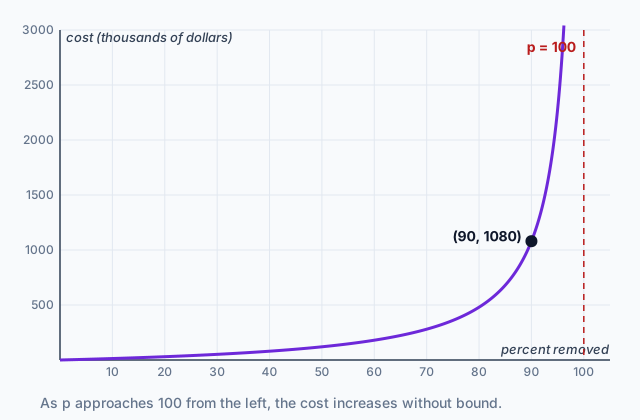 Tap to open the picture full size
Part 1 Think first
The last bit of pollution
Guess before you learn. A wrong guess still makes the answer stick.
Predict first
A factory's cost, in thousands of dollars, to remove percent of a pollutant from its smokestack is modeled by . Removing 90% costs 1,080 thousand dollars. What does the model say about removing 100%?
In short. A rational function has a vertical asymptote at when is a real zero of the denominator that the numerator does not cancel.
- If is a zero of the denominator and not of the numerator, there is a vertical asymptote at .
- If is a zero of both, there is still a vertical asymptote when its multiplicity in the denominator is greater than in the numerator.
- Near the asymptote the denominator is close to zero, so the outputs increase or decrease without bound, written with one-sided limits such as .
Part 2 Learn it
Three short ideas, each checked as you go
2a. Where a vertical asymptote comes from
If is a real zero of the denominator of a rational function , and not a zero of the numerator, then the graph of has a vertical asymptote at .
The reason is the size of the quotient. Near the denominator is very close to zero while the numerator is not, and dividing a number that is not close to zero by a number that is gives an output of huge size.
For , the denominator is zero at 0 and 4, and the numerator is zero at neither, so there are vertical asymptotes at and . Factor the denominator first; its zeros are your candidates.
Quick check · Calculate
No calculator. The graph of has exactly one vertical asymptote, . What is ?
2b. When the numerator shares the zero
Sometimes makes both the numerator and the denominator zero. Then count multiplicities, the number of times each factor appears.
If the multiplicity of in the denominator is greater than its multiplicity in the numerator, there is still a vertical asymptote at . After cancelling, a factor is left on the bottom.
For , the zero 2 appears once on top and twice on the bottom. One factor cancels, leaving , so there is a vertical asymptote at .
If the numerator has at least as many copies, the factor cancels completely and leaves a hole instead. That is 1.10.
Quick check · Decide and justify
No calculator. Let . Does the graph of have a vertical asymptote at ?
Which reason supports your answer?
2c. Approaching from each side
Near a vertical asymptote , the denominator gets arbitrarily close to zero, so the outputs increase or decrease without bound. The two sides can go different ways, so each gets its own one-sided limit:
- is for inputs near and greater than .
- is for inputs near and less than .
To decide the sign, check each factor just to one side. For with slightly more than 2, the top is near 3 and the bottom is a tiny positive number, so . Just left of 2 the bottom is a tiny negative number, so that side goes to .
Quick check · Multiple choice
No calculator. Let . Which statement is true?
Part 3 Watch it done
How expensive is the last percent?
Watch each step, then do the last one yourself.
Use , the cost in thousands of dollars to remove percent of the pollutant, for . Describe what happens near , and find the cost of removing 99%.
Step 1 · Find the asymptote
The denominator is zero at , and the numerator there is , not zero. So is a vertical asymptote.
Step 2 · Which side, which direction
Only makes sense here. Just left of 100, the top is near 12,000 and the bottom is a tiny positive number, so .
Why this step?
Why does the cost grow so fast at the end and not at the start?
The cost divides by , the percent still left to remove. Going from 90% to 99% shrinks that from 10 to 1, which divides by a number ten times smaller. Near the asymptote, tiny changes in the denominator make huge changes in the output.
Step 3 · One value to compare
At 90%: thousand dollars.
Your step · Calculate
No calculator. Finish it. What does removing 99% cost, in thousands of dollars?
thousand dollars
Part 4 Try it
Asymptotes, holes and zeros together
Try it · Sort it
No calculator. Each function has a denominator that is zero at . Tap a function, then what its graph has at .
Vertical asymptote at x = 2
No vertical asymptote at x = 2
Part 5 Explain it
Write it the way the exam asks
Nothing you type leaves this page.
Free response is 37.5% of the exam score. This one is shaped like Question 1, Function Concepts.
Free-response practice · Question 1 style
Graphing calculator required. Let and . Both denominators are zero at . Explain why the graph of has a vertical asymptote at but the graph of does not.
Model answer
Factored, . The zero 3 has multiplicity 1 in the numerator and 1 in the denominator, so the factor cancels completely and has no vertical asymptote at ; its only one is . For , the zero 3 has multiplicity 2 in the denominator, greater than 1 in the numerator, so a factor is left on the bottom and has a vertical asymptote at .
Score your own answer. This is a self-check, not a grade. Tick each point your answer makes.
Part 6 Check yourself
Close to an asymptote
The two case questions use the same data. Answer them from the table.
The table gives values of for inputs close to 4.
| 3.9 | −78 |
|---|---|
| 3.99 | −798 |
| 4.01 | 802 |
| 4.1 | 82 |
Case question 1 · Multiple choice
No calculator. Which pair of statements matches the table?
Case question 2 · Calculate
No calculator. Continue the table: what is ?
The rest stand on their own and do not use the case.
Check yourself · Fill the statement
No calculator. Tap a blank, then tap a word.
In the notation , the inputs are close to 4 and than 4. Near a vertical asymptote the is close to zero, so the outputs grow without bound.
Check yourself · Spot the error
No calculator. A student finds the vertical asymptotes of . Tap the line with the mistake.
Part 7 Keep it
Bring back earlier ideas
Pulling an older idea back up is what makes it last.
From 1.8 Rational Functions and Zeros · Calculate
No calculator. The function has exactly one real zero. What is it?
From 1.6 Polynomial Functions and End Behavior · Match
No calculator. Tap a statement in limit notation, then the words that say the same thing.
In three lines
- A real zero of the denominator that is not a zero of the numerator gives a vertical asymptote.
- A shared zero still gives one when its multiplicity in the denominator is greater than in the numerator.
- Near the outputs increase or decrease without bound, and and describe each side.
Vocabulary
- Vertical asymptote
- A line near which the outputs of a function increase or decrease without bound.
- One-sided limit
- What the outputs do as inputs approach from one side: from the right, from the left.
- Multiplicity
- The number of times a factor appears; compared top and bottom, it decides between an asymptote and a hole.
Course alignment, for teachers
AP Precalculus topic 1.9, Unit 1: Polynomial and Rational Functions.
- Skill 2.A: Identify information from graphical, numerical, analytical, and verbal representations to answer a question or construct a model, with and without technology.
This lesson maps all 2 essential knowledge statements of the topic to the part that teaches each one: 2 are checked by a scored question. The map is in the lesson file.