Unit 1 · Topic 1.12 · about 30 minutes · 7 parts · 11 scored checks, 2 of them multiple choice
Transformations of Functions
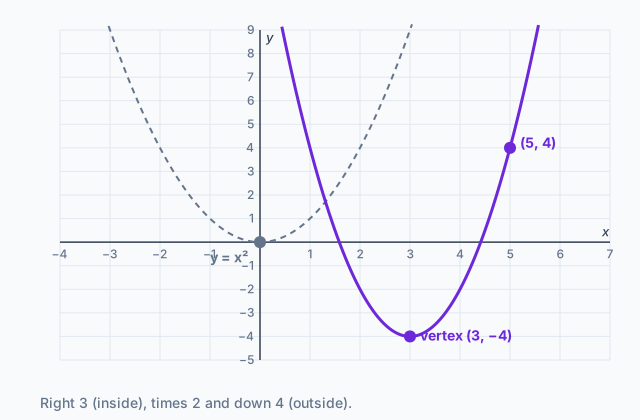 Tap to open the picture full size
Part 1 Think first
Which way does it move?
Guess before you learn. A wrong guess still makes the answer stick.
Predict first
The graph of is known. A new function is . Compared with the graph of , the graph of is moved
In short. A transformation builds a new function from an old one by adding to or multiplying the input or the output, which moves, stretches or reflects the graph.
- translates the graph vertically by ; translates it horizontally by .
- dilates vertically by a factor of , reflecting over the -axis if ; dilates horizontally by a factor of , reflecting over the -axis if .
- Transformations combine, taking a preimage to an image, and the domain and range can change along the way.
Part 2 Learn it
Three short ideas, each checked as you go
2a. Translations: adding
An additive transformation adds a constant.
- adds to every output, a vertical translation of the graph of by units: up if , down if .
- adds to every input before acts, a horizontal translation by units.
The second one is the trap. reaches each output of when is 4 less than before, so the graph moves 4 units left. moves it 4 units right.
In the diagram, the parent has its vertex at . Replacing with and then subtracting 4 moves the vertex to .
Quick check · Match
No calculator. Tap a function, then how its graph compares with the graph of .
2b. Dilations and reflections: multiplying
A multiplicative transformation multiplies by a constant.
- , with , multiplies every output by : a vertical dilation by a factor of . If , it also reflects the graph over the -axis.
- , with , multiplies every input by : a horizontal dilation by a factor of . If , it also reflects the graph over the -axis.
Again the input change works the opposite way. reaches when , so every point moves halfway to the -axis: the graph is squeezed horizontally by a factor of . A point on becomes on , and on .
Quick check · Calculate
No calculator. The point is on the graph of . The corresponding point on the graph of is . What is ?
2c. Combining, and what happens to domain and range
Transformations combine. In , the parent is translated right 3, dilated vertically by 2, and translated down 4. The set of points before the transformations is the preimage; the set after is the image. Each point of the preimage has a partner in the image: goes to .
The domain and range can change. The range of is . Multiplying by flips that to , and adding 5 moves it to . If is only defined for , then is defined for : horizontal changes move the domain, vertical changes move the range.
Quick check · Multiple choice
No calculator. Let , whose range is . What is the range of ?
Part 3 Watch it done
Building a transformed function
Watch each step, then do the last one yourself.
Start from . Write a function whose graph has its vertex at and is dilated vertically by a factor of 2. Then find .
Step 1 · Move the vertex sideways
A vertex at needs a horizontal translation by 3, which is .
Step 2 · Dilate
Multiply the outputs by 2: . The vertex is still at , because .
Why this step?
Why dilate before translating down, and not after?
If you subtract 4 first and then multiply by 2, the 4 is doubled too: , which puts the vertex at . Translating last keeps the vertex where you put it.
Step 3 · Move it down
Subtract 4: . This is the solid graph in the diagram.
Your step · Calculate
No calculator. Finish it. What is ?
Part 4 Try it
Move the sliders
Try it · Calculate
No calculator. In the lab, choose the rational family, , whose vertical asymptote is . With , and , what value of puts the vertical asymptote of at ? Check your answer with the slider.
Part 5 Explain it
Write it the way the exam asks
Nothing you type leaves this page.
Free response is 37.5% of the exam score. This one is shaped like Question 1, Function Concepts.
Free-response practice · Question 1 style
Graphing calculator required. A function has domain and range . Let . Describe the two transformations that take the graph of to the graph of , and give the domain and range of .
Model answer
is a horizontal dilation by a factor of , so every input is halved: the domain becomes , because must be between and 6. Subtracting 3 is a vertical translation down 3 units, so the range becomes . The horizontal dilation does not change the range, and the vertical translation does not change the domain.
Score your own answer. This is a self-check, not a grade. Tick each point your answer makes.
Part 6 Check yourself
Transforming a table
The two case questions use the same data. Answer them from the table.
Selected values of a function are below. Let .
| −2 | 3 |
|---|---|
| 0 | −1 |
| 2 | 5 |
| 4 | 0 |
Case question 1 · Calculate
No calculator. What is ?
Case question 2 · Multiple choice
No calculator. The point is on the graph of . Which point is its image on the graph of ?
The rest stand on their own and do not use the case.
Check yourself · Sort it
No calculator. Tap a transformation of , then whether it changes the graph vertically or horizontally.
Vertically
Horizontally
Check yourself · Decide and justify
No calculator. The graph of passes through . Which function's graph passes through ?
Which reason supports your answer?
Part 7 Keep it
Bring back earlier ideas
Pulling an older idea back up is what makes it last.
From 1.11 Equivalent Representations of Polynomial and Rational Expressions · Fill the statement
No calculator. Tap a blank, then tap a word.
When is divided by , , where is the , is the , and the degree of is the degree of .
From 1.8 Rational Functions and Zeros · Put it in order
No calculator. Tap the steps for solving in the order you do them.
In three lines
- Adding outside translates vertically by ; adding inside translates horizontally by .
- Multiplying outside by dilates vertically by ; multiplying inside by dilates horizontally by ; a negative sign reflects.
- Transformations combine from preimage to image, and they can change the domain and the range.
Vocabulary
- Additive transformation
- Adding a constant to the output, , or to the input, .
- Multiplicative transformation
- Multiplying the output, , or the input, , by a nonzero constant.
- Translation
- A slide of the graph: vertical by for , horizontal by for .
- Dilation
- A stretch or squeeze: vertical by for , horizontal by for .
- Reflection
- A flip over the -axis when , or over the -axis when .
- Preimage and image
- The set of points before a transformation and the set after it.
Course alignment, for teachers
AP Precalculus topic 1.12, Unit 1: Polynomial and Rational Functions.
- Skill 1.C: Construct new functions, using transformations, compositions, inverses, or regressions, that may be useful in modeling contexts, criteria, or data, with and without technology.
- Skill 3.A: Describe the characteristics of a function with varying levels of precision, depending on the function representation and available mathematical tools.
This lesson maps all 6 essential knowledge statements of the topic to the part that teaches each one: 6 are checked by a scored question. The map is in the lesson file.