Unit 1 · Topic 1.4 · about 30 minutes · 7 parts · 12 scored checks, 2 of them multiple choice
Polynomial Functions and Rates of Change
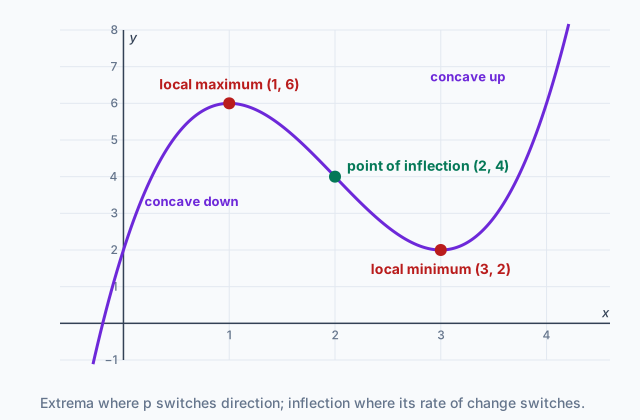 Tap to open the picture full size
Part 1 Think first
The busiest hour at the library
Guess before you learn. A wrong guess still makes the answer stick.
Predict first
A library is busy at 11 a.m., quiet over lunch, and busier than ever after school lets out. A librarian says, "11 a.m. is our peak." Is she right?
In short. A polynomial function is a sum of terms with whole-number powers, and its graph turns where it switches between increasing and decreasing.
- The degree is the highest power, the leading term is the term with that power, and the leading coefficient is its coefficient.
- Switching between increasing and decreasing, or an included endpoint of a restricted domain, gives a local maximum or minimum. The greatest or least of all outputs is global.
- Between two distinct real zeros there is always a local maximum or minimum, and a point of inflection is where the rate of change switches between increasing and decreasing.
Part 2 Learn it
Four short ideas, each checked as you go
2a. What makes a polynomial
A nonconstant polynomial function is any function that can be written as
where is a positive integer, every is a real number, and is not zero.
- The degree is , the highest power of .
- The leading term is , and the leading coefficient is .
The terms do not have to be written in order. In , the highest power is 4, so the degree is 4 and the leading term is , even though it is written third. A nonzero constant such as also counts as a polynomial, of degree zero.
Quick check · Match
No calculator. Let . Tap a term, then the part of it names.
2b. Local and global maximums and minimums
Where a polynomial switches from increasing to decreasing, it has a local maximum: an output larger than the outputs nearby. Where it switches from decreasing to increasing, it has a local minimum. If the domain is restricted to an interval, an included endpoint also gives a local maximum or minimum.
A local maximum that is greater than every other output is the global, or absolute, maximum. A local minimum that is less than every other output is the global minimum.
A polynomial of even degree always has either a global maximum or a global minimum. For a quadratic, that global value is at the vertex, which for is at .
Quick check · Calculate
No calculator. A ball is thrown upward from a 5-foot platform. Its height is feet after seconds. What is the global maximum height of the ball, in feet?
2c. Between two zeros, a turn
Suppose a nonconstant polynomial has real zeros at and . Starting at height 0 and ending at height 0, its graph cannot only rise or only fall in between. It has to turn somewhere.
So between every two distinct real zeros of a nonconstant polynomial there is at least one input value where it has a local maximum or a local minimum. A polynomial with zeros at , 1 and 5 has at least one turn between and 1 and at least one between 1 and 5, so at least two local extrema. It may have more.
Quick check · Decide and justify
No calculator. A nonconstant polynomial has and . Could be increasing over the whole interval from to ?
Which reason supports your answer?
2d. Points of inflection
A local maximum is where the function switches between increasing and decreasing. A point of inflection is where the function's rate of change switches between increasing and decreasing.
That is the same as the place where the graph switches from concave up to concave down, or from concave down to concave up. In the diagram, is concave down until and concave up after, so is a point of inflection. It is where the graph is falling most steeply: the rates of change have stopped getting more negative and start getting less negative.
Quick check · Multiple choice
No calculator. Which description fits a point of inflection of a polynomial function?
Part 3 Watch it done
Finding every extreme value on a restricted domain
Watch each step, then do the last one yourself.
Let on the restricted domain . A graph shows that increases until , decreases from to , then increases. Find every local maximum and minimum, and the global ones.
Step 1 · Where it turns
switches from increasing to decreasing at , so is a local maximum. It switches back at , so is a local minimum.
Step 2 · The endpoints
The domain includes its endpoints, and an endpoint can be a local extremum too. is increasing as it reaches , so is a local maximum.
Why this step?
Why is the local maximum at not the global maximum?
A global maximum has to be greater than every other output on the domain. is greater than the outputs near it, but is greater still, so the global maximum is 22, at the endpoint .
Step 3 · The left end
increases from to , so the left endpoint is a local minimum as well. The global minimum is the smaller of the two local minimums.
Your step · Calculate
No calculator. Finish it. What is the global minimum value of on ?
Part 4 Try it
What must be true?
Try it · Sort it
No calculator. A polynomial has degree 4 and real zeros at exactly , and . Tap each statement, then say whether it must be true or only might be true.
Must be true
Might be true, might not
Part 5 Explain it
Write it the way the exam asks
Nothing you type leaves this page.
Free response is 37.5% of the exam score. This one is shaped like Question 1, Function Concepts.
Free-response practice · Question 1 style
Graphing calculator required. A polynomial of degree 4 has real zeros at , , and . Explain why has at least three local extrema, and why must have a global maximum or a global minimum.
Model answer
Between every two distinct real zeros of a nonconstant polynomial there is at least one local maximum or minimum. The four zeros leave three gaps, from to 0, from 0 to 2, and from 2 to 6, so has at least one local extremum in each, at least three in all. Because the degree, 4, is even, must have a global maximum or a global minimum.
Score your own answer. This is a self-check, not a grade. Tick each point your answer makes.
Part 6 Check yourself
A day at the library
The two case questions use the same data. Answer them from the table and the description.
A library models the number of people inside, in tens, hours after it opens at 9 a.m., with for . The model increases until , decreases from to , then increases.
| (hours) | |
|---|---|
| 0 | 10 |
| 1 | 26 |
| 2 | 30 |
| 3 | 28 |
| 4 | 26 |
| 5 | 30 |
| 6 | 46 |
Case question 1 · Calculate
No calculator. What is the global minimum value of on , in tens of people?
Case question 2 · Multiple choice
No calculator. Over consecutive one-hour intervals, the average rates of change of are 16, 4, , , 4 and 16. At which time does have a point of inflection?
The rest stand on their own and do not use the case.
Check yourself · Fill the statement
No calculator. Let . Tap a blank, then tap an answer.
The degree of is and its leading coefficient is .
Check yourself · Spot the error
No calculator. A student reasons about a polynomial with real zeros at , and . Tap the line with the mistake.
Part 7 Keep it
Bring back earlier ideas
Pulling an older idea back up is what makes it last.
From 1.3 Rates of Change in Linear and Quadratic Functions · Match
No calculator. Each list gives the outputs of a function at . Tap a list, then the kind of function it could come from.
From 1.1 Change in Tandem · Decide and justify
No calculator. Let for every real number , and let . Are and equal functions?
Which reason supports your answer?
In three lines
- Degree, leading term and leading coefficient all come from the highest power of .
- Turns and included endpoints give local extrema; the greatest and least of all outputs are global, and even degree guarantees one of them.
- There is a turn between any two distinct real zeros, and a point of inflection is where the rate of change switches direction.
Vocabulary
- Polynomial function
- A function equivalent to with a positive integer and , or a nonzero constant.
- Degree
- The highest power of in a polynomial; a nonzero constant has degree zero.
- Leading term and leading coefficient
- The term with the highest power, , and its coefficient, .
- Local maximum or minimum
- An output greater or less than the outputs nearby, where the function switches direction or at an included endpoint.
- Global maximum or minimum
- An output greater or less than every other output of the function; also called absolute.
- Point of inflection
- A point where the rate of change switches between increasing and decreasing, so the concavity changes.
Course alignment, for teachers
AP Precalculus topic 1.4, Unit 1: Polynomial and Rational Functions.
- Skill 2.A: Identify information from graphical, numerical, analytical, and verbal representations to answer a question or construct a model, with and without technology.
- Skill 3.A: Describe the characteristics of a function with varying levels of precision, depending on the function representation and available mathematical tools.
This lesson maps all 5 essential knowledge statements of the topic to the part that teaches each one: 5 are checked by a scored question. The map is in the lesson file.