Unit 1 · Topic 1.5 · about 30 minutes · 7 parts · 12 scored checks, 1 of them multiple choice
Polynomial Functions and Complex Zeros
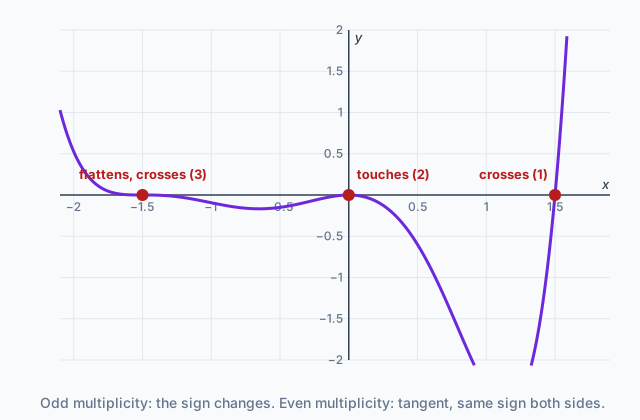 Tap to open the picture full size
Part 1 Think first
How many zeros can you see?
Guess before you learn. A wrong guess still makes the answer stick.
Predict first
The polynomial has degree 3. How many times does its graph meet the -axis?
In short. A zero of a polynomial is a number with , and for a real number that happens exactly when is a factor of .
- A factor repeated times gives a zero of multiplicity , and a polynomial of degree has exactly complex zeros counting multiplicity. Non-real zeros come in conjugate pairs.
- At a real zero of even multiplicity the graph is tangent to the -axis and the output keeps its sign; real zeros mark the endpoints of the intervals that solve an inequality.
- The degree is the first round of successive differences that is constant. Even functions satisfy and odd functions satisfy .
Part 2 Learn it
Four short ideas, each checked as you go
2a. Zeros, factors and intercepts
If is a complex number and , then is a zero of the polynomial function , and a root of the equation .
For a real number , the link to factors goes both ways: is a linear factor of if and only if is a zero of . So has zeros , 1 and 6, and if you learn that for some polynomial, then is one of its factors.
Every real zero is also an -intercept of the graph of , at the point .
In this course, factoring by hand means taking out a common factor and using the rules for quadratics. A polynomial that needs more than that is given to you already factored, or you find its zeros with technology.
Quick check · Fill the statement
No calculator. A polynomial has . Tap a blank, then tap an answer.
Because , the expression is a factor of , and the graph of has an -intercept at .
2b. Multiplicity and the shape at a zero
If the linear factor appears times, the zero has multiplicity . In , the zero has multiplicity 2 and the zero 1 has multiplicity 1.
Multiplicity shows on the graph:
- Even multiplicity: the outputs have the same sign on both sides of . The graph touches the -axis and turns back, tangent to the axis at .
- Odd multiplicity: the sign changes, so the graph crosses. With multiplicity 3 or more it flattens against the axis as it crosses.
The diagram at the top shows all three behaviors on one graph.
Quick check · Sort it
No calculator. Let . Tap each zero, then what the graph does there.
Crosses the x-axis
Touches the x-axis and turns back
2c. Counting complex zeros
A polynomial function of degree has exactly complex zeros when you count multiplicities. Complex numbers include the real numbers, so real zeros count too.
If the polynomial has real coefficients, its non-real zeros come in conjugate pairs: if is a zero, then is a zero as well.
Put the two facts together to count. A degree 4 polynomial with real coefficients and zeros and 1, with 1 of multiplicity 2, has used up , its partner , and two copies of 1. That is all four zeros, so it has no others.
Quick check · Calculate
No calculator. A polynomial of degree 5 with real coefficients has and among its zeros. How many real zeros does it have, counting multiplicity?
2d. Even and odd functions
An even function is symmetric over the -axis, the line . In symbols, for every in the domain.
An odd function is symmetric about the origin, the point . In symbols, .
For a single term with and , the exponent decides: an even gives an even function, and an odd gives an odd one. Most polynomials are neither. To test one, replace with and compare with and with . For , , which matches neither, so is neither even nor odd.
Quick check · Sort it
No calculator. Tap a function, then tap its kind.
Even
Odd
Neither
Part 3 Watch it done
How many layers of oranges?
Watch each step, then do the last one yourself.
A grocer stacks oranges in a pyramid with square layers. is the total number of oranges in a pyramid with layers:
, , , , , .
If is a polynomial function of , what is its degree?
Step 1 · First differences
Subtract consecutive outputs: , then 9, 16, 25 and 36. They are not constant, so is not linear.
Step 2 · Second differences
Subtract consecutive first differences: 5, 7, 9 and 11. Still not constant, so is not quadratic.
Why this step?
Why do the inputs have to be equally spaced for this to work?
The test compares output changes over equal input steps. If some steps were longer than others, the differences would grow just because the steps did, and the pattern would say nothing about the degree.
Step 3 · Third differences
Subtract consecutive second differences: , and .
Your step · Calculate
No calculator. Finish it. What is the degree of the polynomial ?
Part 4 Try it
Read zeros from a factored form
Try it · Calculate
No calculator. A designer models the height of a toy roller coaster track above the floor, in centimeters, decimeters from the start, with for . At one point between the start and the end, the track comes down to the floor and rises again without going below it. What is there?
Part 5 Explain it
Write it the way the exam asks
Nothing you type leaves this page.
Free response is 37.5% of the exam score. This one is shaped like Question 1, Function Concepts.
Free-response practice · Question 1 style
Graphing calculator required. A polynomial of degree 5 has real coefficients. Two of its zeros are and 3, and 3 has multiplicity 2. Explain how many real zeros has, counting multiplicity, and describe what the graph of does at .
Model answer
A degree 5 polynomial has exactly 5 complex zeros counting multiplicity. Because the coefficients are real, is also a zero, so there are two non-real zeros. The zero 3 counts twice, which makes four zeros, so there is exactly one more, and it must be real, since a non-real zero would bring a partner. So has 3 real zeros counting multiplicity. Because 3 has even multiplicity, the graph is tangent to the -axis at and the outputs have the same sign on both sides.
Score your own answer. This is a self-check, not a grade. Tick each point your answer makes.
Part 6 Check yourself
When does a product line pay off?
The two case questions use the same data. Answer them from the model and the table.
A small company models its monthly profit, in thousands of dollars, from making hundred units of a product: for . Below 200 units it cannot cover its costs, and above 900 it has to pay for overtime.
| Interval | Test value | Value of |
|---|---|---|
| 1 | −4, negative | |
| 5 | 30, positive | |
| 10 | −40, negative |
Case question 1 · Multiple choice
No calculator. For which production levels in the domain is ?
Case question 2 · Calculate
No calculator. What is the greatest production level, in hundreds of units, at which the company at least breaks even, ?
The rest stand on their own and do not use the case.
Check yourself · Decide and justify
No calculator. A polynomial with real coefficients has degree 4, and its zeros include and 1. Must also be a zero of ?
Which reason supports your answer?
Check yourself · Spot the error
No calculator. A student checks whether is odd. Tap the line with the mistake.
Part 7 Keep it
Bring back earlier ideas
Pulling an older idea back up is what makes it last.
From 1.4 Polynomial Functions and Rates of Change · Fill the statement
No calculator. Let . Tap a blank, then tap an answer.
The degree of is and its leading coefficient is .
A weather service launches a balloon. is its altitude in meters minutes after launch.
| (minutes) | (meters) |
|---|---|
| 0 | 0 |
| 10 | 1800 |
| 20 | 3300 |
| 30 | 4500 |
| 40 | 5400 |
From 1.2 Rates of Change · Calculate
No calculator. What is the average rate of change of from to , in meters per minute?
In three lines
- is a zero when ; for real that means is a factor and is an -intercept.
- Degree means complex zeros counting multiplicity, non-real ones in conjugate pairs; even multiplicity makes the graph tangent to the axis.
- The degree is the first round of constant differences, and even and odd functions are tested with .
Vocabulary
- Zero
- A number , real or complex, with ; also called a root of .
- Linear factor
- A factor ; for real it is a factor exactly when is a zero.
- Multiplicity
- The number of times a linear factor is repeated, and so the number of times the zero counts.
- Complex conjugate
- The partner of ; non-real zeros of a polynomial with real coefficients come in such pairs.
- Even function
- A function with , symmetric over the line .
- Odd function
- A function with , symmetric about the origin.
Course alignment, for teachers
AP Precalculus topic 1.5, Unit 1: Polynomial and Rational Functions.
- Skill 1.B: Express functions, equations, or expressions in analytically equivalent forms that are useful in a given mathematical or applied context.
- Skill 2.B: Construct equivalent graphical, numerical, analytical, and verbal representations of functions that are useful in a given mathematical or applied context, with and without technology.
This lesson maps all 8 essential knowledge statements of the topic to the part that teaches each one: 8 are checked by a scored question. The map is in the lesson file.