Unit 1 · Topic 1.6 · about 25 minutes · 7 parts · 11 scored checks, 3 of them multiple choice
Polynomial Functions and End Behavior
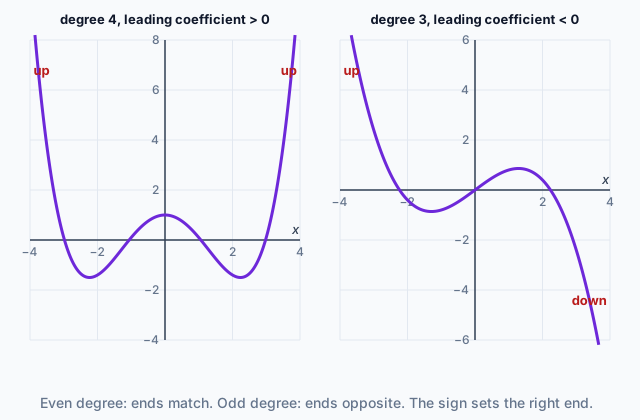 Tap to open the picture full size
Part 1 Think first
A model that runs out of road
Guess before you learn. A wrong guess still makes the answer stick.
Predict first
A biologist models a deer population with , where is years since a study began. It fits the first 40 years well. What does the model predict for the far future?
In short. The end behavior of a polynomial is what its outputs do as the inputs increase or decrease without bound, and the degree and sign of the leading term decide it.
- As increases or decreases without bound, a nonconstant polynomial's outputs either increase or decrease without bound.
- Limit notation records each end: says the outputs increase without bound as does.
- For inputs of large magnitude the leading term dominates every lower-degree term, so even degree sends both ends the same way and odd degree sends them opposite ways.
Part 2 Learn it
Three short ideas, each checked as you go
2a. Without bound, and how to write it
The end behavior of a function is what its outputs do as the inputs move far to the right or far to the left.
For a nonconstant polynomial there are only two possibilities at each end. As the input values increase without bound, the outputs either increase without bound or decrease without bound. The same is true as the inputs decrease without bound. A polynomial never levels off at its ends.
Limit notation says this in one line. The arrow means "approaches" and the symbol means "without bound":
- : as increases without bound, increases without bound.
- : as decreases without bound, decreases without bound.
The other two combinations are written the same way.
Quick check · Match
No calculator. Tap a statement in limit notation, then the words that say the same thing.
2b. The leading term takes over
Why can a single term decide the ends? Compare with its leading term, . At they are not close: , while . At , against . At , is 97.5% of .
As the inputs get large in size, the highest power grows faster than every lower power, so the leading term dominates the values of all lower-degree terms. The degree and the sign of the leading term therefore decide the end behavior.
A large coefficient on a lower term, or a large constant, can control the middle of the graph. It cannot control the ends.
Quick check · Multiple choice
No calculator. Which term decides the end behavior of ?
2c. Degree and sign
Two facts about the leading term give the whole picture.
- The sign of the leading coefficient sets the right end: positive sends the outputs up as , negative sends them down.
- The degree sets the left end compared with the right. Even degree: both ends go the same way, like . Odd degree: they go opposite ways, like .
In factored form, find the leading term by multiplying the leading terms of the factors. For that is : odd degree with a negative sign, so the left end rises and the right end falls.
Quick check · Sort it
No calculator. Tap a polynomial, then its end behavior.
Both ends up
Both ends down
Left down, right up
Left up, right down
Part 3 Watch it done
End behavior from a factored form
Watch each step, then do the last one yourself.
Describe the end behavior of with limit notation.
Step 1 · The leading term
Multiply the leading terms of the factors: . The degree is 6 and the leading coefficient is .
Step 2 · The right end
The leading coefficient is negative, so as increases without bound the outputs decrease without bound: .
Why this step?
Why can you ignore the zeros at 0, 4 and here?
The zeros shape the middle of the graph. For inputs of large magnitude the leading term dominates the values of all lower-degree terms, so it alone decides the ends.
Step 3 · Degree decides the left end
The degree is 6. Whether it is even or odd decides if the left end goes the same way as the right end or the opposite way.
Your step · Multiple choice
No calculator. Finish it. Which statement describes the left end of ?
Part 4 Try it
When a model stops making sense
Try it · Decide and justify
No calculator. A biologist's model of a deer population, with in years, fits the first 40 years of data. Should the biologist use it to predict the population after 100 years?
Which reason supports your answer?
Part 5 Explain it
Write it the way the exam asks
Nothing you type leaves this page.
Free response is 37.5% of the exam score. This one is shaped like Question 1, Function Concepts.
Free-response practice · Question 1 style
Graphing calculator required. Let . Describe the end behavior of using limit notation, and explain how you know, using the leading term.
Model answer
The leading term is the product of the leading terms of the factors: . For inputs of large magnitude it dominates all lower-degree terms. Its degree, 3, is odd and its coefficient, , is negative. So and .
Score your own answer. This is a self-check, not a grade. Tick each point your answer makes.
Part 6 Check yourself
Watching the leading term win
The two case questions use the same data. Answer them from the table.
Let . Going left, , and . Going right, , and . The table gives the ratio of to its leading term, , to four decimal places.
| −1000 | 1.0250 |
|---|---|
| −100 | 1.2500 |
| −10 | 3.4965 |
| 10 | −1.4965 |
| 100 | 0.7500 |
| 1000 | 0.9750 |
Case question 1 · Calculate
No calculator. As increases or decreases without bound, what number does the ratio approach?
Case question 2 · Multiple choice
No calculator. Which statement describes the left end of ?
The rest stand on their own and do not use the case.
Check yourself · Spot the error
No calculator. A student describes the end behavior of . Tap the line with the mistake.
Check yourself · Fill the statement
No calculator. Let . Tap a blank, then tap a word.
The end behavior of is decided by its term. That term has degree and a negative coefficient, so as increases without bound the outputs without bound.
Part 7 Keep it
Bring back earlier ideas
Pulling an older idea back up is what makes it last.
From 1.5 Polynomial Functions and Complex Zeros · Calculate
No calculator. A polynomial of degree 5 with real coefficients has and among its zeros. How many real zeros does it have, counting multiplicity?
From 1.3 Rates of Change in Linear and Quadratic Functions · Spot the error
No calculator. A student tests whether is linear, where , , and . Tap the line with the mistake.
In three lines
- At each end, a nonconstant polynomial's outputs increase or decrease without bound, written with limit notation.
- For inputs of large magnitude, the leading term dominates every lower-degree term.
- Sign of the leading coefficient sets the right end; even degree makes the left end match it, odd degree makes it opposite.
Vocabulary
- End behavior
- What a function's outputs do as its inputs increase or decrease without bound.
- Without bound
- Growing past any number you name, in the positive or negative direction.
- Limit notation
- A way to write end behavior, such as .
- Leading term
- The term with the highest power; it dominates the values of all lower-degree terms for inputs of large magnitude.
Course alignment, for teachers
AP Precalculus topic 1.6, Unit 1: Polynomial and Rational Functions.
- Skill 3.A: Describe the characteristics of a function with varying levels of precision, depending on the function representation and available mathematical tools.
This lesson maps all 3 essential knowledge statements of the topic to the part that teaches each one: 3 are checked by a scored question. The map is in the lesson file.