Unit 1 · Topic 1.7 · about 30 minutes · 7 parts · 11 scored checks, 2 of them multiple choice
Rational Functions and End Behavior
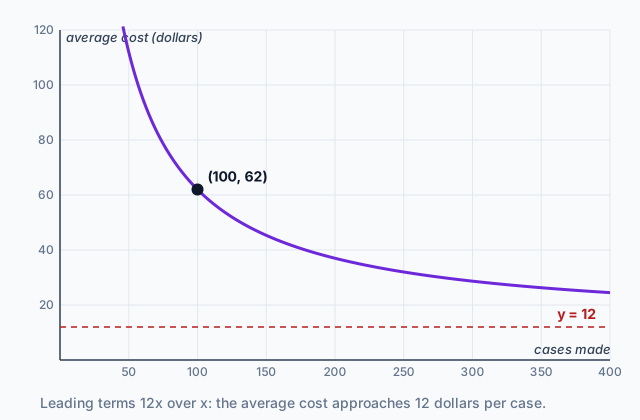 Tap to open the picture full size
Part 1 Think first
How cheap can a phone case get?
Guess before you learn. A wrong guess still makes the answer stick.
Predict first
A small business pays 5,000 dollars for a mold, then 12 dollars in materials for each phone case it makes. As it makes more and more cases, what happens to its average cost per case?
In short. A rational function is a quotient of two polynomial functions, and its end behavior comes from the quotient of their leading terms.
- If the numerator has the greater degree, the function behaves like a nonconstant polynomial at its ends; if that polynomial is linear, there is a slant asymptote.
- If the degrees are equal, the quotient of the leading terms is a constant , and there is a horizontal asymptote at .
- If the denominator has the greater degree, there is a horizontal asymptote at . Limit notation writes this as .
Part 2 Learn it
Three short ideas, each checked as you go
2a. A quotient of polynomials
A rational function is a quotient of two polynomial functions, . Its value at each input in its domain measures the size of the numerator compared with the size of the denominator: an output of 3 means the numerator is three times the denominator there.
As the inputs grow large in size, whichever polynomial has the greater degree dominates. And each polynomial is itself dominated by its leading term (1.6). So the end behavior of a rational function can be read from one quotient: leading term over leading term.
For the phone cases, . The leading terms are and , and .
Quick check · Fill the statement
No calculator. Tap a blank, then tap a word.
A rational function is a of two polynomial functions. For inputs of large magnitude, its end behavior comes from the quotient of their terms.
2b. Three cases
Compare the degrees of the numerator and the denominator.
- Numerator degree greater. The quotient of the leading terms is a nonconstant polynomial, and has its end behavior, increasing or decreasing without bound. If that polynomial is linear, the graph has a slant asymptote parallel to its line. For the quotient is , so the graph runs alongside a line of slope 1.
- Degrees equal. The quotient is a constant, and there is a horizontal asymptote at that constant. For it is .
- Denominator degree greater. The quotient is a constant over a nonconstant polynomial, which shrinks toward zero, so there is a horizontal asymptote at . For the quotient is .
Quick check · Sort it
No calculator. Tap a function, then its end behavior.
Horizontal asymptote y = 0
Horizontal asymptote at another constant
No horizontal asymptote
2c. Horizontal asymptotes in limit notation
When the graph of has a horizontal asymptote at , the outputs get arbitrarily close to , and stay arbitrarily close, as the inputs increase or decrease without bound. In limit notation:
For the phone cases, . At 1,000 cases the average is 17 dollars, and at 10,000 it is 12.50: closer every time, never below 12.
A graph may cross a horizontal asymptote in the middle. The asymptote describes the ends, not the whole graph.
Quick check · Calculate
No calculator. Let . Find if .
Part 3 Watch it done
The long-run cost of a phone case
Watch each step, then do the last one yourself.
The average cost per case, in dollars, of making phone cases is . What happens to the average cost as the number of cases increases without bound?
Step 1 · Check a few values
and . The average falls as more cases share the cost of the mold.
Step 2 · Compare degrees
Both the numerator, , and the denominator, , have degree 1. Equal degrees mean a horizontal asymptote.
Why this step?
Why can the 5000 be ignored at the ends, when it is the biggest number in the formula?
It is a constant. As increases without bound, grows past any constant, so , the mold's share per case, shrinks toward zero. Only the leading terms matter for large inputs.
Your step · Calculate
No calculator. Finish it. Find , in dollars, where .
dollars
Part 4 Try it
A medicine in the bloodstream
Try it · Decide and justify
No calculator. The concentration of a medicine in a patient's blood, in milligrams per liter, hours after a dose, is modeled by . In the long run, does the model predict the concentration levels off at a positive amount or fades toward zero?
Which reason supports your answer?
Part 5 Explain it
Write it the way the exam asks
Nothing you type leaves this page.
Free response is 37.5% of the exam score. This one is shaped like Question 2, Modeling a Non-Periodic Context.
Free-response practice · Question 2 style
Graphing calculator required. A school prints yearbooks. A setup fee of 1,800 dollars covers the design, and each book costs 9 dollars to print. The average cost per book for books is . Explain what happens to the average cost per book as the number of books increases without bound. Use limit notation, and say what the value means in context.
Model answer
The numerator and denominator both have degree 1, so the end behavior comes from the quotient of the leading terms, . So , and the graph has a horizontal asymptote at . In context, as the school prints more and more books the setup fee is spread across more of them, and the average cost per book gets closer and closer to the 9 dollar printing cost.
Score your own answer. This is a self-check, not a grade. Tick each point your answer makes.
Part 6 Check yourself
How long does a dose last?
The two case questions use the same data. Answer them from the model and the table.
The medicine model from Try it, , in milligrams per liter, hours after a dose. Values are rounded to three decimal places.
| (hours) | |
|---|---|
| 1 | 10.000 |
| 2 | 12.500 |
| 5 | 8.621 |
| 10 | 4.808 |
| 50 | 0.998 |
| 100 | 0.500 |
Case question 1 · Multiple choice
No calculator. Which statement describes the end behavior of ?
Case question 2 · Calculate
No calculator. For large , is close to the quotient of its leading terms, . Use it to estimate , in milligrams per liter.
The rest stand on their own and do not use the case.
Check yourself · Spot the error
No calculator. A student finds the horizontal asymptote of . Tap the first line with a mistake.
Check yourself · Match
No calculator. Tap a function, then what its graph does at the ends.
Part 7 Keep it
Bring back earlier ideas
Pulling an older idea back up is what makes it last.
From 1.6 Polynomial Functions and End Behavior · Fill the statement
No calculator. Let . Tap a blank, then tap a word.
The end behavior of is decided by its term. That term has degree and a negative coefficient, so as increases without bound the outputs without bound.
From 1.4 Polynomial Functions and Rates of Change · Multiple choice
No calculator. Which description fits a point of inflection of a polynomial function?
In three lines
- End behavior of a rational function comes from the quotient of the leading terms.
- Equal degrees give a horizontal asymptote at that constant; a larger denominator degree gives ; a larger numerator degree gives polynomial end behavior, with a slant asymptote when the quotient is linear.
- means the outputs get and stay arbitrarily close to .
Vocabulary
- Rational function
- A quotient of two polynomial functions, .
- Horizontal asymptote
- A line that the outputs get and stay arbitrarily close to as the inputs increase or decrease without bound.
- Slant asymptote
- A slanted line that the graph runs alongside at its ends, when the quotient of the leading terms is linear.
- Dominate
- To outgrow: for inputs of large magnitude, the polynomial of greater degree, and the leading term within a polynomial, outgrows the rest.
Course alignment, for teachers
AP Precalculus topic 1.7, Unit 1: Polynomial and Rational Functions.
- Skill 1.B: Express functions, equations, or expressions in analytically equivalent forms that are useful in a given mathematical or applied context.
- Skill 3.A: Describe the characteristics of a function with varying levels of precision, depending on the function representation and available mathematical tools.
This lesson maps all 6 essential knowledge statements of the topic to the part that teaches each one: 6 are checked by a scored question. The map is in the lesson file.