Unit 1 · Topic 1.8 · about 30 minutes · 7 parts · 11 scored checks, 3 of them multiple choice
Rational Functions and Zeros
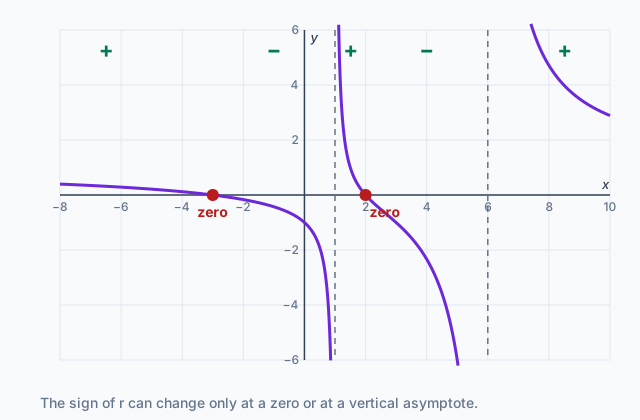 Tap to open the picture full size
Part 1 Think first
A zero that is not there
Guess before you learn. A wrong guess still makes the answer stick.
Predict first
Let . The numerator is zero at and at . Where is ?
In short. The real zeros of a rational function are the real zeros of its numerator that are also in its domain.
- A value that makes the denominator zero is not in the domain, so it cannot be a zero, even if it also makes the numerator zero.
- The real zeros of the numerator and of the denominator are the only places the sign of a rational function can change.
- To solve or , test the sign between those values; include the zeros of and never the zeros of the denominator.
Part 2 Learn it
Three short ideas, each checked as you go
2a. Zeros come from the numerator, inside the domain
A fraction is zero only when its top is zero and its bottom is not. So the real zeros of a rational function are the real zeros of the numerator that are in the domain of .
To find them, factor both polynomials. List the zeros of the numerator, then cross out any that also make the denominator zero.
For , the numerator is zero at and 4. But 4 also makes the denominator zero, so it is not in the domain. The only zero of is .
Quick check · Calculate
No calculator. The function has exactly one real zero. What is it?
2b. Where the sign can change
A rational function can change sign only where its numerator or its denominator is zero. Between those values, every factor keeps its sign, so the whole quotient does too.
That is how to solve a rational inequality such as . The real zeros of both polynomials split the number line into intervals. Each zero of the numerator is a possible endpoint of a solution interval, and each zero of the denominator is a possible asymptote at the edge of one.
Pick one test value in each interval, find the sign of there, and keep the intervals with the sign you want. The diagram at the top shows the pattern: the sign of changes only at its two zeros and its two vertical asymptotes.
Quick check · Put it in order
No calculator. Tap the steps for solving in the order you do them.
2c. Which endpoints belong
With or , the solution includes the places where , so the zeros of are included endpoints.
The zeros of the denominator are never included, because is not defined there. With the sign chart for :
- left of : , positive
- between and 2: , negative
- right of 2: , positive
The solution is or . The 2 is in, because . The is out, because does not exist.
Quick check · Multiple choice
No calculator. Which set of values solves ?
Part 3 Watch it done
Solving a rational inequality
Watch each step, then do the last one yourself.
Solve .
Step 1 · The values that split the line
The numerator is zero at and . The denominator is zero at . These split the number line into four intervals.
Step 2 · Test each interval
At : , negative. At : , positive. At : , negative. At : , positive.
Why this step?
Why do the endpoints and 3 belong to the solution, but 5 does not?
At and 3 the quotient equals 0, and includes 0. At 5 the denominator is zero, so the quotient is not defined there; 5 is an asymptote at the edge of a solution interval, never part of it.
Your step · Multiple choice
No calculator. Finish it. Which is the solution of ?
Part 4 Try it
When does a phone case cost 14 dollars or less?
Try it · Calculate
No calculator. From 1.7, the average cost per phone case for cases is dollars. The inequality rearranges to . What is the fewest cases the business can make so that the average cost is at most 14 dollars?
Part 5 Explain it
Write it the way the exam asks
Nothing you type leaves this page.
Free response is 37.5% of the exam score. This one is shaped like Question 1, Function Concepts.
Free-response practice · Question 1 style
Graphing calculator required. Let . A classmate says the zeros of are and , because those are the zeros of the numerator. Explain whether the classmate is correct, and give every real zero of .
Model answer
Factored, . The numerator is zero at 3 and , but the denominator is zero at 0 and 3, so 3 is not in the domain of and cannot be a zero. The classmate is not correct. The only real zero is , where the numerator is zero and the denominator is , not zero.
Score your own answer. This is a self-check, not a grade. Tick each point your answer makes.
Part 6 Check yourself
Reading a sign chart
The two case questions use the same data. Answer them from the sign chart.
Let , the function in the diagram at the top. A student built this sign chart for it.
| Interval | Test value | Sign of |
|---|---|---|
| positive | ||
| 0 | negative | |
| 1.5 | positive | |
| 4 | negative | |
| 7 | positive |
Case question 1 · Calculate
No calculator. The student found the sign for by evaluating . What is ?
Case question 2 · Multiple choice
No calculator. Which set of values solves ?
The rest stand on their own and do not use the case.
Check yourself · Spot the error
No calculator. A student solves . Tap the first line with a mistake.
Check yourself · Fill the statement
No calculator. Let . Tap a blank, then tap an answer.
Of the two zeros of the numerator, also makes the denominator zero, so the only real zero of is .
Part 7 Keep it
Bring back earlier ideas
Pulling an older idea back up is what makes it last.
From 1.7 Rational Functions and End Behavior · Sort it
No calculator. Tap a function, then its end behavior.
Horizontal asymptote y = 0
Horizontal asymptote at another constant
No horizontal asymptote
A small company models its monthly profit, in thousands of dollars, from making hundred units of a product: for . Below 200 units it cannot cover its costs, and above 900 it has to pay for overtime.
| Interval | Test value | Value of |
|---|---|---|
| 1 | −4, negative | |
| 5 | 30, positive | |
| 10 | −40, negative |
From 1.5 Polynomial Functions and Complex Zeros · Calculate
No calculator. What is the greatest production level, in hundreds of units, at which the company at least breaks even, ?
In three lines
- The real zeros of a rational function are the real zeros of its numerator that are in its domain.
- A rational function can change sign only at a zero of its numerator or its denominator.
- For or , test each interval, include the zeros of , and never include a zero of the denominator.
Vocabulary
- Zero of a rational function
- A real zero of the numerator that is in the domain, so the denominator is not zero there.
- Domain of a rational function
- Every real number except the real zeros of the denominator.
- Rational inequality
- An inequality such as or with a rational function .
- Sign chart
- A list of the intervals between the real zeros of the numerator and denominator, with the sign of the function in each.
Course alignment, for teachers
AP Precalculus topic 1.8, Unit 1: Polynomial and Rational Functions.
- Skill 1.A: Solve equations and inequalities represented analytically, with and without technology.
This lesson maps all 2 essential knowledge statements of the topic to the part that teaches each one: 2 are checked by a scored question. The map is in the lesson file.