Unit 2 · Topic 2.1 · about 30 minutes · 7 parts · 14 scored checks, 4 of them multiple choice
Change in Arithmetic and Geometric Sequences
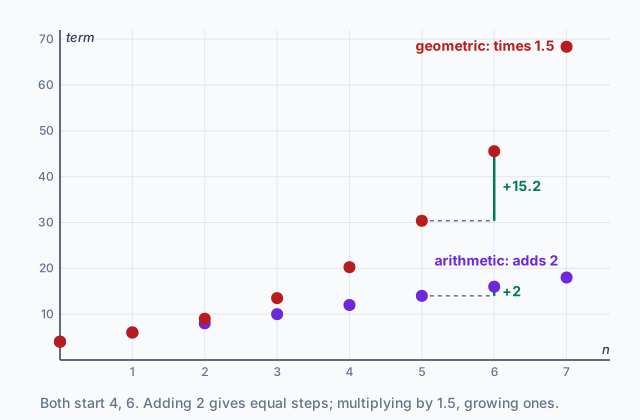 Tap to open the picture full size
Part 1 Think first
Two ways to raise an allowance
Guess before you learn. A wrong guess still makes the answer stick.
Predict first
You get to pick a weekly allowance plan. Plan A pays 20 dollars in week 0 and 5 dollars more each week after that. Plan B pays 1 dollar in week 0 and doubles every week. Which plan pays more in week 10 alone?
In short. A sequence is a function whose inputs are the whole numbers; an arithmetic sequence changes by adding the same amount each step, and a geometric sequence changes by multiplying by the same factor.
- The graph of a sequence is a set of separate points, one for each whole-number input, not a curve.
- An arithmetic sequence has a common difference , with or ; a geometric sequence has a common ratio , with or .
- An increasing arithmetic sequence goes up by the same amount every step, while an increasing geometric sequence of positive values goes up by more at every step.
Part 2 Learn it
Four short ideas, each checked as you go
2a. A sequence is a function of the whole numbers
A theater's front row is row 0 and has 18 seats. Each row behind it has 2 more seats than the row in front. Write for the number of seats in row : , , , and so on.
That is a function. You put in a row number and get one seat count out. The inputs are the whole numbers 0, 1, 2, 3, and so on, and the outputs are real numbers. A function from the whole numbers to the real numbers is a sequence, and each output is a term.
The inputs are what change the picture. There is a row 2 and a row 3, but no row 2.5, so there is nothing to plot between them. The graph of a sequence is a set of separate points, not a curve. You might sketch a light line through the points to see the pattern, but only the dots belong to the sequence.
Quick check · Multiple choice
No calculator. A tile pattern grows in steps. Step 0 has 5 tiles, and each step adds 3 more. Let be the number of tiles in step . Which describes the graph of for steps 0 through 6?
2b. Arithmetic sequences add the same amount
The theater's seats go 18, 20, 22, 24. Each term is the one before plus 2. When successive terms always differ by the same amount, the sequence is arithmetic, and that amount is the common difference, . Here seats per row, a constant rate of change.
Start at the initial value and take steps of :
Row 15 has seats.
You do not need . If you know some other term , step from there:
Say you only know that row 10 has 38 seats. Row 15 is rows further on, so . Same answer.
Given two terms, the total change between them is shared equally by the steps between them. With and , five steps added 25, so .
Quick check · Calculate
No calculator. An arithmetic sequence has and . What is ?
2c. Geometric sequences multiply by the same factor
A video gets 256 views on the day it is posted, and each day after that it gets 1.5 times as many as the day before: 256, 384, 576, 864. The differences, 128, 192, 288, keep changing, so this is not arithmetic. Divide instead: .
When successive terms always have the same quotient, the sequence is geometric, and that quotient is the common ratio, . Each step multiplies by , a constant proportional change: every day brings 50% more views than the day before.
Start at the initial value and multiply times:
Or start from a known term and multiply once for each step after it:
Day 5 is 2 days after day 3, so views.
With positive terms, a ratio greater than 1 makes an increasing sequence and a ratio between 0 and 1 makes a decreasing one.
Quick check · Fill the statement
No calculator. A patient takes 400 milligrams of a medicine. The amounts left in the body, measured every 6 hours, are 400, 200, 100, 50 milligrams. Let be the amount left after six-hour periods. Tap a blank, then tap a word.
Each term is the term before, so the sequence is with common ratio .
2d. Adding or multiplying: what the steps do
Put the theater and the video side by side. The theater adds 2 seats every row, so the increase from one row to the next is 2 at row 1 and still 2 at row 100. An increasing arithmetic sequence increases equally with each step.
The video multiplies by 1.5. Each new day adds half of the day before, and the day before keeps getting bigger, so the daily increases are 128, 192, 288, 432. An increasing geometric sequence of positive values increases by a larger amount with each successive step.
That gives you a test for any table whose inputs go up by 1. Subtract successive terms. If every difference is the same, the sequence is arithmetic. If not, divide successive terms. If every ratio is the same, it is geometric. If neither is constant, it is neither one, and that happens often: 1, 4, 9, 16 has differences 3, 5, 7 and ratios that shrink.
Quick check · Decide and justify
No calculator. A running club offers two training plans. Plan A adds 2 kilometers to the weekly distance each week. Plan B adds 10% to the weekly distance each week. Both plans start at 20 kilometers in week 0, so both have 22 kilometers in week 1. Which plan's weekly distance increases more from week 8 to week 9?
Which reason supports your answer?
Part 3 Watch it done
How big will the chess club get?
Watch each step, then do the last one yourself.
An online chess club had 96 members 1 month after it started and 216 members 3 months after it started. Its membership grows by the same proportion each month. How many members does it have 6 months after it started?
Step 1 · Name the sequence and what you know
Let be the number of members months after the start. Growth by the same proportion each month is a constant ratio, so the sequence is geometric. You know and .
Step 2 · Find the common ratio
From to is 2 steps, so 96 gets multiplied by twice: . Then , so . Each month the club has 1.5 times as many members as the month before.
Why this step?
Why is and not , which also squares to 2.25?
Member counts are positive and the club is growing. A ratio of would flip the sign at every step, giving the club a negative number of members in month 2.
Step 3 · Write the general term from a known term
Start at : . You could also back up one step from to get and write . Both give the same terms.
Your step · Calculate
No calculator. Finish it. How many members does the model give 6 months after the start, ?
members
Part 4 Try it
New sequences, and one that shrinks
The medicine in 2c shrank by keeping half of each term. Here is another shrinking geometric sequence, where each step keeps a different fixed fraction of the term before.
Try it · Calculate
No calculator. A used phone is worth 900 dollars now. Each year it loses 20% of the value it had at the start of that year. Let be its value, in dollars, years from now. What is ?
Part 5 Explain it
Write it the way the exam asks
Nothing you type leaves this page.
Free response is 37.5% of the exam score. This one is shaped like Question 2, Modeling a Non-Periodic Context.
Free-response practice · Question 2 style
Graphing calculator required. Two job offers pay the same salary, 40,000 dollars, in year 0. Offer A raises the salary by 2,000 dollars each year. Offer B raises the salary by 4% each year. (a) Write an expression for , the Offer A salary in year , and for , the Offer B salary in year . (b) Find each salary in year 15. (c) Explain why the yearly raises under Offer B get larger each year while the raises under Offer A do not.
Model answer
(a) Offer A adds the same amount each year, so it is arithmetic with : . Offer B multiplies by 1.04 each year, so it is geometric with : . (b) , so 70,000 dollars. , so about 72,037.74 dollars. (c) Offer A's raise is always 2,000 dollars, a common difference. Offer B's raise is 4% of the previous year's salary, and that salary goes up every year, so each raise is 4% of a larger number than the last.
Score your own answer. This is a self-check, not a grade. Tick each point your answer makes.
Part 6 Check yourself
Two new podcasts
The three case questions use the same data. Answer them from the table.
Two podcasts launched on the same day. Show P gains the same number of listeners each week. Show Q grows by the same percent each week. The table gives each show's listeners in week .
| Week | Show P | Show Q |
|---|---|---|
| 0 | 625 | 625 |
| 1 | 750 | 750 |
| 2 | 875 | 900 |
| 3 | 1000 | 1080 |
| 4 | 1125 | 1296 |
Case question 1 · Multiple choice
No calculator. Which expression gives Show P's listeners in week ?
Case question 2 · Multiple choice
No calculator. Using week 4 as the known term, which expression gives Show Q's listeners in week ?
Case question 3 · Multiple choice
No calculator. From week 3 to week 4, how many listeners does each show gain?
The rest stand on their own and do not use the case.
Check yourself · Calculate
No calculator. A school's stock of printer paper drops by the same number of reams each week, so the stock after weeks, , is an arithmetic sequence. After 6 weeks there are 47 reams, and the stock drops 4 reams a week. How many reams were there at the start, ?
Check yourself · Spot the error
No calculator. A geometric sequence has and common ratio . A student finds . Tap the first line with a mistake.
Check yourself · Sort it
No calculator. Each list gives the first four terms of a sequence. Tap a list, then the kind of sequence it is.
Arithmetic
Geometric
Neither
Part 7 Keep it
Bring back earlier ideas
Pulling an older idea back up is what makes it last.
From 1.14 Function Model Construction and Application · Fill the statement
No calculator. A bike rental costs 12 dollars for up to 2 hours, then 5 dollars for each extra hour. Tap a blank, then tap a phrase.
The cost model has for and for .
From 1.12 Transformations of Functions · Calculate
No calculator. The point is on the graph of . The corresponding point on the graph of is . What is ?
In three lines
- A sequence is a function of the whole numbers, so its graph is separate points.
- Arithmetic: common difference , . Geometric: common ratio , .
- Increasing arithmetic sequences go up by equal steps; increasing geometric sequences of positive values go up by larger steps each time.
Vocabulary
- Sequence
- A function from the whole numbers to the real numbers; its graph is a set of separate points.
- Term
- One output of a sequence, such as , the term for input 3.
- Arithmetic sequence
- A sequence whose successive terms have a common difference, with general term or .
- Common difference
- The constant amount added to each term of an arithmetic sequence to get the next, its constant rate of change.
- Geometric sequence
- A sequence whose successive terms have a common ratio, with general term or .
- Common ratio
- The constant factor each term of a geometric sequence is multiplied by to get the next, a constant proportional change.
- Initial value
- The term for input 0, written or .
Course alignment, for teachers
AP Precalculus topic 2.1, Unit 2: Exponential and Logarithmic Functions.
- Skill 1.B: Express functions, equations, or expressions in analytically equivalent forms that are useful in a given mathematical or applied context.
- Skill 3.A: Describe the characteristics of a function with varying levels of precision, depending on the function representation and available mathematical tools.
This lesson maps all 6 essential knowledge statements of the topic to the part that teaches each one: 6 are checked by a scored question. The map is in the lesson file.