Unit 2 · Topic 2.2 · about 30 minutes · 7 parts · 13 scored checks, 1 of them multiple choice
Change in Linear and Exponential Functions
 Tap to open the picture full size
Part 1 Think first
What comes next?
Guess before you learn. A wrong guess still makes the answer stick.
Predict first
A seedling is 4 centimeters tall when you plant it, 6 centimeters a week later and 9 centimeters a week after that. If it keeps growing the same way, how tall will it be at the end of week 3?
In short. Linear and exponential functions extend arithmetic and geometric sequences to real-number inputs: over equal input steps, a linear function adds the same amount and an exponential function multiplies by the same factor.
- is an initial value plus repeated addition of the slope ; is an initial value times repeated multiplication by the ratio , which cannot be 0 or 1.
- In a table, compare outputs over equal-length input intervals: a constant rate of change means linear, a constant ratio means exponential.
- Two distinct values determine a linear or an exponential function, and either can be written from a known point: or .
Part 2 Learn it
Four short ideas, each checked as you go
2a. Adding the same amount: linear functions
An arithmetic sequence starts at and adds the common difference once for every step. A linear function is built the same way: an initial value , plus the slope , a constant rate of change, added for every unit the input grows.
A candle 30 centimeters tall burns down 2 centimeters an hour. After whole hours its height is the sequence . The function tells the same story and also works between the hours: after 2.5 hours, centimeters. A sequence is defined only at whole-number steps, while its function can take any real input in its domain, so the two can have different domains.
You do not need the starting value. Just as starts from any known term, a linear function can start from any known point :
If the candle is 22 centimeters tall at hour 4, then .
Quick check · Calculate
No calculator. A linear function has slope 3 and . What is ?
2b. Multiplying by the same factor: exponential functions
A geometric sequence starts at and multiplies by the common ratio at every step. An exponential function does the same with a real input: the initial value times repeated multiplication by the constant ratio .
A lab culture starts with 200 bacteria and triples every hour. Hour by hour that is : 200, 600, 1800. The function agrees at every whole hour and also gives a value between the hours: half an hour in, is about 346.
You can start from any known point here too. Matching ,
so if you know there were 1800 bacteria at hour 2, then .
Put the two families side by side. Each is an initial value and one constant that controls change. In that constant is added once per unit of input. In it multiplies.
Quick check · Match
No calculator. Tap a function, then how it starts and how it changes for each unit of .
2c. Reading a table: differences or ratios
To decide which family a table belongs to, compare outputs over equal-length input intervals.
- If the outputs change at a constant rate, the same amount added each time, the function is linear.
- If the outputs change proportionally, the same factor each time, the function is exponential. That factor can never be 0 or 1. Multiplying by 1 changes nothing, and multiplying by 0 wipes the output out after one step.
For inputs 0, 1, 2, 3 with outputs 5, 8, 11, 14, every difference is 3: linear. With outputs 5, 10, 20, 40, every ratio is 2: exponential.
The trap is a table whose inputs are not equally spaced. Inputs 0, 1, 2, 4 with outputs 3, 6, 12, 48 seem to double, double, then quadruple. But the last jump covers 2 units of input, and two doublings make a factor of 4. That table is exponential.
So read the input column before you compare a single output. When the steps differ, compare over intervals of the same length, or, to test for linear, divide each difference by its input step and see whether that rate stays the same.
Quick check · Decide and justify
No calculator. A function has , , and . Based on these values, what kind of function is ?
Which reason supports your answer?
2d. Two values pin it down
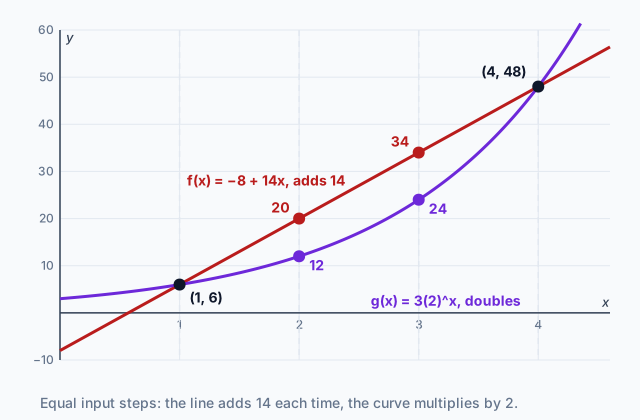
An arithmetic or geometric sequence is fixed once you know two of its terms. The same goes for a linear or an exponential function: two distinct values determine it. Take the points and , whose inputs are 3 units apart.
Linear. The output rises over 3 units, so and , which simplifies to .
Exponential. The output is multiplied by over 3 units, one factor of per unit, so and . Then , which is .
The diagram draws both. At and the line gives 20 and 34, adding 14 each step; the curve gives 12 and 24, doubling. Same two points, two different functions between and beyond them.
The step that trips people up: a ratio over 3 units is , not . Take the cube root. Dividing the ratio by the number of units would spread the growth out as if it were added, which is not how a ratio works.
Quick check · Calculate
No calculator. An exponential function has and . What is ?
Part 3 Watch it done
Predicting a podcast's audience
Watch each step, then do the last one yourself.
A new podcast had 40 thousand listeners in week 2 and 135 thousand in week 5. Its audience grows by the same factor every week. Build a function for the audience, in thousands, in week , and use it to predict week 6.
Step 1 · Name the family
The same factor every week is proportional change over equal intervals, so is exponential. Starting from a known point, it has the form .
Step 2 · Find the ratio
Week 2 to week 5 is 3 weeks, so . Since , the weekly ratio is .
Why this step?
Why take a cube root here instead of dividing 3.375 by 3?
The audience was multiplied by once in each of the 3 weeks, so the 3-week ratio is . Dividing by 3 would treat the growth as an amount added each week, which is how a linear function changes.
Step 3 · Write it from a known point
Use week 2: . Check week 5: .
Your step · Calculate
No calculator. Finish it. How many thousand listeners does the model predict for week 6?
thousand listeners
Part 4 Try it
Sort six tables
Each card is a small table of inputs and outputs. Read the input column first. Then check differences, ratios or rates over equal-length intervals, and put the card where it belongs.
Try it · Sort it
No calculator. Tap a table, then whether the function it shows is linear, exponential or neither.
Linear
Exponential
Neither
Part 5 Explain it
Write it the way the exam asks
Nothing you type leaves this page.
Free response is 37.5% of the exam score. This one is shaped like Question 2, Modeling a Non-Periodic Context.
Free-response practice · Question 2 style
Graphing calculator required. The algae in a pond covers 20 square meters on day 0 and 45 square meters on day 2. Model L is linear and Model E is exponential with a positive base, and each fits both measurements. (a) Write an expression for each model. (b) On day 4 the algae covers 101 square meters. Which model fits better? Justify your answer using values from both models.
Model answer
(a) Model L: the slope is , so . Model E: , so and . (b) On day 4, and square meters. Model E fits better, because its prediction is within 0.25 of the measured 101, while Model L is 31 square meters too low.
Score your own answer. This is a self-check, not a grade. Tick each point your answer makes.
Part 6 Check yourself
What an e-bike is worth
The three case questions use the same data. Answer them from the table.
A bike shop tracks what a used e-bike resells for. is its value in dollars years after it was bought new. The shop has no record for year 3.
| (years) | (dollars) |
|---|---|
| 0 | 1600 |
| 1 | 1200 |
| 2 | 900 |
| 4 | 506.25 |
Case question 1 · Multiple choice
No calculator. Which description of fits the table?
Case question 2 · Calculate
No calculator. If the pattern in the table holds, what was the e-bike worth in year 3, in dollars?
Case question 3 · Fill the statement
No calculator. Write in the form . Tap a blank, then tap a number.
The initial value is and the ratio is .
The rest stand on their own and do not use the case.
Check yourself · Spot the error
No calculator. A student finds the exponential function , with , whose graph passes through and . Tap the first line with a mistake.
Check yourself · Select all
No calculator. Compare the sequence , for , with the function for real . Select the two true statements.
Select 2 answers, then check.
Part 7 Keep it
Bring back earlier ideas
Pulling an older idea back up is what makes it last.
A water tank is filled from a hose. After 10 minutes the flow is turned down. is the volume of water in liters, minutes after the hose is turned on.
| (minutes) | (liters) |
|---|---|
| 0 | 0 |
| 5 | 150 |
| 10 | 300 |
| 15 | 350 |
| 20 | 400 |
| 25 | 450 |
From 1.14 Function Model Construction and Application · Calculate
No calculator. What is the average rate of change of from to , in liters per minute?
From 1.13 Function Model Selection and Assumption Articulation · Sort it
No calculator. Each list gives outputs at inputs 0, 1, 2, 3, 4. Tap a list, then the polynomial type that fits it best.
Linear
Quadratic
Cubic
In three lines
- A linear function adds the slope once per unit of input; an exponential function multiplies by the ratio , never 0 or 1.
- Compare outputs over equal-length input intervals: constant differences mean linear, constant ratios mean exponential. Check the inputs first.
- Two values determine either kind; a ratio over units is , so take a root, never divide by .
Vocabulary
- Linear function
- A function : an initial value plus repeated addition of the slope .
- Exponential function
- A function : an initial value times repeated multiplication by a constant ratio , which cannot be 0 or 1.
- Arithmetic sequence
- A sequence , which adds the same common difference at every step.
- Geometric sequence
- A sequence , which multiplies by the same common ratio at every step.
- Slope
- The constant rate of change of a linear function: the amount the output changes for each unit of input.
- Initial value
- The output at input 0: in and in .
Course alignment, for teachers
AP Precalculus topic 2.2, Unit 2: Exponential and Logarithmic Functions.
- Skill 1.C: Construct new functions, using transformations, compositions, inverses, or regressions, that may be useful in modeling contexts, criteria, or data, with and without technology.
- Skill 3.B: Apply numerical results in a given mathematical or applied context.
This lesson maps all 8 essential knowledge statements of the topic to the part that teaches each one: 8 are checked by a scored question. The map is in the lesson file.