Unit 2 · Topic 2.10 · about 30 minutes · 7 parts · 14 scored checks, 2 of them multiple choice
Inverses of Exponential Functions
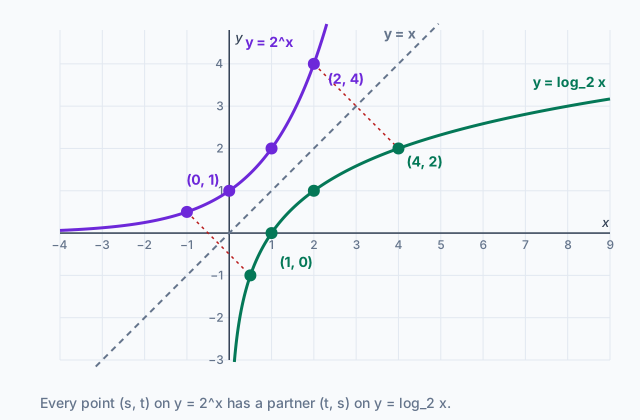 Tap to open the picture full size
Part 1 Think first
A thousand times bigger
Guess before you learn. A wrong guess still makes the answer stick.
Predict first
A biology class grows a bacteria culture that doubles in size every hour. About how long will it take for the culture to be 1,000 times its starting size?
In short. The logarithmic function is the inverse of the exponential function , so it takes an output of and hands back the input that produced it.
- If is an ordered pair of , then is an ordered pair of , so the graph of is the graph of reflected over the line .
- Exponential outputs change multiplicatively as the inputs change additively. Logarithmic outputs change additively as the inputs change multiplicatively.
- Each function undoes the other: and . The general form of a logarithmic function is , with , and .
Part 2 Learn it
Four short ideas, each checked as you go
2a. Swap the columns
Start with , an exponential function with initial value 1. Here is part of its table.
| 0 | 1 |
|---|---|
| 1 | 2 |
| 2 | 4 |
| 3 | 8 |
| 4 | 16 |
The inverse of runs this table backward. Give it 8 and it hands back 3, because . So to build its table, swap the columns. If is an ordered pair of , then is an ordered pair of the inverse.
| 1 | 0 |
|---|---|
| 2 | 1 |
| 4 | 2 |
| 8 | 3 |
| 16 | 4 |
That inverse is the logarithmic function with base 2, . Each output is the exponent you put on 2 to get the input. You already know ; now you can see it as the row , which is the row of turned around.
Quick check · Fill the statement
No calculator. The graph of passes through and . Tap a blank, then tap an answer.
The graph of passes through the point with input 81 and output , and the point with input and output .
2b. Multiply on one side, add on the other
Read the two tables again, top to bottom.
In the table of , the inputs go up by 1 on every row and the outputs are multiplied by 2. Equal-length input intervals give proportional outputs. That is exponential growth: the outputs change multiplicatively as the inputs change additively.
Swapping the columns swaps the pattern. In the table of , the inputs are multiplied by 2 on every row and the outputs go up by 1. Now the inputs change proportionately while the outputs increase over equal-length intervals. That is logarithmic growth: the outputs change additively as the inputs change multiplicatively.
The base sets the size of the multiplying step. For the common logarithm , base 10, the inputs 1, 10, 100 and 1000 give the outputs 0, 1, 2 and 3. Multiplying any input by 10 adds 1 to the output, wherever you are in the table. Multiplying by 100 is two of those steps, so it adds 2.
That is why the culture in Think first needs only about 10 hours to grow a thousandfold. Hours are the output of , and every doubling of the target adds just one hour.
Quick check · Multiple choice
No calculator. For , an input is multiplied by 16. What happens to the output of ?
2c. Each one undoes the other
When and , the functions and are inverse functions. Whatever one does, the other undoes, in either order:
Written out, that is and .
Check it on the base 2 tables. , and then , so you are back at 8. The other order: , and then , back at 3.
This lets you simplify without knowing what the logarithm equals. is not a whole number, but , because 5 raised to the exponent that gives 7 is 7. In the same way, .
The bases have to match. In the logarithm is base 3 and the power is base 2, so nothing cancels: , and , not 9.
Quick check · Match
No calculator. Tap an expression, then its value.
2d. The mirror line
Plot the points of and of its inverse on the same axes, as in the diagram. Each point on one graph has a partner on the other: and , and .
Swapping the coordinates of a point reflects it over the line , the graph of the identity function . So the graph of is the graph of reflected over . Fold the picture along that line and the two curves land on each other. The point of every lands on , a point of every .
Not every logarithmic function is a plain . The general form is , with base , where , and . The constant multiplies every output. For , the inputs 1, 2, 4 and 8 give 0, 3, 6 and 9: the inputs still multiply by the same factor, and the outputs still rise in equal steps, now of 3.
Quick check · Spot the error
No calculator. A student sketches from the graph of . Tap the line with the mistake.
Part 3 Watch it done
Building the inverse from a table
Watch each step, then do the last one yourself.
Let , and let be the inverse of . Build a table for , write , and find .
Step 1 · Table the exponential
Use inputs that go up by 1: , , , , and .
Step 2 · Swap the columns
Each pair of becomes for . So takes the inputs , , 1, 4, 16 and 64 to the outputs , , 0, 1, 2 and 3. That is .
Why this step?
Why is swapping the columns enough to make the inverse of ?
Because then undoes on every row. sends 3 to 64 and sends 64 back to 3, so , and the same is true of each pair in the table.
Step 3 · Place 8 in the table
Down the table of , each input is 4 times the one before and each output is 1 more. The input 8 is not listed. It sits between 4 and 16, so sits between and .
Your step · Calculate
No calculator. Finish it. What is ? Give a decimal.
Part 4 Try it
How many digits for the lock?
A keypad lock uses a code of digits, each from 0 to 9. It has possible codes, so a 4-digit lock has 10,000 of them. A lock maker works the other way round. She starts from how many possible codes she wants and needs the number of digits that gives exactly that many. That is a question for the inverse of .
Try it · Decide and justify
No calculator. Which function takes a number of possible codes and returns the number of digits that gives exactly that many codes?
Which reason supports your answer?
Try it · Calculate
No calculator. The lock maker wants exactly 1,000,000 possible codes. Use the inverse of . How many digits does the code need?
Part 5 Explain it
Write it the way the exam asks
Nothing you type leaves this page.
Free response is 37.5% of the exam score. This one is shaped like Question 1, Function Concepts.
Free-response practice · Question 1 style
Graphing calculator required. The function is given by , and is the inverse of . (i) Write an expression for . (ii) The point is on the graph of . Identify the corresponding point on the graph of , and describe how the graph of is related to the graph of . (iii) The inputs 1, 5, 25 and 125 are each 5 times the one before. Describe how the corresponding outputs of change. (iv) Find the value of , and explain your reasoning.
Model answer
(i) . (ii) The point is on the graph of , because an inverse swaps the input and output of every ordered pair. The graph of is the reflection of the graph of over the line . (iii) The outputs are 0, 1, 2 and 3, so they go up by 1 each time the input is multiplied by 5. (iv) . Since and are inverse functions, undoes : .
Score your own answer. This is a self-check, not a grade. Tick each point your answer makes.
Part 6 Check yourself
One table, two functions
The two case questions use the same table. Answer them from it.
The table gives selected values of an exponential function . The function is the inverse of .
| 0.4 | |
| 0 | 1 |
| 1 | 2.5 |
| 2 | 6.25 |
| 3 | 15.625 |
Case question 1 · Multiple choice
No calculator. Which point lies on the graph of ?
Case question 2 · Calculate
No calculator. Each output of in the table is 2.5 times the one before. What is ?
The rest stand on their own and do not use the case.
Check yourself · Sort it
No calculator. Each card lists four inputs and their outputs. Tap a card, then the pattern it shows.
Exponential pattern
Logarithmic pattern
Neither
Check yourself · Spot the error
No calculator. A student simplifies four expressions, one per line. Tap the line with the mistake.
Check yourself · Select all
No calculator. Which two of these are logarithmic functions in general form? Pick two.
Select 2 answers, then check.
Part 7 Keep it
Bring back earlier ideas
Pulling an older idea back up is what makes it last.
From 2.5 Exponential Function Context and Data Modeling · Fill the statement
No calculator. A town's population grows by 3% each year. One year after the count began, it had 12,360 people. Tap a blank, then tap an answer.
The model is , with in years, where = and = .
From 2.2 Change in Linear and Exponential Functions · Decide and justify
No calculator. A function has , , and . Based on these values, what kind of function is ?
Which reason supports your answer?
In three lines
- The inverse of is : every ordered pair of becomes , and the graph reflects over .
- Exponential outputs multiply as the inputs add; logarithmic outputs add as the inputs multiply.
- and when the bases match, and the general form is with , , .
Vocabulary
- Logarithmic function
- A function of the form , with base , where , and .
- Inverse functions
- Two functions that undo each other, as and do: .
- Identity function
- The function , whose graph is the line over which the graphs of and reflect onto each other.
- Exponential growth
- Outputs changing multiplicatively as the inputs change additively, as in a table of .
- Logarithmic growth
- Outputs changing additively as the inputs change multiplicatively, as in a table of .
Course alignment, for teachers
AP Precalculus topic 2.10, Unit 2: Exponential and Logarithmic Functions.
- Skill 1.C: Construct new functions, using transformations, compositions, inverses, or regressions, that may be useful in modeling contexts, criteria, or data, with and without technology.
- Skill 2.B: Construct equivalent graphical, numerical, analytical, and verbal representations of functions that are useful in a given mathematical or applied context, with and without technology.
This lesson maps all 5 essential knowledge statements of the topic to the part that teaches each one: 5 are checked by a scored question. The map is in the lesson file.