Unit 2 · Topic 2.11 · about 30 minutes · 7 parts · 15 scored checks, 3 of them multiple choice
Logarithmic Functions
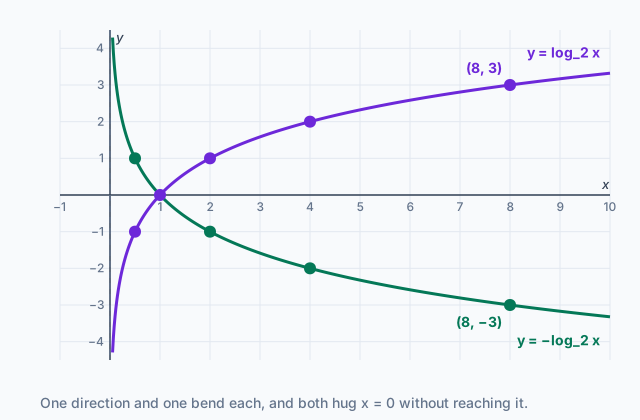 Tap to open the picture full size
Part 1 Think first
One key too far
Guess before you learn. A wrong guess still makes the answer stick.
Predict first
Maya's calculator says and , where log with no base means base 10. Her calculator is in its usual real-number mode. She types , expecting again. What will her calculator show?
In short. A logarithmic function in general form, , accepts only positive inputs and can produce any real output, and because it is the inverse of an exponential function its graph keeps one direction and one bend everywhere.
- The domain is and the range is all real numbers. The graph is always increasing or always decreasing, and always concave up or always concave down, so it has no extrema except on a closed interval and no points of inflection.
- The line is a vertical asymptote, and the outputs are unbounded at both ends: and are each or .
- Over equal-length output intervals, the inputs of are proportional. A horizontal shift , , breaks that pattern, and if some shift of a function's inputs makes them proportional, the function is logarithmic.
Part 2 Learn it
Four short ideas, each checked as you go
2a. What goes in, what comes out
In 2.10 you built by swapping the columns of a table of . Swapping columns swaps inputs and outputs, so the inverse trades domain and range.
The exponential function takes any real exponent, and every output it gives is positive. So for :
- the domain is every real number greater than zero, because only positive numbers ever come out of ;
- the range is all real numbers, because every real number is an exponent of .
Take . It reaches 10 at and at . Pick any output you like, as big or as negative as you want, and some positive input produces it. What it never takes is 0 or a negative number as input.
The general form changes neither fact. The constant multiplies outputs, and a nonzero multiple of all real numbers is still all real numbers. The inputs are untouched, so they still have to be positive.
Quick check · Multiple choice
No calculator. Let . Which gives the domain and range of ?
2b. One direction, one bend
Reflecting a graph over cannot make it turn around. Since is always increasing or always decreasing, so is its inverse. The bend carries over too: a logarithmic graph is always concave up or always concave down.
Watch it in a table of . The output rises from 0 to 1 over a run of 1 (from to 2), then from 1 to 2 over a run of 2, then over a run of 4. The graph keeps rising but needs longer and longer runs to do it. Rising and flattening is concave down.
A negative flips that: is always decreasing and always concave up. So does a base between 0 and 1: gives 0, , and at 1, 2, 4 and 8, the same outputs as .
A graph that never turns around has no maximum or minimum on its whole domain, so a logarithmic function has extrema only on a closed interval, and they sit at the endpoints: on , runs from a minimum of to a maximum of 3. And a bend that never switches means no points of inflection.
Quick check · Sort it
No calculator. Tap a function, then the description of its whole graph.
Always increasing, always concave down
Always decreasing, always concave up
2c. The wall at x = 0
Walk toward 0 along the inputs of : , , , and on to . The outputs are , , , and on to . Every halving of the input subtracts another 1, and you can halve forever without reaching 0, so the outputs have no floor:
The means you approach 0 from the right, the only side the domain allows. The graph hugs the line without touching it. That line is a vertical asymptote.
The other end is slow but has no ceiling either. Doubling the input adds 1, so is 10 at 1024 and 20 at , which is about a million. Slow is not the same as leveling off:
That is the whole list for the general form . Each of the two limits is or . A negative , or a base between 0 and 1, swaps both signs, so . There is no horizontal asymptote at either end.
Quick check · Fill the statement
No calculator. Let . Tap a blank, then tap an answer.
is , and is . The graph of has the vertical asymptote .
2d. Proportional inputs, and what a shift does to them
In a table of , the outputs 0, 1, 2, 3 come at the inputs 1, 2, 4, 8. Over equal-length output intervals, the inputs are proportional: each is 2 times the one before. Every logarithmic function in general form has this pattern.
Now shift. The additive transformation with is , and its outputs 0, 1, 2, 3 come at , , 1 and 5. Those inputs are not proportional; nothing multiplies into and also into 1. For any , the pattern breaks.
It also works as a test. Suppose a function has outputs 0, 1, 2, 3 at the inputs , , 1, 5. Try with . Then , , and . The inputs of are 1, 2, 4, 8, proportional over equal-length output intervals, so is logarithmic. In plain words: if moving every input by the same amount makes them proportional, you are looking at a logarithm.
Quick check · Calculate
No calculator. A function has , , and . Let . For which value of are the four inputs of that give the outputs 1, 2, 3 and 4 proportional?
Part 3 Watch it done
Reading a decreasing logarithm
Watch each step, then do the last one yourself.
Let . Describe the graph of , and find the minimum value of on the closed interval .
Step 1 · Domain and range
The domain is and the range is all real numbers. The 2 multiplies outputs, so neither changes.
Step 2 · Make a table
Use inputs that multiply by 3: , , 1, 3, 9 and 27. Since , , and the rest follow the same way. The outputs of are 4, 2, 0, , and .
Step 3 · Direction and bend
The outputs drop by 2 each step, but each step covers a longer run of than the last. So is always decreasing and always concave up, as a base between 0 and 1 with a positive always is. No extrema on the whole domain, no point of inflection.
Step 4 · End behavior
and . The line is a vertical asymptote.
Why this step?
Why does have no minimum on its whole domain, even though it has one on the closed interval?
Because is always decreasing and . Whatever output you name, an input farther right gives a smaller one. The closed interval stops at , so there is a last input and a smallest output.
Step 5 · Choose the endpoint
On a closed interval, a function that is always decreasing has its smallest output at the right endpoint. Here that is .
Your step · Calculate
No calculator. Finish it. What is the minimum value of on ?
Part 4 Try it
Slide the asymptote
Try it · Calculate
No calculator. In the lab, . The outputs 0, 1 and 2 of come at the inputs , and 1. At what input does give the output 3? Use the lab to check.
Try it · Decide and justify
No calculator. Your partner looks at the inputs , , 1 and 5, where the lab's gives 0, 1, 2 and 3, and says cannot come from a logarithmic function because the inputs are not proportional. Is a horizontal shift of a logarithmic function?
Which reason supports your answer?
Part 5 Explain it
Write it the way the exam asks
Nothing you type leaves this page.
Free response is 37.5% of the exam score. This one is shaped like Question 1, Function Concepts.
Free-response practice · Question 1 style
Graphing calculator required. The function is given by for constants and , and , , , and . (i) Identify the domain and the range of . (ii) Describe whether the graph of is increasing or decreasing, and its concavity, and give a reason based on the given values. (iii) Write and . (iv) Does have a minimum value on its domain? Does it have one on ? Explain your reasoning.
Model answer
(i) The domain is and the range is all real numbers. (ii) The graph is always decreasing and always concave up. The outputs drop by 2 each time the input is multiplied by 4, so the drops are equal while the runs of get longer, and the graph falls more and more slowly. (iii) and . (iv) On its domain, has no minimum, because it is always decreasing and its outputs go to as increases. On the minimum is , at the right endpoint, because a decreasing function is smallest at the right end of a closed interval.
Score your own answer. This is a self-check, not a grade. Tick each point your answer makes.
Part 6 Check yourself
Two tables, one logarithm
The three case questions use the same two tables. Answer them from the tables of and .
The tables give values of two functions, and , each defined for all .
| 1 | 0 |
|---|---|
| 5 | 2 |
| 25 | 4 |
| 125 | 6 |
| 1 | 1 |
|---|---|
| 4 | 2 |
| 9 | 3 |
| 16 | 4 |
| 25 | 5 |
Case question 1 · Multiple choice
No calculator. Based on the tables of and , which of the two functions could be logarithmic?
Case question 2 · Multiple choice
No calculator. Assume is logarithmic, so . Which statement about is true?
Case question 3 · Calculate
No calculator. Assume is logarithmic, so the pattern in its table continues. What is ?
The rest stand on their own and do not use the case.
Check yourself · Spot the error
No calculator. A student writes four facts about , one per line. Tap the line with the mistake.
Check yourself · Match
No calculator. Each description is the graph of one function, for . Tap a function, then its graph.
Check yourself · Select all
No calculator. Which two statements are true of every logarithmic function in general form? Pick two.
Select 2 answers, then check.
Part 7 Keep it
Bring back earlier ideas
Pulling an older idea back up is what makes it last.
From 2.10 Inverses of Exponential Functions · Match
No calculator. Tap an expression, then its value.
From 2.8 Inverse Functions · Decide and justify
No calculator. Let on the domain . Is invertible on this domain?
Which reason supports your answer?
In three lines
- A logarithmic function in general form takes only and gives every real number as an output.
- Its graph has one direction and one bend everywhere, so no extrema except on a closed interval, no inflection points, and a vertical asymptote at with unbounded ends.
- Over equal output steps its inputs are proportional; a shift breaks that, and a shift that restores it shows the function is logarithmic.
Vocabulary
- Logarithmic function in general form
- A function , with , and , whose domain is and whose range is all real numbers.
- Vertical asymptote
- A vertical line the graph approaches without bound; for it is , approached from the right.
- Unbounded end behavior
- Outputs that increase or decrease without limit, as in .
- Concavity
- Which way a graph bends; a logarithmic graph is either always concave up or always concave down.
- Point of inflection
- A point where a graph changes concavity, which a logarithmic graph never has.
- Additive transformation
- A function such as , , which shifts the graph of sideways and so shifts its inputs.
Course alignment, for teachers
AP Precalculus topic 2.11, Unit 2: Exponential and Logarithmic Functions.
- Skill 3.A: Describe the characteristics of a function with varying levels of precision, depending on the function representation and available mathematical tools.
This lesson maps all 4 essential knowledge statements of the topic to the part that teaches each one: 4 are checked by a scored question. The map is in the lesson file.