Unit 2 · Topic 2.9 · about 30 minutes · 7 parts · 14 scored checks, 2 of them multiple choice
Logarithmic Expressions
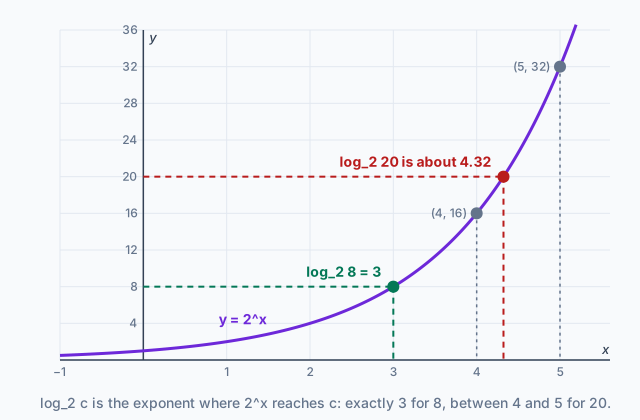 Tap to open the picture full size
Part 1 Think first
Folding a sheet of paper
Guess before you learn. A wrong guess still makes the answer stick.
Predict first
Fold a sheet of paper in half and it is 2 layers thick. Fold it again and it is 4 layers, then 8. Suppose you could keep folding as long as you liked. About how many folds would it take to get past 1,000 layers?
In short. The logarithm is the exponent you raise the base to in order to get .
- says exactly what says, for and . With no base written, the base is 10, the common logarithm.
- When is a power of , arithmetic gives exactly. Otherwise, find the two powers of that sits between, and use technology for a decimal.
- On a logarithmic scale each unit multiplies by the base, so base 10 marks read 1, 10, 100, 1000, evenly spaced.
Part 2 Learn it
Four short ideas, each checked as you go
2a. A logarithm is an exponent
A logarithm answers one question: what exponent turns the base into this number? asks what power of 2 gives 8. Since , .
In symbols:
The base must be positive and not equal to 1. (Every power of 1 is 1, so base 1 could never reach 8.) The value is an exponent, so it can be negative or a fraction.
It helps to read a logarithm as a count of factors. because , four factors of 3.
When no base is written, the base is 10. That is the common logarithm: because .
To switch forms, keep the base as the base. In the base is 5 and the exponent is 2, so the exponential form is . Writing swaps the two, and is 32.
Quick check · Match
No calculator. Tap a logarithm, then its value.
2b. Values you can find by hand
When is a power of the base, comes straight from arithmetic. Write as a power of and read off the exponent. The exponent properties from 2.4 Exponential Function Manipulation handle the cases that look strange.
- , since for every allowed base.
- , since .
- A reciprocal gives a negative value: , because .
- A square root gives one half: , because .
Common logarithms of powers of 10 count places. , and because .
A negative logarithm does not mean a negative number. says 0.01 is two factors of 10 below 1. The number 0.01 is still positive, like every power of a positive base.
Quick check · Fill the statement
No calculator. Find . Tap a blank, then tap a word or a value.
asks what power of gives . A exponent gives a reciprocal, so is .
2c. Between two powers
Most numbers are not powers of the base. asks what power of 3 gives 50, and no whole number works: and . Since 50 is between 27 and 81, is between 3 and 4.
You can always get that bracket by hand. List powers of the base until you pass the number. It works below 1 as well: is between and 0, because and .
For a decimal, use technology. On most graphing calculators the LOG key is the common logarithm, and many also have a template for any base. A calculator gives .
Look at where that lands. 50 is below 54, the number halfway between 27 and 81, yet is above 3.5. Halfway in the exponent means multiplying 27 by , which gives about 46.8, not 54. Equal steps in a logarithm are equal multiplications, so you cannot place a logarithm by measuring evenly between two powers.
Quick check · Sort it
No calculator. Tap a logarithm, then the two integers its value is between.
between 1 and 2
between 2 and 3
between 3 and 4
2d. Logarithmic scales
A ruler adds. Its marks are 0, 1, 2, 3, and each unit is one more than the last. A logarithmic scale multiplies instead. On a base 10 logarithmic scale the evenly spaced marks are , which is 1, 10, 100, 1000. Each unit to the right multiplies by 10.
A number's position on that scale is its common logarithm. 1000 sits at 3, because . Two units to the right of 1000 is , not 1002.
This is why a logarithmic scale can show a village of 300 people and a city of 3 million on one line, with both easy to read. Distance on the scale measures a ratio. Numbers one unit apart differ by a factor of 10, whatever their size, so 3 and 30 are exactly as far apart as 30,000 and 300,000.
A base 2 scale works the same way with doubling: the marks are 1, 2, 4, 8, 16, and each unit is a factor of 2.
Quick check · Multiple choice
No calculator. On a base 10 logarithmic scale, point P is 3 units to the right of point Q. How does the number at P compare with the number at Q?
Part 3 Watch it done
An exact value that is a fraction
Watch each step, then do the last one yourself.
Without a calculator, find the exact value of .
Step 1 · Turn it into an exponent question
Call the value . Then means . No whole number works, since and , so is between 0 and 1.
Step 2 · Write both numbers with one base
8 and 4 are both powers of 2: and . By the power property, , so the equation becomes .
Why this step?
Why does mean ?
The function is always increasing, so no two different exponents give the same power of 2. If and are the same number, the exponents and 2 must be the same too.
Your step · Calculate
No calculator. Finish it. What is ? Give a decimal rounded to three places.
Part 4 Try it
When the value is not exact
A town of 4,700 people goes on a base 10 logarithmic scale at the position . That is not a whole number, so this time you bracket it by hand and then let the calculator finish.
Try it · Calculate
Graphing calculator required. First decide which two integers is between. Then use your calculator to find , rounded to three decimal places.
Part 5 Explain it
Write it the way the exam asks
Nothing you type leaves this page. Check your answer against the model and each scoring point.
Free response is 37.5% of the exam score. This one is shaped like Question 4, Symbolic Manipulations.
Free-response practice · Question 4 style
No calculator. (A) Write in exponential form, and find the exact value of . (B) The value of is not an integer. Find the two consecutive integers that is between, and justify your answer.
Model answer
(A) In exponential form, . Since and , this is , so and . Check: . (B) is between 5 and 6. The value of is the exponent that 2 must be raised to in order to get 50. Since and , and , that exponent is between 5 and 6.
Score your own answer. This is a self-check, not a grade. Tick each point your answer makes.
Part 6 Check yourself
Bacteria counts on a logarithmic chart
The three case questions use the same table. Answer them from it.
A lab counts the bacteria in five samples. Its chart uses a base 10 logarithmic scale and puts each sample at the common logarithm of its count. For example, a count of 1,000 sits at the mark 3.
| Sample | Count |
|---|---|
| A | 1,000 |
| B | 10,000,000 |
| C | 300 |
| D | 3,000 |
| E | 100,000 |
Case question 1 · Calculate
No calculator. How many units apart are samples A and B on the chart?
Case question 2 · Multiple choice
No calculator. Which two samples are exactly one unit apart on the chart?
Case question 3 · Calculate
No calculator. A sixth sample sits exactly 2 units to the left of sample A on the chart. What is its count?
The rest stand on their own and do not use the case.
Check yourself · Put it in order
No calculator. Put the values in order from least to greatest.
Check yourself · Spot the error
No calculator. A student estimates . Tap the first line with a mistake.
Check yourself · Decide and justify
No calculator. A classmate says and are equal, because both use the numbers 2 and 8. Is he right?
Which reason supports your answer?
Part 7 Keep it
Bring back earlier ideas
Pulling an older idea back up is what makes it last.
From 2.4 Exponential Function Manipulation · Fill the statement
No calculator. Find . Tap a blank, then tap a word or a value.
The takes the of 32. The negative sign takes the of that, so is .
From 2.1 Change in Arithmetic and Geometric Sequences · Fill the statement
No calculator. A patient takes 400 milligrams of a medicine. The amounts left in the body, measured every 6 hours, are 400, 200, 100, 50 milligrams. Let be the amount left after six-hour periods. Tap a blank, then tap a word.
Each term is the term before, so the sequence is with common ratio .
In three lines
- means : the logarithm is the exponent, and with no base written the base is 10.
- Exact values come from writing as a power of ; otherwise bracket between two powers and use technology for a decimal.
- On a logarithmic scale each unit multiplies by the base, so distance measures a ratio.
Vocabulary
- Logarithmic expression
- , the exponent that the base must be raised to in order to get ; exactly when .
- Base
- The number in , which must satisfy and .
- Common logarithm
- The logarithm with base 10, written with no base shown, so .
- Logarithmic scale
- A scale whose evenly spaced marks are powers of the base, such as , so each unit is a multiplicative change by the base.
Course alignment, for teachers
AP Precalculus topic 2.9, Unit 2: Exponential and Logarithmic Functions.
- Skill 1.B: Express functions, equations, or expressions in analytically equivalent forms that are useful in a given mathematical or applied context.
This lesson maps all 3 essential knowledge statements of the topic to the part that teaches each one: 3 are checked by a scored question. The map is in the lesson file.