Unit 2 · Topic 2.12 · about 30 minutes · 7 parts · 13 scored checks, 1 of them multiple choice
Logarithmic Function Manipulation
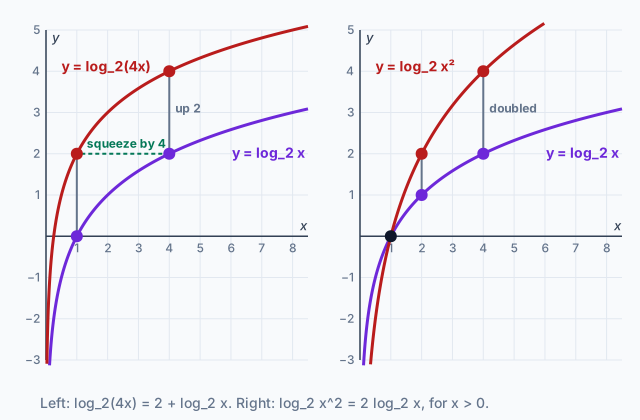 Tap to open the picture full size
Part 1 Think first
Squeezed or lifted?
Guess before you learn. A wrong guess still makes the answer stick.
Predict first
Ana and Ben graph on the same screen as . Ana says the new curve is the old one squeezed toward the -axis. Ben says it is the old one moved straight up. Who is right?
In short. Manipulating a logarithmic function means rewriting it in an equivalent form with the product, power and change of base properties, and reading what the new form says about the graph.
- Product property: . So a horizontal dilation is the vertical translation .
- Power property: for , . So is a vertical dilation of by a factor of .
- Change of base: , so every logarithmic function is a vertical dilation of every other. The natural logarithm is .
Part 2 Learn it
Three properties, each checked as you go
2a. The product property
A logarithm is an exponent, so it follows the rules exponents follow. Multiply two powers of the same base and the exponents add: . In logarithm form, that is the product property:
for positive and . Check it: , and .
Now watch what it does to a graph. In every input is multiplied by 4 before the logarithm acts, so is a horizontal dilation of , squeezed toward the -axis. The product property rewrites it:
So the same curve is moved up 2. The left panel of the diagram shows both moves landing on one curve. In general, with . When , is negative and the shift is down: .
The property needs a product inside the logarithm. A sum does not split: , but .
Quick check · Fill the statement
No calculator. Rewrite with the product property, then describe its graph. Tap a blank, then tap an answer.
The graph of is the graph of by .
2b. The power property
Raise a power to a power and the exponents multiply: . In logarithm form, that is the power property, for :
Check it: , and . The power can be a fraction, so a root comes out front too: .
On a graph, cubes each input before taking the logarithm. Rewritten, , a vertical dilation of by a factor of 3: every output is tripled. At , is 2 and is 6. Read both forms for , where is defined. The right panel of the diagram shows the same idea with a power of 2.
The exponent has to sit on the input. is , not 6, because there the whole logarithm is squared. In the 3 belongs to alone, so split the product first: .
The two properties also cover a quotient, since dividing by is multiplying by : .
Quick check · Spot the error
No calculator. A student rewrites and then evaluates it at . Tap the line where the mistake is made.
2c. Change of base, and the natural logarithm
Your calculator has two logarithm keys. LOG is base 10. LN is the natural logarithm, the logarithm with the natural base : . So and , for the same reason that .
For any other base you switch to one you have. The change of base property says
for any base with . So , and gives the same number. The base you started with goes in the denominator.
Here is why it works. Let , so . Take of both sides and use the power property: . Divide by .
That denominator is just a number, so is a constant times . For example, . Every logarithmic function is a vertical dilation of every other one, and the graph of is the graph of with every output divided by 3.
Quick check · Match
No calculator. Each function is a vertical dilation of . Tap a function, then the rewrite that equals it.
Part 3 Watch it done
One rewrite, all three properties
Watch each step, then do the last one yourself.
Rewrite in the form , for , and say what the rewrite tells you about the graph of .
Step 1 · Split the product
By the product property, .
Step 2 · Evaluate, then bring the power down
, because . By the power property, . So .
Why this step?
Why split the product before bringing the 5 to the front?
Because the 5 is an exponent on alone, not on . Writing would raise the 16 to the fifth power as well, which changes the function.
Step 3 · Change the base to 2
By the change of base property, . Substitute that into .
Your step · Calculate
No calculator. Finish it. With , what is ? Give a decimal.
So . The original form hid both numbers. The rewrite shows them: stretch vertically by 2.5, then lift it 2.
Part 4 Try it
Make two graphs land on each other
The grapher below has one logarithm, , and four sliders. That is enough to test both graph claims in this lesson, because a horizontal dilation and a vertical translation should give the same curve, and so should a change of base and a vertical dilation.
Try it · Calculate
No calculator. In the grapher, set , and , so the curve is . Then set back to 1. What value of draws the same curve?
Try it · Decide and justify
No calculator. In the grapher, set and . Which value of makes the curve ?
Which reason supports your answer?
Part 5 Explain it
Write it the way the exam asks
Nothing you type leaves this page. Check your answer against the model and each scoring point.
Free response is 37.5% of the exam score. This one is shaped like Question 4, Symbolic Manipulations.
Free-response practice · Question 4 style
No calculator. (A) The function is given by for . Rewrite in the form , where and are constants. (B) The function is given by . Rewrite as a constant times , and describe how the graph of is related to the graph of .
Model answer
(A) By the product property, . Since is the logarithm with base , . By the power property, for . So . (B) By the change of base property, . The graph of is a vertical dilation of the graph of by a factor of : every output is half as large.
Score your own answer. This is a self-check, not a grade. Tick each point your answer makes.
Part 6 Check yourself
Three values, many more
The three case questions use the same table. Answer them from it.
The table gives three values of a logarithmic function , rounded to three decimal places. The base is greater than 1, and you do not need to know it.
| 2 | 0.356 |
|---|---|
| 3 | 0.565 |
| 5 | 0.827 |
Case question 1 · Calculate
No calculator. Use the table of to find . Give a decimal.
Case question 2 · Decide and justify
No calculator. Dev says that for , , because . Is he right?
Which reason supports your answer?
Case question 3 · Multiple choice
No calculator. For , which expression is equal to ?
The rest stand on their own and do not use the case.
Check yourself · Put it in order
No calculator. Put the lines of this rewrite of in order, for . Each line takes one step from the line before it, using one property or simplifying. Tap them from first to last.
Check yourself · Sort it
No calculator. Rewrite each function with a property of logarithms. Is its graph, for , a vertical translation of , a vertical dilation of it, or neither? Tap a card, then a bin.
Vertical translation
Vertical dilation
Neither
Part 7 Keep it
Bring back earlier ideas
Pulling an older idea back up is what makes it last.
From 2.10 Inverses of Exponential Functions · Spot the error
No calculator. A student sketches from the graph of . Tap the line with the mistake.
From 2.9 Logarithmic Expressions · Decide and justify
No calculator. A classmate says and are equal, because both use the numbers 2 and 8. Is he right?
Which reason supports your answer?
In three lines
- Product property: , so is translated vertically by .
- Power property: for , , so is dilated vertically by .
- Change of base: , so all logarithmic functions are vertical dilations of each other, and .
Vocabulary
- Product property for logarithms
- , which makes the horizontal dilation the same as the vertical translation .
- Power property for logarithms
- For , , so raising the input to the power dilates the graph vertically by a factor of .
- Change of base property for logarithms
- for any base with , which makes every logarithmic function a vertical dilation of every other.
- Natural base e
- The number ; the logarithmic function with this base is , on the LN key of a calculator.
Course alignment, for teachers
AP Precalculus topic 2.12, Unit 2: Exponential and Logarithmic Functions.
- Skill 1.B: Express functions, equations, or expressions in analytically equivalent forms that are useful in a given mathematical or applied context.
- Skill 3.A: Describe the characteristics of a function with varying levels of precision, depending on the function representation and available mathematical tools.
This lesson maps all 4 essential knowledge statements of the topic to the part that teaches each one: 4 are checked by a scored question. The map is in the lesson file.