Unit 2 · Topic 2.13 · about 30 minutes · 7 parts · 13 scored checks, 2 of them multiple choice
Exponential and Logarithmic Equations and Inequalities
 Tap to open the picture full size
Part 1 Think first
When does the account reach 1,500?
Guess before you learn. A wrong guess still makes the answer stick.
Predict first
Maya puts 1,000 dollars into a savings account that pays 6% interest once a year, and she leaves the interest in the account. About how many years until it holds 1,500 dollars?
In short. To solve an exponential or logarithmic equation, get the power or the logarithm alone on one side, apply its inverse function to both sides, and then check every answer in the original equation.
- A candidate that makes the input of a logarithm zero or negative, or that falls outside what a context allows, is an extraneous solution and gets thrown out.
- Dividing both sides of an inequality by a negative number reverses it, and the natural or common logarithm of a number between 0 and 1, such as , is negative.
- The inverse of or undoes the operations of in reverse order, and lets you put two powers on one base.
Part 2 Learn it
Four ideas, each checked as you go
2a. Isolate, then undo
Solve . Peel off what sits outside the power first. Subtract 5 to get , then divide by 3 to get . Now the power is alone, and , so .
When the number is not a power of the base, the logarithm is the answer. gives , about 4.32. Maya's account works the same way: gives , so , about 6.96 years.
A logarithm comes off the other way, by turning it into a power. means , so .
When two powers have different bases, rewrite one so the bases match. Any can be written as . Since , the equation becomes . Equal powers of 3 have equal exponents, so and .
Quick check · Calculate
No calculator. Solve for .
2b. Check every answer in the original
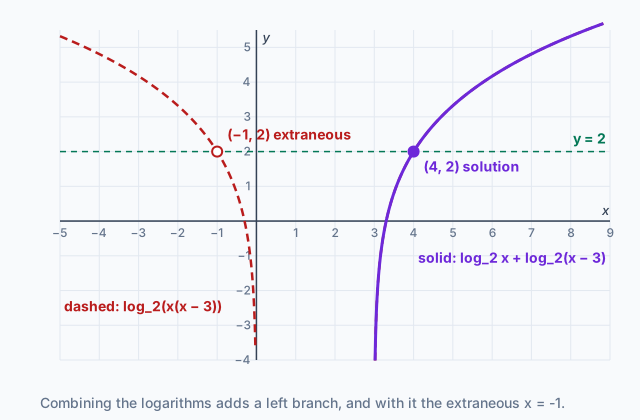
Solve . Combine the logarithms into , then turn it into a power: . That factors as , so the algebra hands you and .
Put each one back into the original equation. For : . It works. For : has no value, because the input of a logarithm must be positive. So is an extraneous solution. Your algebra produced it, but it does not solve the equation you started with. It slipped in because accepts and the original two logarithms do not.
A negative answer is not automatically extraneous. In , the answer makes the input 5, which is fine.
A context can rule a value out too. If counts minutes after a tank starts to drain and the model holds only for , then is not an answer, even if it solves the equation. That goes for a value you read off a graph as well.
Quick check · Sort it
No calculator. Each card gives an equation and a value a student found while solving it. Tap a card, then whether that value solves the original equation.
Solution
Extraneous
2c. Inequalities, and when they flip
Solve . Since , you want . But is decreasing: bigger inputs give smaller outputs. So the outputs beat when the inputs are smaller than 3, and the solution is . Try : , which is less than .
With logarithms, the flip shows up in a particular step. Take of both sides: . Taking keeps the direction, because is increasing. (A logarithm whose base is between 0 and 1, such as , is decreasing, so applying it reverses the inequality at once.) Now divide by . Since 0.5 is between 0 and 1, is negative, and dividing by a negative number reverses the inequality: .
A logarithmic inequality needs its domain as well. For , rewrite it as , which keeps the direction because is increasing. The input must also be positive, so . Together, . Stopping at would let in , where has no value.
Quick check · Decide and justify
No calculator. Which describes every solution of ?
Which reason supports your answer?
2d. Building the inverse
Take . Read what does to an input, in the order it happens: subtract 1, raise 2 to that power, multiply by 3, add 4.
The inverse runs that list backward, undoing each step. The last thing did is the first thing to undo. So subtract 4, divide by 3, take , and add 1:
Check it on a point. , and . You are back where you started.
You may have learned to swap and in and solve for . That does exactly the same four steps in the same order. If the input is scaled first, as in , the scaling is one more step on the list: divide by 10 going forward, so multiply by 10 last going back.
A function of the form inverts the same way, and its inverse is exponential, because a power of is what undoes . Domain comes along for free: every output of is more than 4, and accepts only .
Quick check · Put it in order
No calculator. Let . Put the steps that turn an input into in order. Tap them in sequence.
Part 3 Watch it done
Inverting a logarithmic function
Watch each step, then do the last one yourself.
Let . Find , then use it to find the input of that gives an output of 1.
Step 1 · List what $f$ does
Read from the input outward: add 1, take , multiply by 2, subtract 5.
Step 2 · Undo it in reverse
Start from the last operation and work back: add 5, divide by 2, raise 3 to that power, subtract 1.
Why this step?
Why does undoing start with the and not with the ?
Because the is the last thing does to an input, so it sits on the outside. The is inside the logarithm, and you cannot reach it until the subtraction, the multiplication and the logarithm have been undone.
Step 3 · Write the inverse and test it
. Test one pair: , and .
Your step · Calculate
No calculator. Finish it. Use to find the input of that gives an output of 1.
Part 4 Try it
When is the car worth less?
A car bought for 24,000 dollars loses 15% of its value every year. After years it is worth dollars. The owner wants to know from what point on it is worth less than 9,000 dollars. That is the inequality , and the numbers are not friendly, so this one is for the calculator.
Try it · Calculate
Graphing calculator required. A car's value after years is dollars. The car is worth less than 9,000 dollars exactly when . Find , rounded to three decimal places.
Part 5 Explain it
Write it the way the exam asks
Nothing you type leaves this page.
Free response is 37.5% of the exam score. This one is shaped like Question 4, Symbolic Manipulations.
Free-response practice · Question 4 style
No calculator. (i) Solve for all values of in the domain of the expression on the left. If the algebra gives a value that is not a solution, explain why it is rejected. (ii) Solve . (iii) The function is given by . Find an expression for .
Model answer
(i) , so and . That gives or . Reject , because is not defined: the input of a logarithm must be positive. The solution is . (ii) Since and is decreasing, the inequality holds for inputs less than . So . (iii) subtracts 1, raises 2 to that power, multiplies by 5 and adds 3. Undoing those in reverse order gives .
Score your own answer. This is a self-check, not a grade. Tick each point your answer makes.
Part 6 Check yourself
A cooling cup of coffee
The two case questions use the same model. Answer them from it.
A cup of coffee is poured at 80 degrees Celsius in a room that stays at 20 degrees Celsius. Its temperature minutes after pouring is modeled by degrees Celsius, for .
| (minutes) | (degrees Celsius) |
|---|---|
| 0 | 80 |
| 10 | 50 |
| 20 | 35 |
| 30 | 27.5 |
| 40 | 23.75 |
Case question 1 · Calculate
No calculator. Using the coffee model , find the time , in minutes, at which the coffee's temperature is 21.875 degrees Celsius.
Case question 2 · Multiple choice
No calculator. The coffee model is . Which expression gives the time, in minutes, at which the coffee's temperature is degrees Celsius, for ?
The rest stand on their own and do not use the case.
Check yourself · Spot the error
No calculator. A student solves . Tap the first line with a mistake.
Check yourself · Match
No calculator. Tap each expression, then the expression equal to it for every .
Check yourself · Fill the statement
No calculator. Let . Tap a blank, then tap an answer.
Starting from an input , to compute you first 4, then raise to that power, then 3.
Part 7 Keep it
Bring back earlier ideas
Pulling an older idea back up is what makes it last.
From 2.10 Inverses of Exponential Functions · Multiple choice
No calculator. For , an input is multiplied by 16. What happens to the output of ?
From 2.8 Inverse Functions · Decide and justify
No calculator. Let . A student claims that is the inverse of . Is the student right?
Which reason supports your answer?
In three lines
- Isolate the power or the logarithm, apply its inverse to both sides, and rewrite as when two bases need to match.
- Check each value in the original equation and throw out any that make a logarithm's input zero or negative or that the context does not allow. Reverse an inequality when you divide by a negative logarithm.
- To invert or , undo its operations in reverse order, starting with the last one.
Vocabulary
- Extraneous solution
- A value produced while solving that does not satisfy the original equation, such as one that makes a logarithm's input negative or falls outside a context's limits.
- Inverse relationship
- and undo each other, so a logarithm removes a power of the same base and a power removes a logarithm of the same base.
- Additive transformation
- Adding a constant to the input or the output of a function, like the and in and .
- Inverse operations
- The operations that reverse a function's steps, applied in the opposite order, which is how the inverse of is built.
- Rewriting a base
- Using to write a power in a new base, as in .
Course alignment, for teachers
AP Precalculus topic 2.13, Unit 2: Exponential and Logarithmic Functions.
- Skill 1.A: Solve equations and inequalities represented analytically, with and without technology.
- Skill 1.B: Express functions, equations, or expressions in analytically equivalent forms that are useful in a given mathematical or applied context.
- Skill 1.C: Construct new functions, using transformations, compositions, inverses, or regressions, that may be useful in modeling contexts, criteria, or data, with and without technology.
This lesson maps all 5 essential knowledge statements of the topic to the part that teaches each one: 5 are checked by a scored question. The map is in the lesson file.