Unit 2 · Topic 2.4 · about 30 minutes · 7 parts · 13 scored checks, 1 of them multiple choice
Exponential Function Manipulation
 Tap to open the picture full size
Part 1 Think first
Two models for one colony
Guess before you learn. A wrong guess still makes the answer stick.
Predict first
A yeast colony doubles every hour. Two students model it, with in hours and the count in thousands of cells. Ana writes . Ben writes . Without a calculator, which is true?
In short. Manipulating an exponential function means using the properties of exponents to rewrite it in an equivalent form that shows something the first form hid.
- The product property, , makes every horizontal translation the same as the vertical dilation .
- The power property, , makes every horizontal dilation the same as a change of base, .
- A negative exponent gives a reciprocal, , and an exponent of gives the th root of , when it exists.
Part 2 Learn it
Three short ideas, each checked as you go
2a. Product property: a translation is a dilation
When you multiply two powers of the same base, the exponents add: . That is the product property for exponents. Read it from right to left and it splits an exponent apart.
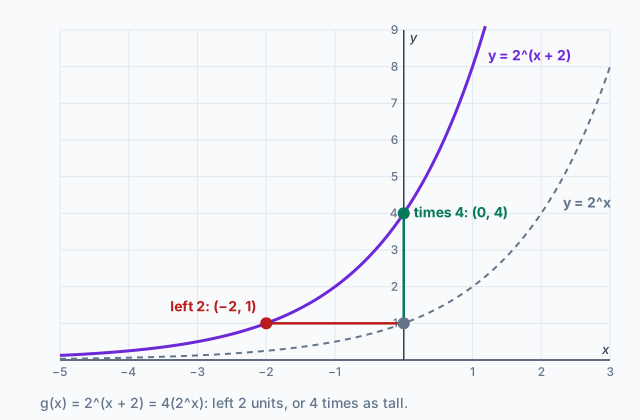
Take . Adding 2 to the input is a horizontal translation, 2 units left. Now split the exponent:
Multiplying every output by 9 is a vertical dilation. So one graph is both: the graph of moved 2 units left, or made 9 times as tall. In general, with . Every horizontal translation of an exponential function is a vertical dilation, and the diagram shows it for .
Which form you want depends on the question. shows the -intercept, 9, at a glance. shows where the graph of went.
Quick check · Calculate
No calculator. The function can be written as . What is ?
2b. Power property: a horizontal dilation is a new base
Raise a power to a power and the exponents multiply: . That is the power property for exponents.
Read it backward on . Multiplying the input by 3 is a horizontal dilation by a factor of . But
so the same graph is an exponential function with a new base, 8. Each step of 1 in now multiplies the output by 8, not by 2. In general, for any constant : every horizontal dilation of an exponential function is a change of base.
Keep the two properties apart, because they look alike. A number added in the exponent splits off as a factor in front: . A number multiplying the exponent goes onto the base: . Same 8, different place, and the two functions are not equal. At the first is 32 and the second is 64.
Quick check · Match
No calculator. Tap a function, then the equivalent form.
2c. Negative exponents and unit fraction exponents
Two more properties let an exponent go below zero or sit between whole numbers.
The negative exponent property: . A negative exponent means a reciprocal, never a negative number. , which is positive, like every output of when .
An exponent of , where is a natural number, is an exponential unit fraction, and it takes a root: is the th root of , when that root exists. So and . The words "when it exists" matter: has no real value. The base of an exponential function is positive, so you will not meet that problem there.
These combine with the power property. : a cube root, then a reciprocal. A function that looked like growth, base 27, turns out to be decay with base .
Quick check · Sort it
No calculator. Tap an expression, then its value.
1/4
1/2
2
Part 3 Watch it done
Rewriting into a form you can read
Watch each step, then do the last one yourself.
Rewrite in the form , where and are constants.
Step 1 · Split the exponent
, so the product property gives . The second factor has no in it. It is a constant, and it will become .
Step 2 · Change the base
by the power property, and . So , and . The base is .
Why this step?
Why is equal to , and not ?
Dividing the exponent by 2 is multiplying it by , and the power property moves that onto the base as a square root. The root is taken once, of the base, and the stays whole. Check at : and , while .
Your step · Calculate
No calculator. Finish it. In , what is ? Give a decimal.
Part 4 Try it
Make a translation into a dilation
Try it · Calculate
No calculator. The lab graphs for the exponential family. Set , , and , so the colored graph is . Now set back to 0. What value of gives the same graph? Give a decimal, then check with the slider.
Part 5 Explain it
Write it the way the exam asks
Nothing you type leaves this page. Check your answer against the model and each scoring point.
Free response is 37.5% of the exam score. This one is shaped like Question 4, Symbolic Manipulations.
Free-response practice · Question 4 style
No calculator. Let . (A) Rewrite in the form , where and are constants, and name the property of exponents you use at each step. (B) The graph of is a horizontal translation of the graph of . Find the translation, and explain why it is also a vertical dilation.
Model answer
(A) By the product property, . By the power property, , and . So . (B) Since , , which is the graph of translated 2 units left. By the product property, , so the same graph is the graph of dilated vertically by a factor of 9.
Score your own answer. This is a self-check, not a grade. Tick each point your answer makes.
Part 6 Check yourself
Three forms of one function
The three case questions use the same three forms.
Three students each wrote a form of the same function . All three forms are equivalent.
| Form | |
|---|---|
| P | |
| Q | |
| R |
Case question 1 · Spot the error
No calculator. A fourth student rewrites Form R with base 2. Tap the first line with a mistake.
Case question 2 · Calculate
No calculator. What is ? Give a decimal.
Case question 3 · Multiple choice
No calculator. The graph of is a horizontal translation of the graph of . Rewrite one of the forms to find which translation.
The rest stand on their own and do not use the case.
Check yourself · Put it in order
No calculator. Start from . Put the expressions in order so that each one rewrites the one before it, ending in the form .
Check yourself · Decide and justify
No calculator. Let . A classmate says the graph of is the graph of dilated vertically. Is she right?
Which reason supports your answer?
Check yourself · Fill the statement
No calculator. Find . Tap a blank, then tap a word or a value.
The takes the of 32. The negative sign takes the of that, so is .
Part 7 Keep it
Bring back earlier ideas
Pulling an older idea back up is what makes it last.
From 1.12 Transformations of Functions · Calculate
No calculator. The point is on the graph of . The corresponding point on the graph of is . What is ?
From 1.12 Transformations of Functions · Sort it
No calculator. Tap a transformation of , then whether it changes the graph vertically or horizontally.
Vertically
Horizontally
In three lines
- Product property: , so a horizontal translation of an exponential function is a vertical dilation.
- Power property: , so a horizontal dilation of an exponential function is a change of base.
- , and is the th root of when it exists.
Vocabulary
- Product property for exponents
- : multiplying powers of the same base adds the exponents.
- Power property for exponents
- : raising a power to a power multiplies the exponents.
- Negative exponent property
- : a negative exponent gives the reciprocal of the positive power.
- Exponential unit fraction
- An exponent of , where is a natural number; is the th root of , when it exists.
- Horizontal translation and vertical dilation
- For an exponential function these can be the same graph: moves the graph of sideways and equals , which stretches it vertically.
Course alignment, for teachers
AP Precalculus topic 2.4, Unit 2: Exponential and Logarithmic Functions.
- Skill 1.B: Express functions, equations, or expressions in analytically equivalent forms that are useful in a given mathematical or applied context.
- Skill 3.A: Describe the characteristics of a function with varying levels of precision, depending on the function representation and available mathematical tools.
This lesson maps all 4 essential knowledge statements of the topic to the part that teaches each one: 4 are checked by a scored question. The map is in the lesson file.