Unit 2 · Topic 2.7 · about 30 minutes · 7 parts · 14 scored checks, 3 of them multiple choice
Composition of Functions
 Tap to open the picture full size
Part 1 Think first
Two discounts on one jacket
Guess before you learn. A wrong guess still makes the answer stick.
Predict first
A jacket costs 60 dollars. A store gives you two deals at once: 10 dollars off, and 20% off. The cashier can apply them in either order. Which order leaves you paying less?
In short. Composing two functions means feeding the output of one into the other, so sends through first and then through .
- Work from the inside out with any representation: find from a table, a graph or a formula, then use that number as the input of . An input is in the domain of only when is an input accepts.
- Order matters: and are usually different. The identity function is the one function that changes nothing it is composed with.
- To build from formulas, replace every in with . To take a function apart, find the inside expression; and are compositions with and .
Part 2 Learn it
Four short ideas, each checked as you go
2a. The inner output is the outer input
The composite function , read " composed with ," takes an input , sends it through , and then sends through . You can write it as or as . The function written closest to acts first.
Say one table gives and another gives . Then
The 4 never goes into at all. If comes as a graph, read off the graph and carry that number to . Tables, graphs, formulas and descriptions in words all work the same way: find the inner output, then use it as the outer input.
That also limits the domain. A value of is in the domain of only if exists and is an input accepts. If the table for has no entry at , then has no value there, even if itself does.
Quick check · Fill the statement
No calculator. A table for gives and . A table for gives and . Find . Tap a blank, then tap an answer.
The inner function is , so the first value to find is , which is . That number is the input of , so is .
2b. Order matters, and one function changes nothing
Swap the order and you usually get a different function. Take and :
Adding 5 and then doubling is not the same as doubling and then adding 5. Composition is not commutative: and are typically different functions, so and are typically different values. Read the notation, and start from the inside every time.
One function leaves everything alone. The identity function, , sends every input to itself, so for any function ,
Here the order does not matter, because does nothing either way. Adding 0 leaves a number unchanged, and so does multiplying by 1. In composition, the identity function plays that same part.
Quick check · Match
No calculator. Let , and . Tap an expression, then its value.
2c. Building the composite
Composition links two quantities that no single formula connects. A delivery van's fuel use depends on the miles it drives, and the miles depend on the hours it is out. Neither formula gives fuel from hours, but composing them does.
When you have formulas, build by substitution: write out , then replace every in it with , in parentheses. For and ,
Both copies of in were replaced. Check it at : and , and the new formula gives too.
Without formulas you can still build a table or a graph of . Choose inputs , work out for each, and list or plot the points . The first coordinate is the original input , not the inner output .
Quick check · Multiple choice
No calculator. Let and . Which expression is ?
2d. Taking a function apart
Reading a formula backward is decomposing it. In the last step is the square root, so the outside function is and the inside is . Then .
When the inside expression shows up more than once, every copy of it becomes in the outside function. is with and .
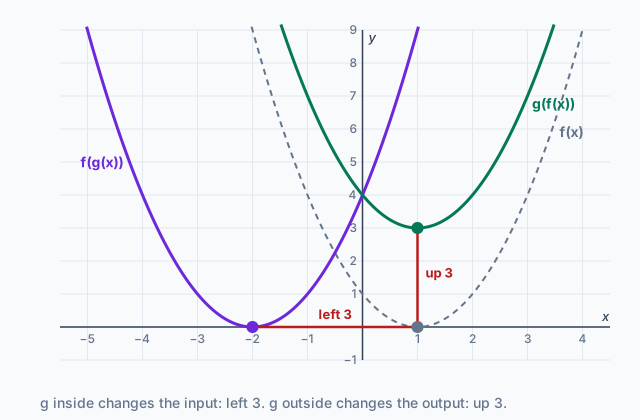
The transformations from Unit 1 are compositions too. With , the composite is a horizontal translation of the graph of , and is a vertical translation. With , is a horizontal dilation and is a vertical dilation.
Inside changes the input, so the graph changes sideways. Outside changes the output, so the graph changes up and down. The diagram shows both for .
Quick check · Sort it
No calculator. Each function is built from a function by composing it with . Tap a card, then what happens to the graph of .
Horizontal translation
Vertical translation
Horizontal dilation
Vertical dilation
Part 3 Watch it done
From minutes to degrees Celsius
Watch each step, then do the last one yourself.
Water in a kettle starts at 50 degrees Fahrenheit and warms 18 degrees Fahrenheit each minute, so its temperature after minutes is degrees Fahrenheit, for . A Fahrenheit reading converts to Celsius by . Write the Celsius temperature as a function of time, and find it at minutes.
Step 1 · Decide which function goes inside
Time goes into and gives a Fahrenheit temperature. A Fahrenheit temperature is exactly what takes in. So is inside and is outside: the Celsius temperature at time is .
Step 2 · Substitute
Replace the in with the whole expression : This one formula relates two quantities that no single formula linked before, minutes and degrees Celsius.
Why this step?
Why and not ?
would treat a number of minutes as a Fahrenheit temperature, which makes no sense. The output of the inside function has to be the kind of quantity the outside function takes in. Here that is a Fahrenheit temperature, which produces and uses.
Your step · Calculate
No calculator. Finish it. What is the Celsius temperature of the water at minutes?
degrees Celsius
Part 4 Try it
Find the inside function on a graph
Try it · Calculate
No calculator. The lab draws with . The function is with inside function . Set , and . What value of makes the colored graph the graph of ? Then check it with the slider.
Part 5 Explain it
Write it the way the exam asks
Nothing you type leaves this page. Check your answer against the model and each scoring point.
Free response is 37.5% of the exam score. This one is shaped like Question 1, Function Concepts.
Free-response practice · Question 1 style
Graphing calculator required. Let . The function has , , and . (A) (i) Find . (ii) Find . Show the inner value in each. (B) Let . Write an expression for and simplify it. Describe how the graph of is related to the graph of . (C) Is the same function as ? Justify your answer.
Model answer
(A) (i) , so . (ii) , so . (B) . Expanding gives . Since is inside , the graph of is the graph of translated 2 units left. (C) No. At , , but . Different outputs for the same input mean different functions.
Score your own answer. This is a self-check, not a grade. Tick each point your answer makes.
Part 6 Check yourself
A table and a graph
The three case questions use the same two functions.
The function is defined only at the five inputs in the table. The graph of is a line, and the marked points on it are at the whole-number inputs from to .
Graph of
The line through the marked points is the graph of .
Case question 1 · Calculate
No calculator. What is ?
Case question 2 · Spot the error
No calculator. A student finds . Tap the first line with a mistake.
Case question 3 · Multiple choice
No calculator. Which point is on the graph of ?
The rest stand on their own and do not use the case.
Check yourself · Put it in order
No calculator. Use the table of and the graph of to find . Put the steps in order.
Check yourself · Fill the statement
No calculator. Write as . Tap a blank, then tap an answer.
The expression that appears twice is the inside function, = . Replacing each copy of it with gives = .
Check yourself · Decide and justify
No calculator. Is in the domain of ?
Which reason supports your answer?
Part 7 Keep it
Bring back earlier ideas
Pulling an older idea back up is what makes it last.
From 2.4 Exponential Function Manipulation · Put it in order
No calculator. Start from . Put the expressions in order so that each one rewrites the one before it, ending in the form .
From 1.11 Equivalent Representations of Polynomial and Rational Expressions · Multiple choice
No calculator. What is the slant asymptote of the graph of ?
In three lines
- : find from any representation, then use it as the input of ; is in the domain only if accepts .
- and are usually different, and the identity function changes nothing it is composed with.
- Build by replacing every in with , and decompose by finding the inside expression; and are compositions.
Vocabulary
- Composite function
- uses the output values of as the input values of ; is also written .
- Domain of a composite
- The inputs of whose outputs are in the domain of .
- Identity function
- , which returns every input unchanged, so composing it with any function gives back.
- Not commutative
- Composition depends on order: and are typically different functions.
- Decomposing a function
- Rewriting a function as a composition of less complicated functions, where the inside variable replaces each instance of the function it was composed with.
Course alignment, for teachers
AP Precalculus topic 2.7, Unit 2: Exponential and Logarithmic Functions.
- Skill 1.C: Construct new functions, using transformations, compositions, inverses, or regressions, that may be useful in modeling contexts, criteria, or data, with and without technology.
- Skill 2.B: Construct equivalent graphical, numerical, analytical, and verbal representations of functions that are useful in a given mathematical or applied context, with and without technology.
This lesson maps all 10 essential knowledge statements of the topic to the part that teaches each one: 10 are checked by a scored question. The map is in the lesson file.