Unit 2 · Topic 2.8 · about 30 minutes · 7 parts · 16 scored checks, 4 of them multiple choice
Inverse Functions
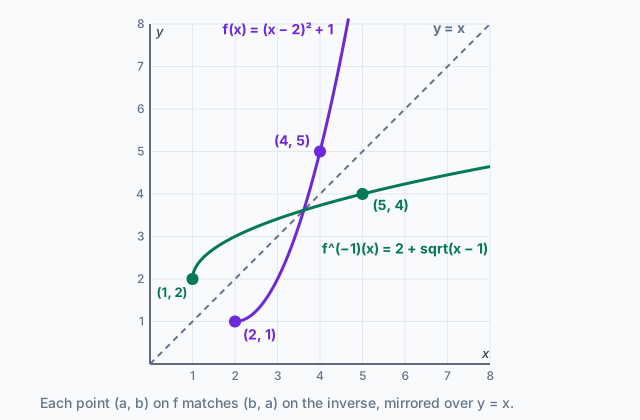 Tap to open the picture full size
Part 1 Think first
A recipe in the wrong units
Guess before you learn. A wrong guess still makes the answer stick.
Predict first
A recipe from the United States says to bake at 350 degrees Fahrenheit. Your oven only shows Celsius. To turn Celsius into Fahrenheit, you multiply by 1.8 and then add 32. About what should you set your oven to?
In short. The inverse function runs backward: if , then , on a domain where every output of comes from exactly one input.
- A table of swaps every pair of to , and the graph of is the graph of reflected over the line . The domain and range trade places.
- From a formula, swap and in and solve for . Then .
- A function that repeats an output has no inverse until its domain is restricted, and a context can limit where the inverse makes sense.
Part 2 Learn it
Four short ideas, each checked as you go
2a. Running a function backward
A function sends each input to an output. Its inverse function, written , sends each output back to the input it came from. It is a reverse mapping:
Here is a table for a function .
| 0 | 1 | 2 | 3 | 4 | |
|---|---|---|---|---|---|
| 3 | 5 | 9 | 17 | 33 |
Since , you know . To get a whole table for , reverse every input-output pair: on becomes on . The outputs of become the inputs of .
| 3 | 5 | 9 | 17 | 33 | |
|---|---|---|---|---|---|
| 0 | 1 | 2 | 3 | 4 |
Read the notation carefully. The in is not an exponent. asks which input sends to 9. It does not mean , and it does not mean .
Quick check · Fill the statement
No calculator. A function has , , , and . Tap a blank, then tap an answer.
= and = . The inputs of are the of .
2b. When there is no way back
Some functions cannot be run backward as they stand. Take . Both and equal 4. So what would be? It would have to be 1 and 5 at once, and a function gives each input only one output.
A function has an inverse, or is invertible, on a domain where each output value comes from a unique input value. Being a function is not enough: gives every input one output, but two inputs share the output 4. On a graph you can see the problem as a horizontal line that crosses the graph twice.
The fix is to restrict the domain. Keep only , the right half of the parabola, where is always increasing. Now every output from 0 upward comes from one input, and . Keeping also works, and then . So does . A domain can be restricted in many ways. What matters is that no output repeats on the piece you keep.
That is why a statement such as " has an inverse" means nothing until you say on which domain.
Quick check · Decide and justify
No calculator. Let on the domain . Is invertible on this domain?
Which reason supports your answer?
2c. On a graph, swap the axes
Every point on the graph of gives the point on the graph of . Swapping the coordinates of every point is the same as swapping the roles of the - and -axes.
On the page, that swap is a reflection over the line , which is the graph of the identity function . In the diagram, on lands at on : the same distance from the line, on the other side. Where the graph of meets the line , the graph of meets it at the same point.
The swap carries the domain and range with it. On its invertible domain, the domain of becomes the range of , and the range of becomes the domain of . In the diagram, takes inputs to outputs , so takes inputs to outputs .
Quick check · Multiple choice
No calculator. The graph of an invertible function passes through and . Which two points must be on the graph of ?
2d. With a formula, undo the steps
When is given by a formula, write , swap and , and solve for . Swapping the letters is the algebra version of reversing every pair. Take .
- Swap:
- Add 12:
- Divide by 3:
Look at the order. multiplies by 3 and then subtracts 12. The inverse uses the inverse operations in reverse order: add 12 first, then divide by 3. You put on socks before shoes, and you take off the shoes first.
Then check. A function and its inverse undo each other, so composing them gives the identity function: on the invertible domain. Here . If your composition simplifies to anything other than , the inverse is wrong.
One trap: is the reciprocal of , not its inverse. Compose it with and you will not get .
Quick check · Put it in order
No calculator. Put the steps for finding the inverse of in order. Tap them in sequence.
Part 3 Watch it done
An inverse on a restricted domain
Watch each step, then do the last one yourself.
Let on the domain . Find an expression for and its domain, then find .
Step 1 · Check that it is invertible
On , grows as grows, so is always increasing there and no output repeats. The outputs start at and go up, so the range of is .
Step 2 · Swap x and y
becomes .
Step 3 · Undo in reverse order
subtracted 2, squared, then added 1. So subtract 1, take the square root, then add 2. Subtracting 1 gives , and the square root gives .
Step 4 · Choose the sign
Keep the plus: , with domain , the range of . Check: for . These are the two curves in the diagram.
Why this step?
Why the plus sign and not the minus?
The outputs of are the inputs of , and those were restricted to . is never less than 2. is never more than 2, which would give back the left half of the parabola, the half the restriction removed.
Your step · Calculate
No calculator. Finish it. What is ?
Part 4 Try it
A rocket on the way up
A model rocket is launched straight up. Its height in meters seconds after launch is , for . It reaches its highest point, 80 meters, at , and it lands at .
Over the whole flight, is not invertible: the rocket passes most heights twice, once climbing and once falling. Restrict to the climb, , and it is invertible. That inverse takes a height and gives the time the rocket reaches it on the way up.
Try it · Calculate
No calculator. Using restricted to , find .
Try it · Multiple choice
No calculator. On the climb, . What does this statement mean in this context?
Try it · Sort it
No calculator. Use restricted to the climb, . Tap each request, then whether this inverse can answer it.
gives a time
Outside what this can answer
Part 5 Explain it
Write it the way the exam asks
Nothing you type leaves this page.
Free response is 37.5% of the exam score. This one is shaped like Question 1, Function Concepts.
Free-response practice · Question 1 style
Graphing calculator required. The function is given by for all real numbers except , and is invertible on that domain. (i) Given , identify and explain how you know. (ii) Determine an expression for , showing the steps. (iii) The range of is all real numbers except 2. Identify the domain of and give a reason. (iv) Use your expression to find , and show that .
Model answer
(i) . The pair is on , so the reversed pair is on . (ii) Write and swap: . Multiply by : . Collect the terms: , so and . (iii) All real numbers except 2, because the domain of is the range of . (iv) , and .
Score your own answer. This is a self-check, not a grade. Tick each point your answer makes.
Part 6 Check yourself
An inverse from a table
The three case questions use the same table. Answer them from it.
The table gives every value of a function . Its domain is just these five inputs, and no output repeats, so is invertible.
| −3 | 11 |
|---|---|
| −1 | 6 |
| 0 | 4 |
| 2 | −1 |
| 5 | −3 |
Case question 1 · Calculate
No calculator. What is ?
Case question 2 · Multiple choice
No calculator. What is the value of ?
Case question 3 · Multiple choice
No calculator. Which list gives the domain of ?
The rest stand on their own and do not use the case.
Check yourself · Spot the error
No calculator. A student works with . Tap the line with the mistake.
Check yourself · Match
No calculator. Tap a function, then its inverse.
Check yourself · Decide and justify
No calculator. Let . A student claims that is the inverse of . Is the student right?
Which reason supports your answer?
Part 7 Keep it
Bring back earlier ideas
Pulling an older idea back up is what makes it last.
From 2.3 Exponential Functions · Calculate
No calculator. A function has , , and . These outputs are not proportional, but subtracting the same constant from every output makes them proportional. What is the common ratio of those new outputs?
From 1.9 Rational Functions and Vertical Asymptotes · Decide and justify
No calculator. Let . Does the graph of have a vertical asymptote at ?
Which reason supports your answer?
In three lines
- If , then : a table swaps every pair, a graph reflects over , and the domain and range trade places.
- A function is invertible on a domain where each output comes from one input; restricting the domain can make it so, and a context can limit the inverse further.
- To find , swap and and solve for , undoing the last step first, then check that .
Vocabulary
- Inverse function
- The function that maps each output of , on its invertible domain, back to its input: if , then .
- Invertible
- A function is invertible on a domain when each of its output values there comes from a unique input value.
- Input-output pair
- A pair with ; the inverse function has the reversed pair .
- Identity function
- The function ; a function composed with its inverse gives it, and its graph is the line a graph reflects over to give its inverse's graph.
- Invertible domain
- A domain on which a function is invertible, often found by restricting the domain to a piece where no output repeats.
Course alignment, for teachers
AP Precalculus topic 2.8, Unit 2: Exponential and Logarithmic Functions.
- Skill 1.A: Solve equations and inequalities represented analytically, with and without technology.
- Skill 2.B: Construct equivalent graphical, numerical, analytical, and verbal representations of functions that are useful in a given mathematical or applied context, with and without technology.
This lesson maps all 7 essential knowledge statements of the topic to the part that teaches each one: 7 are checked by a scored question. The map is in the lesson file.