Unit 3 · Topic 3.12 · about 30 minutes · 7 parts · 13 scored checks, 1 of them multiple choice
AP Precalculus 3.12: Equivalent Representations of Trigonometric Functions
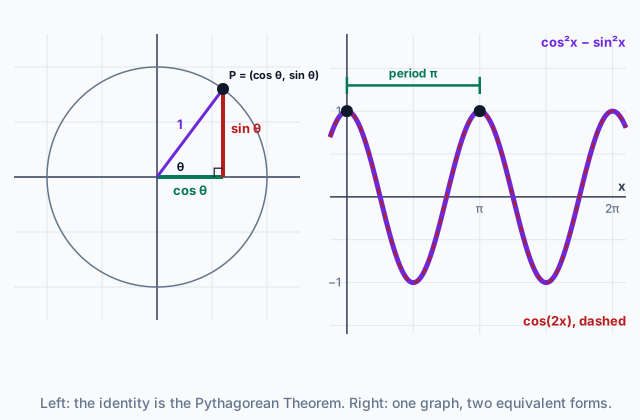 Tap to open the picture full size
Part 1 Think first The ladder and the missing angle
Guess before you learn. A wrong guess still makes the answer stick.
Predict first
A 10-meter ladder leans against a wall. It makes an angle with the ground, and its top touches the wall 8 meters up, so . Nobody has a calculator to find . What is ?
In short. Equivalent representations of a trigonometric function are different expressions that give the same value at every input, and you pick the one that makes the job in front of you easier.
- The unit circle gives the Pythagorean identity , which rearranges into forms such as .
- and . The difference and double-angle identities come from these two.
- A rewritten form can show a feature, such as an amplitude or a period, or turn an equation with two functions or two angles into one you can factor and solve.
Part 2 Learn it Four ideas, each checked as you go
2a. The Pythagorean identity
Put the point on the unit circle, as in the diagram, and drop a segment straight down to the -axis. You get a right triangle with legs of length and and a hypotenuse of 1, the radius. The Pythagorean Theorem gives the Pythagorean identity:
Here means . Squaring wipes out the signs, so the identity holds in every quadrant, for every .
It ties sine to cosine. If , then , so or . The identity gives the size. The quadrant gives the sign.
You can rearrange it, too. Divide every term by , wherever , and you get , or , where .
It even links the inverse functions. Take and let . Then is between 0 and , , and , positive in the first quadrant. That angle is one arccosine can output, so . For a negative this breaks: is then negative, and arccosine never is.
Quick check · Calculate
No calculator. An angle has and . What is ? Give a decimal.
2b. Sums and differences of angles
Sine does not split over a sum. , but , more than any sine can be. The true rules mix sine and cosine:
The sine identity mixes the two functions in each product and keeps the plus sign. The cosine identity pairs like with like and takes a minus.
A difference is a sum with a negative angle. Since and , the same identities give
These give exact values at angles off the usual list. Since ,
Quick check · Spot the error
No calculator. A student finds the exact value of . Tap the first line that goes wrong.
2c. Double angles
Set in the two sum identities and the angle doubles:
The Pythagorean identity turns into two more forms. Replace with and you get . Replace with instead and you get .
That is three forms with one value. Pick the one that uses what you know. If all you have is , then , and you never had to find .
A doubled angle does not double the output. is not : at , , while .
Quick check · Match
No calculator. Tap an expression, then the expression that equals it for every angle where both are defined.
2d. Choose the form that does the work
An identity is an equation that is true for every input where both sides are defined. To verify one, start with one side and use identities you know, plus algebra, until it becomes the other side. For example, wherever ,
A different form can show you what the first one hides. looks like a difference of two squares. Written as , it is plainly a sinusoid with amplitude 1 and period , as the diagram shows.
A different form also helps you solve. In , the two sides use different angles. Rewrite the left side and collect terms:
Now you have or , two equations you already know how to solve. Factor out rather than dividing by it. Dividing would throw away every solution where . The factored form answers inequalities too: exactly where is positive, so you read it from the signs of the two factors.
Quick check · Decide and justify
No calculator. Let . Which form of shows its greatest value most directly?
Which reason supports your answer?
Part 3 Watch it done Two angles become one
Watch each step, then do the last one yourself.
Solve for .
Step 1 · Pick a form of cos 2x
has three forms. Use , so the equation becomes
Why this step?
Why , and not or ?
The right side is . This form leaves only sine in the equation, so it becomes a quadratic in . The other two forms keep a cosine, and you would be stuck with two different functions.
Step 2 · Make it a quadratic
Move every term to one side: . Treat as the unknown and factor:
Step 3 · Split it
So or . Each is an equation you solved in 3.10. The first has two solutions in the interval and the second has one.
Your step · Calculate
No calculator. Finish it. The equation becomes . The largest solution with is . What is ? Give a fraction or a decimal.
Part 4 Try it A wave in disguise
Work this one on paper. A graphing app plots , and the curve looks like an ordinary sine wave, only taller and shifted. The sine sum identity says why. Expand :
So for every . Use that form to read off what the first form hides.
Try it · Calculate
No calculator. The function is equal to for every . What is the greatest value of ?
Try it · Calculate
No calculator. The function is equal to for every . At what with does reach its greatest value? That is . What is ? Give the exact value; a fraction such as 5/3 is fine.
Part 5 Explain it Write it the way the exam asks
Nothing you type leaves this page. Check your answer against the model and each scoring point.
Free response is 37.5% of the exam score. This one is shaped like Question 4, Symbolic Manipulations.
Free-response practice · Question 4 style
No calculator. (A) Let . Rewrite as an equivalent expression that involves and no other trigonometric function. Then identify the greatest value of and the period of . (B) Solve for . Show the work that leads to your answer. (C) An angle has and . Find the exact value of . Show the work that leads to your answer.
Model answer
(A) . That is a sinusoid with amplitude 3 and midline , so the greatest value is 3, and the period is . (B) , so and . gives and . gives and . The solutions are . (C) , and because is in the first quadrant, so . Then .
Score your own answer. This is a self-check, not a grade. Tick each point your answer makes.
Part 6 Check yourself Two angles, two known sines
The two case questions use the same pair of angles. Answer them from the table.
Two angles and , in radians, are known only by their sines and the interval each lies in.
| Angle | Interval | Sine |
|---|---|---|
Case question 1 · Calculate
No calculator. The angles and satisfy with , and with . What is ? Give the exact value; a fraction such as 5/3 is fine.
Case question 2 · Multiple choice
No calculator. The angle satisfies and . What is ?
The rest stand on their own and do not use the case.
Check yourself · Put it in order
No calculator. Tap the lines of a proof that in order, starting from the left side.
Check yourself · Decide and justify
No calculator. A student uses the rule with and writes . Is the student right?
Which reason supports your answer?
Part 7 Keep it Bring back earlier ideas
Pulling an older idea back up is what makes it last.
From 3.11 The Secant, Cosecant, and Cotangent Functions · Decide and justify
No calculator. A classmate says the graph of has vertical asymptotes at for every integer . Is the classmate right?
Which reason supports your answer?
From 3.6 Sinusoidal Function Transformations · Decide and justify
No calculator. Is the graph of the same as the graph of ?
Which reason supports your answer?
In three lines
- gives one function from the other; the quadrant decides the sign of the square root.
- and ; set for the double angles.
- Rewrite to reveal a feature or to get one function and one angle, then factor rather than divide.
Vocabulary
- Pythagorean identity
- , from the Pythagorean Theorem on the right triangle under the point of the unit circle.
- Sum identity for sine
- .
- Sum identity for cosine
- .
- Difference identities
- The sum identities with in place of , such as .
- Double-angle identities
- The sum identities with : and .
- Trigonometric identity
- An equation in trigonometric functions that is true for every input where both sides are defined, verified by turning one side into the other.
Course alignment, for teachers
AP Precalculus topic 3.12, Unit 3: Trigonometric and Polar Functions.
- Skill 1.A: Solve equations and inequalities represented analytically, with and without technology.
- Skill 1.B: Express functions, equations, or expressions in analytically equivalent forms that are useful in a given mathematical or applied context.
- Skill 3.B: Apply numerical results in a given mathematical or applied context.
This lesson maps all 8 essential knowledge statements of the topic to the part that teaches each one: 8 are checked by a scored question. The map is in the lesson file.