Unit 3 · Topic 3.11 · about 30 minutes · 7 parts · 14 scored checks, 4 of them multiple choice
AP Precalculus 3.11: The Secant, Cosecant, and Cotangent Functions
 Tap to open the picture full size
Part 1 Think first A beam that runs away
Guess before you learn. A wrong guess still makes the answer stick.
Predict first
A lighthouse stands on a rock 2 kilometers out from a long, straight beach, and its beam turns slowly. When the beam points straight at the beach, the light travels 2 kilometers to reach the sand. As the beam swings around toward running parallel to the beach, what happens to the distance the light travels before it hits the sand?
In short. The secant, cosecant and cotangent functions are the reciprocals of cosine, sine and tangent: , and .
- Each one is not defined where its denominator is 0, and its graph has a vertical asymptote there: secant at , cosecant and cotangent at .
- Secant and cosecant have range , because the reciprocal of a number between and 1 lies outside that interval.
- Cotangent is 0 where tangent is not defined, and it is decreasing between consecutive asymptotes.
Part 2 Learn it Three short ideas, each checked as you go
2a. Secant and cosecant
Two new trigonometric functions come from flipping the ones you already know:
Secant goes with cosine, and cosecant goes with sine. The names cross over, which is exactly why students mix them up. One way to hold it: each pair has exactly one "co" in it.
To evaluate one, find the cosine or sine first, with its sign, then flip it. At , , so . At , , so . Flipping never changes the sign.
A reciprocal is not an inverse. is an output of cosine turned upside down. The inverse cosine, or , takes a value and hands back an angle. A graphing calculator has no secant key, so you type 1 divided by of the angle, never the key.
Quick check · Multiple choice
No calculator. What is the exact value of ?
2b. Asymptotes, and a gap in the range
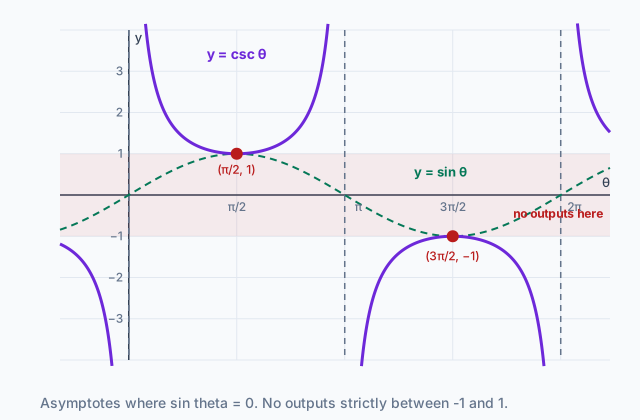
Where cosine is 0 there is nothing to flip, so is not defined. That happens at for every integer . As creeps toward 0, its reciprocal blows up: and . So the graph of has a vertical asymptote at every . In the same way, the graph of has a vertical asymptote wherever , at .
Where cosine is 1 or , flipping changes nothing. So and , and at those angles the graphs of cosine and secant touch.
At every other angle where secant is defined, is strictly between and 1 and is not 0. Flip a number like that and you get something bigger than 1 or less than , with the same sign. That leaves a gap. The range of both and is
The square brackets matter: outputs of exactly 1 and really happen.
The diagram shows this for cosecant. Each branch stays above or below , and it turns around at the point where it touches the sine curve.
Quick check · Fill the statement
No calculator. Tap a blank, then tap an answer.
The graph of has a vertical asymptote at for every integer , because there. At it touches the graph of at height . Its range is .
2c. Cotangent, and the trap in it
The cotangent is the reciprocal of the tangent:
Trust the second form. It is defined wherever , and it tells you what happens at every angle.
Where , at , the tangent is 0 and the cotangent is not defined. Close to those angles is near 1 or while is tiny, so the quotient is huge. The graph of has a vertical asymptote wherever .
Now the trap. At the tangent is not defined, and it is tempting to say the cotangent is not defined either. Use the quotient: . Where tangent has its asymptotes, cotangent has its zeros.
Follow one branch from 0 to . Just right of 0, is a large positive number. It falls through 0 at . Just left of , is near and is small and positive, so is a large negative number. Cotangent is decreasing between consecutive asymptotes, the opposite of tangent.
Quick check · Decide and justify
No calculator. A classmate says the graph of has vertical asymptotes at for every integer . Is the classmate right?
Which reason supports your answer?
Part 3 Watch it done Build cosecant from sine
Watch each step, then do the last one yourself.
Use the graph of to describe the graph of for . Then find .
Step 1 · Mark the asymptotes
is not defined where . Inside the interval that is , and the ends, and , are asymptotes too. Draw dashed vertical lines there.
Step 2 · Mark where the graphs meet
Where is 1 or , its reciprocal is the same number. So the graph of cosecant passes through and , touching the sine curve at each.
Step 3 · Fill in each branch
Between 0 and sine is positive, so cosecant is too. As sine falls toward 0 near either end, cosecant climbs without bound, so this branch is a U opening upward with its lowest point at . One more point helps: , so . Between and sine is negative, and the branch opens downward with its highest point at .
Why this step?
Why can the branch between 0 and never dip below ?
On that interval . The reciprocal of a positive number that is at most 1 is at least 1, so there, and it equals 1 only at .
Your step · Calculate
No calculator. Finish it. What is ?
Part 4 Try it Read secant off the cosine graph
The lab has no secant graph, so you build one from cosine, the way the worked example built cosecant from sine. The graph under the circle traces , and the readouts give , and for the angle you set.
Start at , read , and flip it to get . Then drag P slowly toward and watch shrink: its reciprocal, the secant, is running off toward an asymptote. Take P once around the circle and list every angle where the readout is exactly 0, then every angle where it is 1 or . The first list is where secant has its asymptotes. The second is where the graph of secant touches the graph of cosine.
At the tangent readout says not defined. Use the cosine and sine readouts there to work out , and notice that it is an ordinary number. Then answer the two questions on paper.
Try it · Calculate
No calculator. How many vertical asymptotes does the graph of have on the interval ?
Try it · Calculate
Graphing calculator required. What is , where the angle 2.5 is in radians? Give a decimal to two places.
Part 5 Explain it Write it the way the exam asks
Nothing you type leaves this page. Check your answer against the model and each scoring point.
Free response is 37.5% of the exam score. This one is shaped like Question 4, Symbolic Manipulations.
Free-response practice · Question 4 style
No calculator. Let . (A) Find the exact value of . Show the work that leads to your answer. (B) Rewrite as an expression in and only, and simplify it. Then find every value of with at which is not defined. (C) Explain why is never strictly between and 1 at any where is defined.
Model answer
(A) and , so . (B) , where and . The cotangent is not defined where , at and , and the secant is not defined where , at and . So is not defined at , , and . (C) Wherever is defined, with . The reciprocal of a number whose absolute value is at most 1 has absolute value at least 1, so or .
Score your own answer. This is a self-check, not a grade. Tick each point your answer makes.
Part 6 Check yourself Three functions in a table
The three case questions use the same table. Answer them from it.
Each of the functions , and is one of , and , a different one for each. The table gives their values at five angles, in radians.
| not defined |
Case question 1 · Multiple choice
No calculator. Which statement about the functions , and in the table is true?
Case question 2 · Calculate
No calculator. What is ?
Case question 3 · Multiple choice
No calculator. Which number is an output of the function in the table for some value of ?
The rest stand on their own and do not use the case.
Check yourself · Spot the error
No calculator. A student describes the graph of between its vertical asymptotes at and . Tap the first line that goes wrong.
Check yourself · Match
No calculator. Tap each function, then the description of its graph. Here stands for any integer.
Check yourself · Sort it
No calculator. Each card is an angle in radians. Tap a card, then what is true of , and at that angle.
Only is not defined
and are not defined
All three are defined
Part 7 Keep it Bring back earlier ideas
Pulling an older idea back up is what makes it last.
From 3.10 Trigonometric Equations and Inequalities · Fill the statement
No calculator. Tap a blank, then tap an angle. The equation is , in radians.
With , the solutions are and , smaller first. Every other solution is one of those two plus a whole-number multiple of .
From 3.8 The Tangent Function · Multiple choice
No calculator. The terminal ray of an angle in standard position meets the unit circle at . What is ?
In three lines
- and : find the cosine or sine with its sign, then flip it.
- Secant has vertical asymptotes where and cosecant where ; both have range .
- has vertical asymptotes at , where , equals 0 at , and decreases between asymptotes.
Vocabulary
- Secant function
- The function , the reciprocal of the cosine function, defined where .
- Cosecant function
- The function , the reciprocal of the sine function, defined where .
- Cotangent function
- The function , the reciprocal of the tangent function where ; equivalently, where .
- Reciprocal
- The reciprocal of a nonzero number is , which has the same sign as ; a reciprocal is not an inverse function.
- Vertical asymptote
- A vertical line the graph approaches as its outputs grow without bound; secant and cosecant have them where cosine and sine are zero, respectively, and cotangent where .
- Range
- The set of output values of a function; for secant and cosecant it is .
- Decreasing
- A function is decreasing on an interval when its outputs fall as the input rises; cotangent is decreasing between consecutive asymptotes.
Course alignment, for teachers
AP Precalculus topic 3.11, Unit 3: Trigonometric and Polar Functions.
- Skill 2.B: Construct equivalent graphical, numerical, analytical, and verbal representations of functions that are useful in a given mathematical or applied context, with and without technology.
- Skill 3.A: Describe the characteristics of a function with varying levels of precision, depending on the function representation and available mathematical tools.
This lesson maps all 5 essential knowledge statements of the topic to the part that teaches each one: 5 are checked by a scored question. The map is in the lesson file.