Unit 3 · Topic 3.2 · about 30 minutes · 7 parts · 14 scored checks, 2 of them multiple choice
Sine, Cosine, and Tangent
 Tap to open the picture full size
Part 1 Think first
One wheel, rolled one radius
Guess before you learn. A wrong guess still makes the answer stick.
Predict first
A bike wheel has a radius of 30 centimeters. You roll it forward in a straight line for exactly 30 centimeters, without slipping. About how much of a full turn has the wheel made?
In short. Put an angle's vertex at the origin with one ray along the positive -axis, and the point where its other ray meets a circle centered at the origin gives the angle's sine, cosine and tangent.
- The radian measure of an angle is the length of the arc it cuts off divided by the radius, so a full turn is radians. Positive angles turn counterclockwise, negative ones clockwise, and angles that share a terminal ray differ by a whole number of turns.
- is the vertical displacement of divided by its distance from the origin, and is the horizontal displacement divided by that distance. On the unit circle, .
- is the slope of the terminal ray, , and it is not defined when the ray is vertical.
Part 2 Learn it
Four short ideas, each checked as you go
2a. Measuring an angle with an arc
Put the vertex of an angle at the origin and lay one of its rays along the positive -axis. The angle is now in standard position. The other ray, the one that can point anywhere, is the terminal ray.
Draw a circle of radius centered at the origin. The angle cuts off an arc of that circle, and the radian measure of the angle is the arc length divided by the radius:
On the unit circle, where , an arc of length 1 gives an angle of exactly 1 radian. That is the wheel in Think first: rolling forward one radius turned it through one radian.
The size of the circle does not matter, because it is a ratio. On a circle of radius 5, an arc of length 5 is 1 radian and an arc of length 10 is 2 radians.
A full turn sweeps the whole circumference, , so one revolution is radians, about 6.28. Half a turn is , about 3.14.
You may have measured angles in degrees, where a full turn is 360. In this course an angle with no unit is in radians, so never compare a radian measure with 90 or 360.
Quick check · Calculate
No calculator. A lawn sprinkler sits at the origin and sprays water 6 meters. It turns counterclockwise from the positive -axis, and the edge of the wet patch traces an arc 9 meters long. Through what angle, in radians, did the sprinkler turn?
2b. Turning both ways, and coming back around
The sign of an angle says which way the terminal ray turned. A positive measure rotates counterclockwise from the positive -axis, and a negative measure rotates clockwise. So points the ray straight up the -axis, and points it straight down.
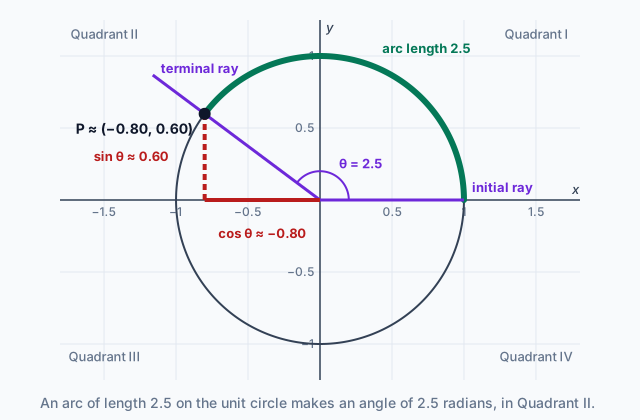
The axes cut the plane into four quadrants, numbered counterclockwise from the upper right. For angles from 0 to the boundaries are , and . An angle of 2.5 radians falls between 1.57 and 3.14, so its terminal ray is in Quadrant II.
Keep turning past and the ray comes back to where it started. Angles in standard position that share a terminal ray are coterminal, and they always differ by a whole number of revolutions, a multiple of . To find the coterminal angle from 0 up to , add or subtract until you land there:
- , so the ray of is in Quadrant I.
- , so the ray of is in Quadrant III.
- , so the ray of radians is in Quadrant II.
Adding is only half a turn. It points the ray the opposite way, so it never gives a coterminal angle.
Quick check · Match
No calculator. Each angle is in standard position, in radians. Tap an angle, then the angle from 0 up to that shares its terminal ray.
2c. Sine and cosine come from the point P
The terminal ray of meets the circle of radius at a point . Its horizontal displacement from the -axis is , and its vertical displacement from the -axis is . Both carry a sign: left of the -axis, is negative, and under the -axis, is negative. The distance from the origin to is the radius, .
Sine and cosine are ratios of those distances:
Say the terminal ray meets the circle of radius 5 at . Then and .
Follow the same ray out to the circle of radius 10 and you reach . Both displacements doubled and so did the distance, so neither ratio changed. Sine and cosine belong to the angle, not to whichever circle you drew.
On the unit circle , and the division disappears. The sine of the angle is the -coordinate of , and the cosine is the -coordinate. That is why the unit circle is the picture people draw.
Quick check · Multiple choice
No calculator. The terminal ray of an angle in standard position meets the circle of radius 25 centered at the origin at . Which is true?
2d. Tangent is the slope of the terminal ray
The terminal ray starts at the origin and passes through . Its slope, rise over run from the origin to , is the tangent of the angle:
Divide the top and bottom by and you get , which is . Any point on the ray gives the same slope, so use whichever point you have. For the ray through , .
When the terminal ray lies along the -axis, and the ray is vertical. A vertical line has no slope, so is not defined at , at , or at any angle coterminal with them. Along the -axis the ray is horizontal and .
The signs come straight from the coordinates. In Quadrant I everything is positive. In Quadrant II, , so only sine is positive. In Quadrant III both coordinates are negative, so sine and cosine are negative, and tangent, a negative divided by a negative, is positive. In Quadrant IV only cosine is positive.
Quick check · Fill the statement
No calculator. Each angle is in standard position. Tap a blank, then tap an answer.
When the terminal ray of is in Quadrant III, is and is . When the terminal ray lies along the positive -axis, is and is .
Part 3 Watch it done
Three values from one point
Watch each step, then do the last one yourself.
The terminal ray of an angle in standard position meets the circle of radius 13 centered at the origin at . Name the quadrant of the terminal ray, and find , and .
Step 1 · Place the ray
Both coordinates of are negative, so is left of the -axis and under the -axis. The terminal ray is in Quadrant III, so one measure of is between and . Any angle coterminal with it has the same ray.
Step 2 · Sine and cosine as ratios
The distance from the origin to is the radius, 13. You can confirm it: . The vertical displacement is , so . The horizontal displacement is , so . Both are negative, as Quadrant III says they should be.
Why this step?
Why divide by 13, instead of reading straight off the point?
Because is on a circle of radius 13, not the unit circle. Sine is the vertical displacement divided by the distance from the origin, and only when that distance is 1 does the division disappear. A sine of is impossible: on the unit circle no point is 12 units from the -axis.
Step 3 · Set up the tangent
The tangent is the slope of the terminal ray. The ray runs from the origin to , so its slope is . The same number comes from , because the 13s cancel.
Your step · Calculate
No calculator. Finish it. What is ? Give a decimal.
Part 4 Try it
Aim the camera
A security camera sits at the origin and starts pointing along the positive -axis. Its controller takes turn commands in radians: a positive number turns it counterclockwise and a negative number turns it clockwise. Where the camera ends up pointing is the terminal ray of the command.
For each command in the sort, decide the quadrant first, using the boundaries 1.57, 3.14, 4.71 and 6.28. Then type the angle into the lab (for example 2.5, -2 or 11pi/4) and read the Terminal ray box to check. The last box shows the coterminal angle from 0 up to .
Try it · Sort it
No calculator. A camera at the origin starts pointing along the positive -axis. Each card is one turn command in radians, positive for counterclockwise and negative for clockwise. Tap a card, then the quadrant the camera ends up pointing into.
Quadrant I
Quadrant II
Quadrant III
Quadrant IV
Try it · Calculate
No calculator. A camera at the origin, pointing along the positive -axis, is told to turn radians, where negative means clockwise. A single counterclockwise turn of radians, with , leaves it pointing the same way. What is ?
Part 5 Explain it
Write it the way the exam asks
Nothing you type leaves this page. Check your answer against the model and each scoring point.
Free response is 37.5% of the exam score. This one is shaped like Question 4, Symbolic Manipulations.
Free-response practice · Question 4 style
No calculator. The terminal ray of an angle in standard position meets the circle of radius 17 centered at the origin at the point . (A) Find the exact values of , and . (B) Let . Find the value of , and explain your reasoning. (C) An angle in standard position has the same tangent as , but its terminal ray is in Quadrant IV. Find the point where the terminal ray of meets the circle of radius 17 centered at the origin, and justify your answer.
Model answer
(A) The distance from the origin to is 17. So , the vertical displacement over that distance, and , the horizontal displacement over that distance. is the slope of the terminal ray, . (B) . Since and differ by , three full revolutions, they share a terminal ray. That ray meets the circle at the same point , so the sines are equal. (C) The point is . The terminal ray of must have slope , so it lies on the same line through the origin as , pointing the other way, into Quadrant IV. The point is on that line, since , and it is 17 from the origin, since .
Score your own answer. This is a self-check, not a grade. Tick each point your answer makes.
Part 6 Check yourself
Four rays on one circle
The three case questions use the same table. Answer them from it.
The table lists four angles in standard position, measured in radians and rounded to three decimal places. For each angle it gives the point where the terminal ray meets the circle of radius 5 centered at the origin.
| Angle | Measure (radians) | Point where the terminal ray meets the circle |
|---|---|---|
| 0.927 | ||
| 2.498 | ||
| 4.069 | ||
Case question 1 · Calculate
No calculator. The terminal ray of angle meets the circle of radius 5 centered at the origin at . What is ? Give a decimal.
Case question 2 · Select all
No calculator. The terminal rays of four angles meet the circle of radius 5 centered at the origin at the points given. Which two angles have a negative tangent? Pick two.
Select 2 answers, then check.
Case question 3 · Multiple choice
No calculator. Angle in standard position has a measure of radians. Which of these is also the measure of an angle that shares its terminal ray?
The rest stand on their own and do not use the case.
Check yourself · Spot the error
No calculator. A student finds the angle in standard position that cuts off an arc of length 10 on the circle of radius 4 centered at the origin, then decides the sign of its cosine. Tap the first line that goes wrong.
Check yourself · Decide and justify
No calculator. The terminal ray of an angle in standard position meets the unit circle at and meets the circle of radius 3 centered at the origin at . Which value is ?
Which reason supports your answer?
Part 7 Keep it
Bring back earlier ideas
Pulling an older idea back up is what makes it last.
From 2.8 Inverse Functions · Match
No calculator. Tap a function, then its inverse.
From 1.11 Equivalent Representations of Polynomial and Rational Expressions · Calculate
No calculator. Divide by using long division. What is the remainder?
In three lines
- An angle in standard position has its vertex at the origin and one ray on the positive -axis; its radian measure is the arc length over the radius, and is one turn.
- Positive angles turn counterclockwise and negative ones clockwise, and angles that share a terminal ray differ by a multiple of .
- Where the terminal ray meets a circle of radius at : , , and , the slope of the ray.
Vocabulary
- Standard position
- An angle whose vertex is at the origin and one of whose rays lies along the positive -axis.
- Terminal ray
- The other ray of an angle in standard position, besides the one on the positive -axis; its direction gives the angle's sine, cosine and tangent.
- Radian measure
- The length of the arc an angle subtends on a circle centered at the origin, divided by that circle's radius, so one full revolution is radians.
- Unit circle
- The circle of radius 1 centered at the origin, on which an arc of length 1 subtends an angle of 1 radian.
- Sine of an angle
- The vertical displacement of from the -axis divided by the distance from the origin to ; on the unit circle, the -coordinate of .
- Cosine of an angle
- The horizontal displacement of from the -axis divided by the distance from the origin to ; on the unit circle, the -coordinate of .
- Tangent of an angle
- The slope of the terminal ray, when it exists, which equals .
Course alignment, for teachers
AP Precalculus topic 3.2, Unit 3: Trigonometric and Polar Functions.
- Skill 2.A: Identify information from graphical, numerical, analytical, and verbal representations to answer a question or construct a model, with and without technology.
- Skill 3.A: Describe the characteristics of a function with varying levels of precision, depending on the function representation and available mathematical tools.
This lesson maps all 5 essential knowledge statements of the topic to the part that teaches each one: 5 are checked by a scored question. The map is in the lesson file.