Unit 3 · Topic 3.3 · about 30 minutes · 7 parts · 12 scored checks, 1 of them multiple choice
Sine and Cosine Function Values
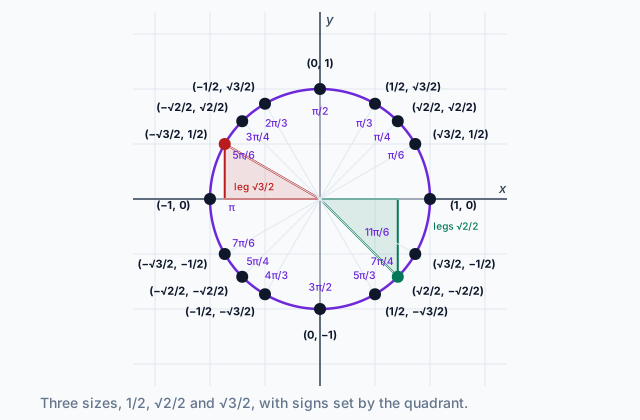 Tap to open the picture full size
Part 1 Think first
Where is the end of the sprinkler arm?
Guess before you learn. A wrong guess still makes the answer stick.
Predict first
A lawn sprinkler has a straight arm 10 meters long that starts out pointing due east. It turns counterclockwise through radians, one twelfth of a full turn. How far north of the sprinkler head is the tip of the arm now?
In short. When the terminal ray of an angle in standard position meets a circle of radius centered at the origin, it meets it at the point .
- Half of an equilateral triangle gives the exact values at and , and an isosceles right triangle gives them at : the sizes are , and .
- Any multiple of or whose terminal ray is off the axes makes one of those triangles with the -axis. The quadrant sets the signs: left of the -axis, below the -axis.
- On a circle of radius , find the unit circle values first, then multiply both by .
Part 2 Learn it
From two triangles to any circle
3a. Two triangles give the exact values
Put an angle of in standard position, and let its terminal ray meet the unit circle at . The origin, and the point form a triangle with two sides of length 1 and an angle of between them. That makes it equilateral, every side 1.
Drop a segment from straight down to the -axis. It cuts the equilateral triangle in half, so it lands halfway to , at . The Pythagorean theorem gives the height: . So and .
The angle uses the same half triangle lying on its long side. The ray is shallow, so is far across and only a little way up: and .
For the ray splits the quadrant evenly, so the triangle is an isosceles right triangle and its legs are equal. With hypotenuse 1, each leg satisfies , so . Both and equal .
A quick test when you forget which is which: a steeper ray means a higher point, so a bigger sine.
Quick check · Fill the statement
No calculator. Tap a blank, then tap a value.
, , and .
3b. Same sizes, new signs
Every multiple of or whose terminal ray is not on an axis makes one of those same triangles with the -axis. Only the direction changes.
Take . It is short of , so its ray sits above the negative -axis. The triangle is the triangle turned into Quadrant II, with legs across and up. Across is now to the left, so , which means and .
Ask two questions about any of these angles. First, how far is the ray from the -axis: , or ? That picks the triangle and the sizes. The angle is short of , and is past . Second, which quadrant? That picks the signs.
| Quadrant | , the -coordinate | , the -coordinate |
|---|---|---|
| I | positive | positive |
| II | negative | positive |
| III | negative | negative |
| IV | positive | negative |
Quick check · Sort it
No calculator. Each card is an angle, in radians, in standard position. Tap a card, then the signs of its cosine and sine.
and
and
and
and
3c. Circles bigger than 1
Back to the sprinkler. Its arm is 10 meters long, so the tip moves on a circle of radius 10 centered at the sprinkler head, not on the unit circle.
Draw the triangle again with a hypotenuse of 10 instead of 1. It is the same shape, so every side is 10 times as long: the legs are across and up. With east as the positive -axis and north as the positive -axis, the tip is at , about 8.66 meters east and exactly 5 meters north.
That works for every angle and every radius. If the terminal ray of meets a circle of radius centered at the origin at the point , then
Find and as if the circle had radius 1, signs included, then multiply both by . The 5.2 meters from Think first, , is how far the tip traveled along the circle. It does not tell you where the tip ended up.
Quick check · Calculate
No calculator. A circle of radius 12 is centered at the origin. The terminal ray of an angle of radians in standard position meets the circle at . What is the -coordinate of ?
Part 3 Watch it done
A point on a circle of radius 8
Watch each step, then do the last one yourself.
A circle of radius 8 is centered at the origin. The terminal ray of an angle of radians in standard position meets the circle at . Find the exact coordinates of .
Step 1 · Place the ray
, so the ray goes past the negative -axis, into Quadrant III. The triangle it makes with the -axis has an angle of at the origin.
Step 2 · Read the triangle
On the unit circle, the triangle has a horizontal leg of and a vertical leg of .
Why this step?
Why is the horizontal leg the long one here, and not the vertical one?
The ray is only away from the -axis, a shallow angle, so the point is much farther across than it is down. A steep ray, from the -axis, would make the vertical leg the long one.
Step 3 · Attach the signs
In Quadrant III the point is left of the -axis and below the -axis, so both coordinates are negative and .
Step 4 · Scale by the radius
The -coordinate of is .
Your step · Calculate
No calculator. Finish it. On the circle of radius 8 centered at the origin, what is the -coordinate of the point where the terminal ray of radians meets the circle?
Part 4 Try it
Predict the point, then move it
The lab draws a circle of radius centered at the origin and the point where the terminal ray of meets it. It starts with and , so . Use it to practise first, then answer the two questions below on paper, without the lab.
Try it · Fill the statement
No calculator. A circle of radius 4 is centered at the origin, and the terminal ray of an angle of radians in standard position meets it at . Tap a blank, then tap a value.
The -coordinate of is and the -coordinate of is .
Try it · Calculate
No calculator. A circle of radius 2.5 is centered at the origin, and the terminal ray of an angle of radians in standard position meets it at . What is the -coordinate of ? Give a decimal.
Part 5 Explain it
Write it the way the exam asks
Nothing you type leaves this page.
Free response is 37.5% of the exam score. This one is shaped like Question 3, Modeling a Periodic Context.
Free-response practice · Question 3 style
No calculator. A Ferris wheel has a radius of 20 feet, and its hub is 30 feet above the ground. Place the origin at the hub, with the positive -axis pointing horizontally to the right and the positive -axis pointing straight up. A car starts level with the hub on the right, at the point , and the wheel turns counterclockwise. (i) The wheel turns through radians. Determine the exact coordinates of the car relative to the hub. (ii) Determine the exact height of the car above the ground at that moment. (iii) Later, the car has turned through radians from its start. Explain how you can tell, without finding its height, that the car is below the hub.
Model answer
(i) The car is on a circle of radius 20 centered at the origin, so it is at . The ray of is from the negative -axis, in Quadrant II, so and . The car is at . (ii) The car is feet above the hub, so its height is feet. (iii) The ray of is past the negative -axis, in Quadrant III, where . So the car's vertical coordinate, , is negative, and the car is below the hub.
Score your own answer. This is a self-check, not a grade. Tick each point your answer makes.
Part 6 Check yourself
Cars on a Ferris wheel
The two case questions use the same wheel. Answer them from it.
A Ferris wheel has a radius of 20 meters, and its hub is 22 meters above the ground. Put the origin at the hub, with the positive -axis pointing horizontally to the right and the positive -axis pointing straight up, in meters. Each car's position is given by an angle in standard position: the angle, in radians, of the ray from the hub to that car.
| Car | Angle (radians) |
|---|---|
| A | |
| B | |
| C | |
| D |
Case question 1 · Match
No calculator. Tap a car on the Ferris wheel of radius 20 meters, then its coordinates relative to the hub, in meters.
Case question 2 · Calculate
No calculator. On the Ferris wheel of radius 20 meters whose hub is 22 meters above the ground, car C is at the angle radians. How high above the ground is car C, in meters?
The rest stand on their own and do not use the case.
Check yourself · Spot the error
No calculator. A student finds the point where the terminal ray of radians meets a circle of radius 6 centered at the origin. Tap the first line that goes wrong.
Check yourself · Multiple choice
No calculator. For which angle , in radians, is and ?
Part 7 Keep it
Bring back earlier ideas
Pulling an older idea back up is what makes it last.
From 2.13 Exponential and Logarithmic Equations and Inequalities · Match
No calculator. Tap each expression, then the expression equal to it for every .
From 1.13 Function Model Selection and Assumption Articulation · Decide and justify
No calculator. A beach stand records its daily lemonade sales at different temperatures. Sales rise as it gets warmer, peak at about 82 degrees, then fall about as fast on the hottest days, when people stay home. Which model type fits?
Which reason supports your answer?
In three lines
- Half an equilateral triangle gives and at and ; an isosceles right triangle gives twice at .
- Off the axes, every multiple of or reuses one of those triangles, and the quadrant sets the signs.
- On a circle of radius centered at the origin, the terminal ray of meets the circle at .
Vocabulary
- Quadrant
- One of the four regions the axes cut the plane into, numbered I to IV counterclockwise from the upper right; the quadrant of a terminal ray sets the signs of its sine and cosine.
- Standard position
- An angle with its vertex at the origin and one ray along the positive -axis; positive angles turn counterclockwise.
- Terminal ray
- The ray of an angle in standard position that is not on the positive -axis; it meets a circle centered at the origin at the point .
- Equilateral triangle
- A triangle with three equal sides, whose half gives the exact values and at and .
- Isosceles right triangle
- A right triangle with two equal legs, each when the hypotenuse is 1, which gives the exact values at .
Course alignment, for teachers
AP Precalculus topic 3.3, Unit 3: Trigonometric and Polar Functions.
- Skill 2.A: Identify information from graphical, numerical, analytical, and verbal representations to answer a question or construct a model, with and without technology.
- Skill 3.B: Apply numerical results in a given mathematical or applied context.
This lesson maps all 2 essential knowledge statements of the topic to the part that teaches each one: 2 are checked by a scored question. The map is in the lesson file.