Unit 3 · Topic 3.4 · about 30 minutes · 7 parts · 12 scored checks, 3 of them multiple choice
Sine and Cosine Function Graphs
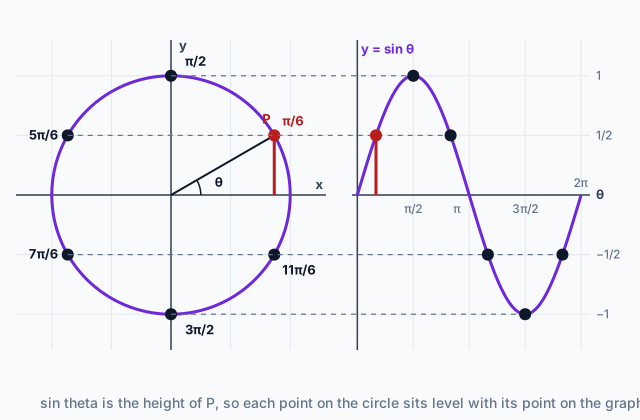 Tap to open the picture full size
Part 1 Think first
Where does your height change fastest?
Guess before you learn. A wrong guess still makes the answer stick.
Predict first
You ride a Ferris wheel that turns at a steady speed. Over one full turn, at which part of the ride is your height above the ground changing fastest?
In short. The sine and cosine functions take an angle as input and give back the -coordinate and the -coordinate of the point P where the terminal ray of meets the unit circle.
- is the vertical displacement of P from the -axis, and is its horizontal displacement from the -axis. Every real number is an allowed angle, so both functions have domain all real numbers.
- As increases, each output oscillates between and and takes every value in between, because P never leaves a circle of radius 1.
- Plot or as P goes round and you get a wave. The sine graph starts at and rises; the cosine graph starts at and falls.
Part 2 Learn it
Three short ideas, each checked as you go
2a. The angle goes in, the height comes out
Put an angle in standard position on the unit circle, the circle of radius 1 centered at the origin. Its terminal ray meets the circle at one point, P.
Now treat that as a function. The sine function, , takes the angle as its input and gives back the -coordinate of P. That -coordinate is P's vertical displacement from the -axis: how far above the axis P sits, or below it when the value is negative.
So each position of P gives one point on a graph. The input goes on the horizontal axis and the height of P goes on the vertical axis.
| P | ||
|---|---|---|
| 0 | 0 | |
| 1 | ||
| 0 | ||
| 0 |
Which angles are allowed? All of them. A negative angle turns clockwise, and an angle bigger than goes round more than once. Either way the terminal ray still meets the circle at some P, and P has a height. The domain of the sine function is all real numbers.
Quick check · Match
No calculator. Each position of P on the unit circle gives one point on the graph of . Tap a position, then its point on the graph.
2b. Following P around once
Start P at and turn it counterclockwise. Watch only its height.
- From to , P climbs from the -axis to the top of the circle, so increases from 0 to 1.
- From to , P comes back down to the axis on the left, and decreases from 1 to 0.
- From to , P keeps dropping, now below the axis, so keeps decreasing, from 0 to .
- From to , P rises back to where it started. The values are negative, but they are getting larger, so is increasing, from to 0.
P stays on a circle of radius 1, so its height is never more than 1 and never less than . On the way between, it passes through every height, with no jumps. That is what it means for the outputs to oscillate between and , taking every value in between.
Keep turning past and P goes round the same circle again, so the graph repeats the same climb and fall. Negative angles do the same thing to the left of the vertical axis.
Quick check · Sort it
No calculator. Each card is an interval of angles , in radians. Tap a card, then whether is increasing or decreasing on it.
is increasing
is decreasing
2c. Cosine reads the other coordinate
The cosine function, , uses the same point P but reads its -coordinate. That is P's horizontal displacement from the -axis: positive when P is to the right of the -axis, negative when P is to the left. Its domain is all real numbers too, for the same reason as sine's.
Run P around again, and this time watch it move side to side. At it is as far right as it ever gets, so . Over the top and down the left side, P moves left the whole way. So decreases from 1, through 0 at , down to at . Along the bottom half P moves right again, and increases, through 0 at , back to 1 at .
So cosine oscillates between and as well, taking every value in between, and its graph is the same kind of wave as the sine graph. The difference you see first is where it starts: the cosine graph begins at the top, at , and the sine graph begins on the axis, at .
Keep the two straight by direction. Sine follows up and down. Cosine follows left and right.
Quick check · Fill the statement
No calculator. The statement is about the graph of on the interval , in radians. Tap a blank, then tap an answer.
The graph crosses the horizontal axis first at and again at . It reaches its least value, , at .
Part 3 Watch it done
Drawing the sine graph from the circle
Watch each step, then do the last one yourself.
Use the unit circle to sketch for . Then use the circle to find .
Step 1 · Plot the quarter turns
At , , , and , P is at , , , and . Their -coordinates give the graph points , , , and .
Step 2 · Fill in between
At and , P sits half a unit above the -axis, so the graph is at . At and it sits half a unit below, so the graph is at . Join the points with a smooth curve: up, down, down, up, one quarter turn each.
Why this step?
Why is the curve rounded at the top and bottom instead of coming to a sharp point?
Near the top of the circle P is moving almost sideways, so its height barely changes and the graph levels off. Near the -axis P moves almost straight up or down, so its height changes fastest, and the graph is steepest where it crosses the axis. That is the Ferris wheel from the start of the lesson.
Step 3 · Go past one turn
. That is one full turn and then more, so the terminal ray is the same ray as for , and P is the same point as it was there.
Your step · Calculate
No calculator. Finish it. What is ? Give a decimal.
Part 4 Try it
Turn the circle and watch both graphs
The lab shows the unit circle with P on it and, underneath, the graphs of and . As you move the angle, each graph traces from 0 up to the angle you have reached, and a dot marks and . The vertical leg of the triangle is and the horizontal leg is , each with its sign.
Your task: set to , then move the slider a step at a time up to . Watch the horizontal leg and the cosine dot together, and say out loud which way each one moves. Then sweep from 0 all the way to and watch the two dots move together.
Try it · Decide and justify
No calculator. As increases from to , is increasing or decreasing on that interval?
Which reason supports your answer?
Try it · Multiple choice
No calculator. On which interval of angles , in radians, are and both decreasing?
Part 5 Explain it
Write it the way the exam asks
Nothing you type leaves this page.
Free response is 37.5% of the exam score. This one is shaped like Question 3, Modeling a Periodic Context.
Free-response practice · Question 3 style
No calculator. A water wheel has radius 1 meter and turns counterclockwise. One paddle starts level with the axle, on the right. After the wheel has turned through an angle of radians, the paddle's height relative to the axle is meters, negative when the paddle is below the axle, and its horizontal position relative to the axle is meters, negative when the paddle is left of the axle. (i) Find , and explain what the value means about the paddle. (ii) On the interval , identify the interval on which is decreasing, and explain your answer using the paddle's motion. (iii) Determine the angle in at which takes its least value, and explain why neither nor can ever give a value greater than 1.
Model answer
(i) . After the wheel turns radians, the paddle is half a meter below the axle. (ii) is decreasing on . Over that turn the paddle goes from the top of the wheel, down the left side, to the bottom, so its height keeps falling. (iii) is least at , where : the paddle is as far left of the axle as it can be. The paddle always stays on a circle of radius 1 around the axle, so it is never more than 1 meter from the axle in any direction, and neither its height nor its horizontal position can be greater than 1.
Score your own answer. This is a self-check, not a grade. Tick each point your answer makes.
Part 6 Check yourself
One table of points, two functions
The two case questions use the same table. Answer them from it and the circle.
A point P moves counterclockwise around the unit circle centered at the origin. For an angle in standard position, in radians, P is where the terminal ray of meets the circle. The table lists P for five angles. Let be the vertical displacement of P from the -axis and the horizontal displacement of P from the -axis. Each is negative when P is below the -axis or to the left of the -axis.
| P | |
|---|---|
Case question 1 · Calculate
No calculator. What is ? Give a decimal to three places.
Case question 2 · Multiple choice
No calculator. As increases from to , which describes the functions and ?
The rest stand on their own and do not use the case.
Check yourself · Spot the error
No calculator. A student lists points on the graph of by reading the unit circle. Tap the line with the mistake.
Check yourself · Put it in order
No calculator. Tap the angles, in radians, in order of the value of , from least to greatest.
Part 7 Keep it
Bring back earlier ideas
Pulling an older idea back up is what makes it last.
From 2.14 Logarithmic Function Context and Data Modeling · Match
No calculator. Each description gives a feature of a context. Tap a description, then the model that fits it.
From 1.12 Transformations of Functions · Multiple choice
No calculator. Let , whose range is . What is the range of ?
In three lines
- is the -coordinate of P, its vertical displacement from the -axis, and is the -coordinate, its horizontal displacement from the -axis.
- Both take every real number as an angle and give outputs that oscillate between and , taking every value in between.
- To graph them, plot (angle, coordinate of P) as P goes round: sine starts at and rises, cosine starts at and falls.
Vocabulary
- Domain
- The input values a function accepts. For and it is all real numbers, since any angle has a terminal ray.
- Sine function
- The function , which gives the -coordinate of the point where the terminal ray of meets the unit circle.
- Cosine function
- The function , which gives the -coordinate of the point where the terminal ray of meets the unit circle.
- Terminal ray
- The ray of an angle in standard position that has turned from the positive -axis; it meets the unit circle at the point P.
- Vertical displacement
- The signed distance of P from the -axis, positive above it and negative below it; this is .
- Horizontal displacement
- The signed distance of P from the -axis, positive to its right and negative to its left; this is .
Course alignment, for teachers
AP Precalculus topic 3.4, Unit 3: Trigonometric and Polar Functions.
- Skill 2.A: Identify information from graphical, numerical, analytical, and verbal representations to answer a question or construct a model, with and without technology.
- Skill 3.A: Describe the characteristics of a function with varying levels of precision, depending on the function representation and available mathematical tools.
This lesson maps all 4 essential knowledge statements of the topic to the part that teaches each one: 4 are checked by a scored question. The map is in the lesson file.