Unit 4 · Topic 4.10 · about 30 minutes · 7 parts · 14 scored checks, 2 of them multiple choice
AP Precalculus 4.10: Matrices
Not assessed on the AP Exam. Unit 4 is part of the course, but nothing in it is on the exam.
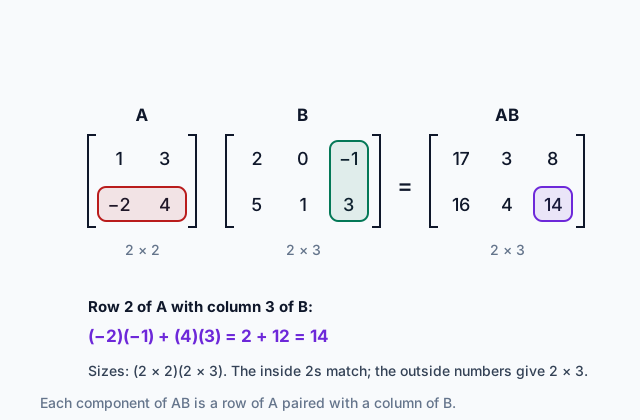 Tap to open the picture full size
Part 1 Think first Count the box office
Make a guess first. Committing to an answer, even a wrong one, helps the lesson stick.
Predict first
A theater sold 150 adult tickets and 90 student tickets for its Friday show. An adult ticket costs 12 dollars and a student ticket costs 8 dollars. Which calculation gives the money the Friday show took in?
In short. The product of two matrices exists when has as many columns as has rows, and its component in row , column is the dot product of row of with column of .
- An matrix has rows and columns, and the number of rows is always written first.
- If is and is , then is . When the two inside numbers differ, the product is not defined.
- Order matters. is usually not equal to , and it can fail to exist even when does.
Part 2 Learn it Matrices and their products
2a. Rows, columns and size
A matrix is a rectangular array of numbers. Its rows run across and its columns run down. A matrix with rows and columns is an matrix, said " by ". Rows always come first.
This one has 2 rows and 3 columns, so it is . Stand it on its end and you get a matrix, which is a different shape, not the same one written another way.
Each number in a matrix is a component. You locate one by its row first and then its column. Here the component in row 2, column 1 is 2, and the component in row 1, column 2 is 0.
A table of data is a matrix with its labels taken off. A shop that tracks sales of two items over three days can keep them in a matrix: one row per day, one column per item.
Quick check · Match
Tap a matrix, then tap its size.
2b. When a product exists
Two matrices can be multiplied only when they fit. The number of columns in the first has to equal the number of rows in the second.
Write the two sizes side by side, in the order of the product. Say is and is :
The two inside numbers are 2 and 2. They match, so exists. The two outside numbers give its size, so is .
Now try . The sizes read , and the inside numbers are 4 and 3. They do not match, so is not defined. The order you write the letters in decides whether there is a product at all.
Why the inside numbers? Each component pairs a row of the first matrix with a column of the second, number by number. A row of holds as many numbers as has columns, and a column of holds as many as has rows. If those counts differ, some number has no partner.
Quick check · Multiple choice
A food truck records its sales in a matrix with one row for each of 5 days and one column for each of 2 menu items. A matrix has one row for each menu item and a single column holding that item's price. What is the size of the product ?
2c. Each component is a dot product
The dot product of two vectors with two components multiplies the matching components and adds:
So . The result is one number.
That is all a matrix product is made of. The component in row , column of is the dot product of row of with column of . Read the row across and the column down.
Take and . For row 1, column 2 of , use row 1 of , , and column 2 of , : . For row 2, column 1, use and : .
A component of is not the product of the two components in the same spot. In row 1, column 2, has 5 and has 0, yet has 30 there.
Quick check · Calculate
Let and . What is the component in row 2, column 2 of ?
2d. The whole product, in order
To write all of , pair every row of with every column of . With and from the last part, there are four dot products:
- row 1 with column 1:
- row 1 with column 2:
- row 2 with column 1:
- row 2 with column 2:
Each result goes in the spot its row and column name, so .
Now multiply the other way. Row 1 of with column 1 of is , so starts with 8, not 3. In full, .
With numbers, and are the same. With matrices, and usually differ, and you saw in the last part that one of them may not exist at all. Multiply in the order you are given.
Quick check · Spot the error
A student finds for and . Tap the first line that goes wrong.
Part 3 Watch it done Revenue and cost at a snack stand
Watch each step, then do the last one yourself.
A ballpark snack stand sold 40 hot dogs and 25 pretzels on Friday, and 55 hot dogs and 30 pretzels on Saturday. A hot dog sells for 3 dollars and costs the stand 1 dollar to make. A pretzel sells for 4 dollars and costs 2 dollars. Use one matrix product to get each day's revenue and cost, then find Saturday's revenue.
Step 1 · Put each table in a matrix
Let , with one row per day (Friday, then Saturday) and one column per item (hot dogs, then pretzels). Let , with one row per item and one column per amount (selling price, then cost), in dollars.
Step 2 · Choose the order
Both are , so and both exist, but only one means anything here. The columns of are items and the rows of are items, so in every dot product pairs hot dogs with hot dogs and pretzels with pretzels. The product has a row for each day and a column for revenue and cost.
Why this step?
Why do the numbers in mean nothing for this stand?
In , row 1 of is a hot dog's price and cost, , and column 1 of is hot dogs sold on each day, . Their dot product, , prices Friday's hot dogs and adds Saturday's hot dogs at cost. The labels that meet inside the product have to agree, items with items.
Step 3 · Fill in Friday
Row 1 of with column 1 of : , Friday's revenue in dollars. Row 1 of with column 2 of : , Friday's cost.
Step 4 · Set up Saturday's revenue
Saturday's revenue is the component in row 2, column 1 of . That is row 2 of , , with column 1 of , .
Your step · Calculate
Finish it. A snack stand's sales are , with rows Friday and Saturday and columns hot dogs and pretzels. Prices and costs in dollars are , with rows hot dogs and pretzels and columns selling price and cost. What is the component in row 2, column 1 of , Saturday's revenue in dollars?
Part 4 Try it Bake for two cafés
A bakery fills a daily order for two cafés. A muffin takes 60 grams of flour, 25 grams of sugar and 15 grams of butter. A loaf takes 400 grams of flour, 30 grams of sugar and 40 grams of butter. The North café orders 24 muffins and 6 loaves, and the South café orders 18 muffins and 10 loaves.
The orders go in , one row per café (North, then South) and one column per item (muffins, then loaves). The recipes go in , one row per item and one column per ingredient (flour, sugar, butter), in grams.
Work on paper, then answer.
Try it · Fill the statement
The order matrix has one row per café and one column per item, muffins then loaves. The recipe matrix has one row per item and one column per ingredient, flour, sugar and butter, in grams. Tap a blank, then tap an answer.
The product is defined, and it is a matrix. The product is not defined.
Try it · Calculate
A bakery's daily orders are , with rows for the North and South cafés and columns for muffins and loaves. Its recipes are , with rows for a muffin and a loaf and columns for grams of flour, sugar and butter. How many grams of flour does the South café's order need each day? That is the component in row 2, column 1 of .
Part 5 Explain it Explain a product in writing
Nothing you type leaves this page. Compare your answer with the model and check off each point.
Unit 4 is not on the AP Exam, so this is written practice for the course.
Written practice
Let and . (i) Identify the size of , of and of , and explain why is not defined. (ii) Determine , showing each component as the dot product of a row and a column. (iii) A classmate wrote . Explain what the classmate did wrong.
Model answer
(i) has 2 rows and 2 columns, so it is . has 2 rows and 1 column, so it is . For the sizes read ; the inside numbers match, so exists and is . For they read : has 1 column but has 2 rows, so is not defined. (ii) Row 1 of with the column of is , and row 2 is . So . (iii) The classmate paired the columns of with : and . A component of uses a row of , read across, with a column of , read down.
Score your own answer. This is a self-check, not a grade. Tick each point your answer makes.
Part 6 Check yourself Three matrices in a graphics program
The three case questions use the same three matrices in the table. Answer them from those components.
A graphics program stores three small matrices, , and , and multiplies them in different orders.
| Matrix | Components |
|---|---|
Case question 1 · Select all
The matrices are , and . Which two of these products are defined? Pick two.
Select 2 answers, then check.
Case question 2 · Calculate
With and , the product is a matrix. What is its one component?
Case question 3 · Multiple choice
With and , which matrix is ?
The rest stand on their own and do not use the case.
Check yourself · Decide and justify
Let and . Is equal to ?
Which reason supports your answer?
Check yourself · Sort it
Each card gives the sizes of two matrices and . Tap a card, then tap whether the product is defined.
is defined
is not defined
Part 7 Keep it Bring back earlier ideas
Pulling an older idea back up is what makes it last.
From 4.9 Vector-Valued Functions · Calculate
A particle's position is . How far is the particle from the origin at ?
From 4.6 Conic Sections · Spot the error
A student finds an asymptote of the hyperbola . Tap the first line that goes wrong.
In three lines
- An matrix has rows and columns, rows first.
- exists when has as many columns as has rows; its size is the rows of by the columns of .
- The component in row , column of is row of dotted with column of , and is usually different.
Vocabulary
- Matrix
- A rectangular array of numbers arranged in rows, which run across, and columns, which run down.
- n × m matrix
- A matrix with exactly rows and columns, with the number of rows written first.
- Component
- One number in a matrix, named by its row and then its column, such as the component in row 2, column 1.
- Dot product
- For two vectors with two components, the sum of the products of their matching components: .
- Product of two matrices
- When has as many columns as has rows, the matrix whose component in row , column is the dot product of row of and column of .
Course alignment, for teachers
AP Precalculus topic 4.10, Unit 4: Functions Involving Parameters, Vectors, and Matrices.
- Skill 1.B: Express functions, equations, or expressions in analytically equivalent forms that are useful in a given mathematical or applied context.
- Skill 3.B: Apply numerical results in a given mathematical or applied context.
This lesson maps all 2 essential knowledge statements of the topic to the part that teaches each one: 2 are checked by a scored question. The map is in the lesson file.