Unit 4 · Topic 4.9 · about 30 minutes · 7 parts · 14 scored checks, 1 of them multiple choice
AP Precalculus 4.9: Vector-Valued Functions
Not assessed on the AP Exam. Unit 4 is part of the course, but nothing in it is on the exam.
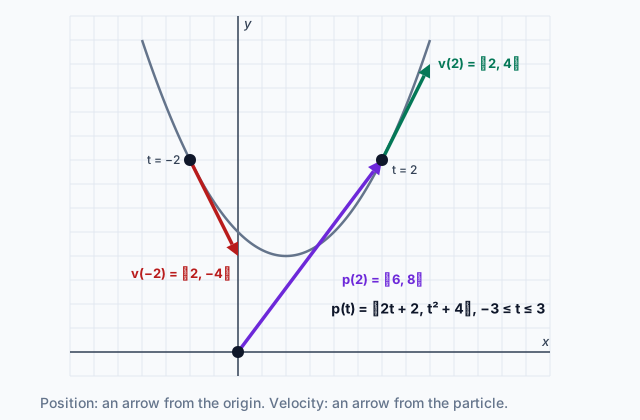 Tap to open the picture full size
Part 1 Think first Coming or going?
Guess before you learn. A wrong guess still makes the answer stick.
Predict first
A drone is flying low over a field, 300 meters east of you. Its controller shows its velocity right now: 2 meters per second west. At this moment, is the drone getting closer to you or moving away?
In short. A vector-valued function gives a vector for each time : the position vector of a moving particle, whose magnitude is its distance from the origin, or its velocity vector, whose magnitude is its speed.
- and describe the same motion as the parametric function , and is the distance from the origin.
- The signs of the velocity's components give the direction at time : a positive horizontal component means right and a negative one left; a positive vertical component means up and a negative one down.
- The magnitude of the velocity vector is the speed. It has no direction and is never negative.
Part 2 Learn it Position and velocity as vectors
2a. Position as a vector-valued function
In 4.2 a particle moving in the plane had its position given by a parametric function . The same motion can be written with vectors. Draw the arrow from the origin to the particle. That arrow is the particle's position vector, and its components are the particle's coordinates.
Written for every time at once, it is a vector-valued function:
Here points right and points up. Whatever multiplies is the horizontal component, and whatever multiplies is the vertical one, whichever order they are written in.
Take the particle in the diagram, , which is also . At , , so the particle is at the point . At , . The vector form says nothing new about where the particle is. What it adds is that the position is now a vector, so everything you know about vectors, length included, applies to it.
Quick check · Match
Each vector-valued function gives the position of a particle. Tap a function, then the point where its particle is at .
2b. Distance from the origin
A position vector starts at the origin and ends at the particle, so its length is how far the particle is from the origin. The length of a vector is its magnitude, the square root of the sum of the squares of its components:
For the particle in the diagram at , . The particle is 10 units from the origin. At it is at , and , about 4.47 units.
Square each component before adding. A negative component still adds a positive amount: at the particle is at , and , so , about 8.25.
The magnitude is a distance measured from the origin, and only from there. It is not how far the particle has traveled. A particle that goes out and comes back to where it started is just as far from the origin as when it began, however long its trip was.
Quick check · Calculate
A particle's position is . How far is the particle from the origin at ?
2c. Velocity and the direction of motion
A particle's velocity is a vector-valued function too, written . Its horizontal component is how fast the particle's -coordinate is changing at time , and its vertical component is how fast the -coordinate is changing. Working out from in general takes calculus, so here it is given. You can see where it comes from in an easy case: the diagram's particle has , which grows 2 units for every unit of , and that 2 is the horizontal component of its velocity .
The signs of the components tell you which way the particle is moving at that moment.
- Horizontal component positive: moving right. Negative: moving left.
- Vertical component positive: moving up. Negative: moving down.
- A component of 0: at that instant there is no motion in that direction.
At , , so the particle is moving right and down. Its position then is , to the left of the -axis. That does not matter. Position says where the particle is, and velocity says which way it is going. At , : for that instant it moves straight right, at the bottom of its U-shaped path.
Quick check · Sort it
Each card gives a particle's position vector and velocity vector at one instant. Tap a card, then tap the way the particle is moving at that instant.
Right and up
Right and down
Left and up
Left and down
2d. Speed is the magnitude of the velocity
The magnitude of the velocity vector is the particle's speed:
For the diagram's particle at , , so the speed is , about 4.47 units per unit of time. At , and the speed is again. At those two times the particle is moving equally fast in two different directions.
That is the difference between the two words. Velocity is a vector, so it carries a direction. Speed is a single number with no direction, and since it is a length it is never negative. A particle moving left at 3 units per second has a velocity with a negative horizontal component and a speed of 3.
Keep the two magnitudes apart. is how far the particle is from the origin. is how fast it is going. A particle far from the origin can be crawling, and one at the origin can be moving fast.
Quick check · Decide and justify
Particle A has velocity and particle B has velocity . At , which particle is moving faster?
Which reason supports your answer?
Part 3 Watch it done Where it is, which way it goes, how fast
Read each step, then do the last one yourself.
A particle moves with position and velocity . At , find how far it is from the origin, which way it is moving, and its speed.
Step 1 · Position at t = 2
. The particle is at the point .
Step 2 · Distance from the origin
. The particle is 29 units from the origin.
Step 3 · Direction from the velocity
. The horizontal component is negative, so the particle is moving left. The vertical component is positive, so it is moving up.
Why this step?
Why read the direction from and not from ?
only says the particle is up and to the right of the origin. Which way it is going depends on how its coordinates are changing, and that is what the components of the velocity measure. Here is shrinking even though is positive.
Step 4 · Set up the speed
Speed is the magnitude of the velocity vector, so it uses the components of , not those of . Square each component of , add, and take the square root.
Your step · Calculate
Finish it. A particle has velocity , so . What is the particle's speed at ?
You can see that really describes the motion at . Go a tenth of a unit later: . Over that short interval changes by , a rate of per unit of , and changes by , a rate of 5. Those average rates of change, the kind you found in 4.3, are almost exactly the components of .
Part 4 Try it A boat on the pond
A remote-control boat crosses a pond. Its position, in meters from a dock at the origin, is for seconds, with east as the positive direction and north as the positive direction. Its velocity, in meters per second, is .
Work on paper. Make a small table with columns for , and at , then answer the two questions.
Try it · Put it in order
A remote-control boat has velocity , in meters per second. Tap the four times in order of the boat's speed, slowest first.
Try it · Calculate
A remote-control boat's position, in meters from a dock at the origin, is , and its velocity is . How many meters is the boat from the dock at ?
Part 5 Explain it Put it in writing
Nothing you type leaves this page. Check your answer against the model and each point on the list.
Unit 4 is not on the AP Exam, so this is written practice for the course.
Written practice
A skater's position on a rink, in meters from the center, is for seconds, and the skater's velocity, in meters per second, is . (i) Write using and , and find how far the skater is from the center at . (ii) Describe which way the skater is moving at and at , and explain how you know. (iii) Find the skater's speed at and at , and explain why the skater's velocity is different at those two times.
Model answer
(i) . At , , so the skater is meters from the center. (ii) . The horizontal component is negative and the vertical component is positive, so at the skater is moving left and up. . Both components are positive, so at the skater is moving right and up. (iii) The speed is the magnitude of the velocity: and , about 2.83 meters per second both times. The velocities are still different, because velocity is a vector and includes direction: the horizontal component is at and 2 at , so the skater is going just as fast but left at one time and right at the other.
Score your own answer. This is a self-check, not a grade. Tick each point your answer makes.
Part 6 Check yourself A tugboat in the harbor
The three case questions use the same table. Answer them from it.
A tugboat T is tracked from a harbor tower at the origin. Its position is in kilometers, with east as the positive direction and north as the positive direction, and its velocity is in kilometers per hour. Time is in hours.
| (hours) | (kilometers) | (kilometers per hour) |
|---|---|---|
Case question 1 · Fill the statement
The tugboat T's velocity is at and at , in kilometers per hour, with east as the positive direction and north as the positive direction. Tap a blank, then tap a direction.
At the tugboat is moving . At it is moving .
Case question 2 · Calculate
The tugboat T is tracked from a harbor tower at the origin. At hours its position is kilometers and its velocity is kilometers per hour. How many kilometers is T from the tower at ?
Case question 3 · Multiple choice
At hours the tugboat T's position is kilometers from the tower and its velocity is kilometers per hour, with north as the positive direction. Which describes T's motion at ?
The rest stand on their own and do not use the case.
Check yourself · Spot the error
A particle has position and velocity . A student works out how far the particle is from the origin at . Tap the first line that goes wrong.
Check yourself · Select all
A particle's position is . Which two describe the same motion? Pick two.
Select 2 answers, then check.
Part 7 Keep it From earlier lessons
Pulling an older idea back up is what makes it last.
From 4.3 Parametric Functions and Rates of Change · Match
Each parametric function is given on an interval of . Tap a function, then the way its point moves as increases.
From 4.8 Vectors · Fill the statement
A vector has its tail at and its head at . Tap a blank, then tap an answer.
The vector from to is ⟨ , ⟩, and its magnitude is .
In three lines
- Position as a vector-valued function: , and is the distance from the origin.
- The signs of the components of say right or left and up or down at time .
- Speed is , a magnitude, never negative and with no direction.
Vocabulary
- Parametric function
- A function in which the two dependent variables and both depend on one independent variable , called the parameter.
- Vector-valued function
- A function whose output for each is a vector, such as or .
- Position vector
- The vector from the origin to a particle moving in the plane at time ; its magnitude is the particle's distance from the origin.
- Velocity vector
- The vector whose horizontal and vertical components give how fast a particle's and are changing at time , so their signs give right or left and up or down.
- Speed
- The magnitude of the velocity vector at time , a number that is never negative.
- Magnitude
- The length of a vector, the square root of the sum of the squares of its components.
- and
- The unit vectors and in the and directions.
Course alignment, for teachers
AP Precalculus topic 4.9, Unit 4: Functions Involving Parameters, Vectors, and Matrices.
- Skill 3.C: Support conclusions or choices with a logical rationale or appropriate data.
This lesson maps all 2 essential knowledge statements of the topic to the part that teaches each one: 2 are checked by a scored question. The map is in the lesson file.