Unit 4 · Topic 4.12 · about 30 minutes · 7 parts · 13 scored checks, 3 of them multiple choice
AP Precalculus 4.12: Linear Transformations and Matrices
Not assessed on the AP Exam. Unit 4 is part of the course, but nothing in it is on the exam.
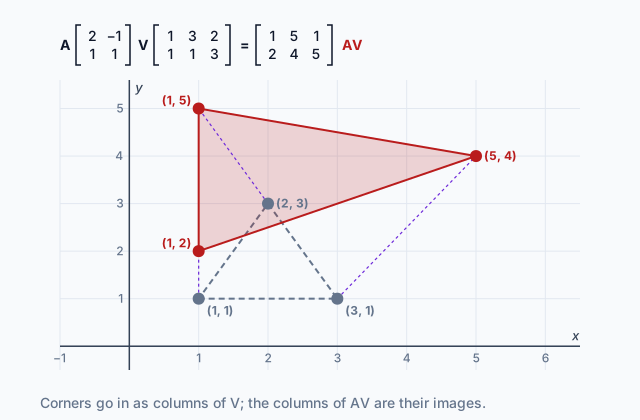 Tap to open the picture full size
Part 1 Think first Which filter is a matrix?
Guess before you learn. A wrong guess still makes the answer stick.
Predict first
A drawing app has two filters that move every point of a picture. Filter P sends the point to . Filter Q sends to . Which filter could the app run by writing each point as a column and multiplying it by one matrix?
In short. A linear transformation from to is a function whose output components are sums of constant multiples of the input components, and it is always for exactly one matrix .
- has the matrix : row 1 holds the multiples in the first output component, and 's multiple sits in column 1.
- Every linear transformation sends the zero vector to the zero vector, so a rule that moves is not one.
- Written as the columns of a matrix , input vectors go through all at once: is a matrix whose columns are the output vectors.
Part 2 Learn it Functions that take vectors
2a. Outputs made from the inputs
A function can take a vector in and give a vector out. A linear transformation from to does it in one particular way: each component of the output vector is a sum of constant multiples of the input vector's components.
Here is one:
The first output component is 2 times plus 1 times . The second is 1 times plus times . For the input , the output is .
A constant can be 0 or negative, so and qualify too. What breaks the pattern is a term that is not a constant times or : a constant added on, as in , or , or .
Put in the zero vector, . Every term is a constant times 0, so every output component is 0. A linear transformation always maps the zero vector to the zero vector, so a rule that moves is not linear. Passing the test proves nothing, though. sends to itself and is still not linear.
Quick check · Sort it
Each card is a function from to . Tap a card, then tap whether it is a linear transformation.
Linear transformation
Not a linear transformation
2b. The matrix behind the rule
A single vector in can be written as a matrix: becomes . Now multiply a matrix by it, row times column as in 4.10:
That is a linear transformation. So any matrix gives one, . It works the other way too: every linear transformation from to has exactly one matrix with .
To find it, line up the rule with and . For , row 1 is and row 2 is :
That matches from before.
Read each component by its letters, not by its order on the page. If a rule says , the 4 goes in column 1, because it multiplies .
Quick check · Multiple choice
A linear transformation is . Which matrix gives , with written as a matrix?
2c. Many vectors in one product
Often you want the outputs for several vectors at once, such as every corner of a shape. Write the vectors as the columns of one matrix. For , and :
Multiply the matrix on the left. The sizes read , so is , and each column of is times the matching column of . With from before:
Column 3 is the output for : and , so .
The vectors go in as columns, and the outputs come out as columns in the same order. Write the vectors as rows instead and the product either does not fit or pairs the wrong numbers.
Quick check · Calculate
Let , and let be the matrix whose columns are the vectors , and , in that order. What is the component in row 2, column 3 of ?
Part 3 Watch it done Move a triangle with one product
Watch each step, then do the last one yourself.
A design program applies to a triangle with corners , and . Each corner is the vector from the origin to it. Find all three image corners with one matrix product.
Step 1 · Write the matrix
Row 1 holds the multiples in , and row 2 those in : .
Step 2 · Put the corners in columns
, a matrix. The product will be , one column per corner.
Why this step?
Why do the corners go in as columns, with A on the left?
needs as a column. Three columns side by side make a matrix that fits after a one, and each column of the product is times one corner.
Step 3 · Multiply column by column
Column 1: and . Column 2: and . Column 3 starts with .
Your step · Calculate
Finish it. With and the triangle's corners in the columns of , what is the component in row 2, column 3 of , the second component of the image of the corner ?
So , and the image triangle has corners , and , in the same order as the corners that went in. One product moved the whole triangle.
Part 4 Try it Slant a game sprite
Warm up in the lab. It holds the matrix and draws the dashed unit square, the unit vectors and , and a dashed vector . The image is not drawn. Type a few vectors into the boxes for , such as and . For each one, work out on paper and find that point on the grid. Then find where sends each corner of the unit square.
The questions that follow use a different matrix. Work them on paper.
A game draws a flag-shaped sprite with corners , , and . To make it lean, the game applies to every point.
Try it · Match
A game applies to a sprite with corners , , and . Tap a corner, then tap its image under .
Try it · Decide and justify
A game designer wants to slide a sprite 4 units to the right, sending every point to . Can the slide be written as for some matrix ?
Which reason supports your answer?
Part 5 Explain it Put it in writing
Nothing you type leaves this page. Check your answer against the model and each point on the list.
Unit 4 is not on the AP Exam, so this is written practice for the course.
Written practice
Let , a function from to .
(i) Explain why is a linear transformation, and determine the matrix with .
(ii) Write the vectors , and as one matrix, and determine all three outputs of with one matrix product.
(iii) Let . Explain why is not a linear transformation.
Model answer
(i) Each output component is a sum of constant multiples of and : and . So is linear, and its matrix holds those multiples row by row: . (ii) With the vectors as columns, , a matrix. Then , so the outputs are , and . For example, column 3 is and . (iii) . A linear transformation sends the zero vector to the zero vector, so is not one. The is not a constant multiple of or .
Score your own answer. This is a self-check, not a grade. Tick each point your answer makes.
Part 6 Check yourself A logo in a drawing app
The three case questions use the same logo and matrix. Answer them from the table.
A drawing app stores the four corners of a logo as the columns of a matrix , each corner as the vector from the origin to it. It transforms the logo with , and the image corners are the columns of .
| Name | Matrix |
|---|---|
Case question 1 · Multiple choice
A drawing app transforms a logo with corners , , and by , where . Which corner is its own image?
Case question 2 · Multiple choice
A logo's corners are the columns of , in order. The transformation , with , sends them to the columns of . Read as a point, which image corner is column 3 of ?
Case question 3 · Spot the error
A student finds the image of the logo's corner under , with . Tap the first line that goes wrong.
The rest stand on their own and do not use the case.
Check yourself · Fill the statement
A linear transformation is for a matrix . You want its outputs for five vectors from at once. Tap a blank, then tap an answer.
Written as the columns of one matrix , the five vectors make a matrix. The product holds the five output vectors, and its column 4 is .
Check yourself · Select all
Let be any matrix, and let for vectors in . Which two statements must be true? Pick two.
Select 2 answers, then check.
Part 7 Keep it Bring back earlier ideas
Pulling an older idea back up is what makes it last.
From 4.11 The Inverse and Determinant of a Matrix · Calculate
What is the area, in square units, of the parallelogram spanned by the vectors and ?
From 2.2 Change in Linear and Exponential Functions · Calculate
A linear function has slope 3 and . What is ?
In three lines
- A linear transformation makes each output component a sum of constant multiples of the input components, and sends to .
- is with , the one matrix that does it.
- Put input vectors in the columns of a matrix ; the columns of are their outputs, in the same order.
Vocabulary
- Linear transformation
- A function that maps an input vector to an output vector so that each component of the output vector is the sum of constant multiples of the input vector components.
- Input vector and output vector
- For a linear transformation , the vector that goes in and the vector that comes out.
- Zero vector
- The vector , which every linear transformation maps to itself.
- Transformation matrix
- The unique matrix with for every in , for a linear transformation from to .
- 2 × n matrix of vectors
- vectors in written as the columns of one matrix, each vector a column.
Course alignment, for teachers
AP Precalculus topic 4.12, Unit 4: Functions Involving Parameters, Vectors, and Matrices.
- Skill 1.B: Express functions, equations, or expressions in analytically equivalent forms that are useful in a given mathematical or applied context.
This lesson maps all 5 essential knowledge statements of the topic to the part that teaches each one: 5 are checked by a scored question. The map is in the lesson file.