Unit 4 · Topic 4.13 · about 30 minutes · 7 parts · 14 scored checks, 2 of them multiple choice
AP Precalculus 4.13: Matrices as Functions
Not assessed on the AP Exam. Unit 4 is part of the course, but nothing in it is on the exam.
 Tap to open the picture full size
Part 1 Think first Which button first?
Guess before you learn. A wrong guess still makes the answer stick.
Predict first
A photo app has two buttons. Rotate turns the picture a quarter turn counterclockwise. Stretch doubles every width and leaves heights alone. Mia and Jon each start with the same photo, 4 inches wide and 3 inches tall. Mia presses Rotate, then Stretch. Jon presses Stretch, then Rotate. How do their pictures compare?
In short. A linear transformation is a function on vectors in , and its matrix records where it sends and .
- The images of and are the first and second columns of , and rotating by counterclockwise about the origin has the matrix .
- The transformation multiplies the area of every region by .
- Applying and then is the linear transformation with matrix , and when exists, undoes .
Part 2 Learn it Matrices that move the plane
2a. Read the matrix off the unit vectors
You have used a matrix to define a transformation . Now go the other way. The linear transformation that maps to is associated with the matrix
The coefficients of the first output component make row 1, and those of the second make row 2. For the matrix is .
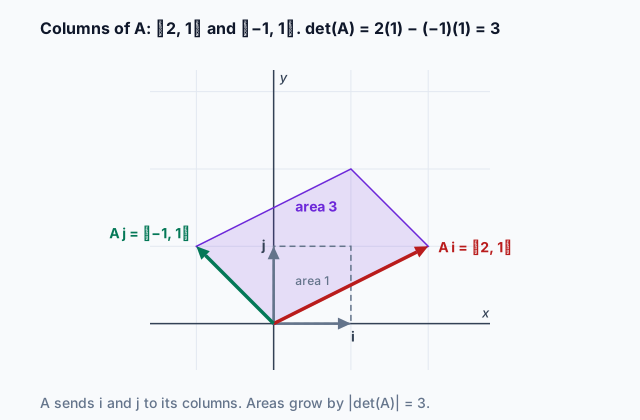
Now put in the unit vectors. , which is the first column, and , the second column. That always happens, so knowing where and land tells you the whole matrix. It tells you every output too: , so . The formula agrees: and .
Written as rows, the images give a different matrix and a different transformation.
Quick check · Fill the statement
A linear transformation is given by . Tap a blank, then tap an answer.
= and = . In the matrix associated with , these two vectors are the .
2b. Rotations, and what happens to area
Rotate every vector by an angle counterclockwise about the origin. The unit vector lands on the unit circle at . The vector starts a quarter turn further round, so it lands at . Those images are the columns:
For that is , and it sends to , a quarter turn.
Now area. The unit square has sides and and area 1. Under it becomes the parallelogram spanned by the columns of , whose area is . Every region is dilated by that same factor: under a matrix with determinant , a shape of area 5 becomes a shape of area 15. The sign does not shrink anything; the factor is the absolute value.
A rotation has determinant , so it moves a region without changing its area. The matrix triples every length, and its determinant is 9, so areas grow by a factor of 9, not 3.
Quick check · Match
Each matrix is associated with a rotation about the origin, with angles in radians. Tap a matrix, then the counterclockwise angle it rotates every vector through.
2c. One transformation after another
Apply first, then . A vector goes to and then to , and that is the same as . So the composition is itself a linear transformation, and its matrix is the product . The transformation applied first sits on the right, next to .
The photo app shows why the order matters. Rotate is and Stretch is . Mia's Stretch after Rotate has matrix
Jon's Rotate after Stretch has matrix . Test : Mia's app turns it to , and stretching leaves that vertical vector alone, so it ends at , the first column of . Jon's stretches it to first and then turns it to , the first column of . Different products, different pictures.
Quick check · Calculate
Let with and with . The transformation that applies first and then is linear. What is the component in row 1, column 2 of its matrix?
2d. Undoing a transformation
Two linear transformations are inverses if their composition maps any vector to itself. If and has an inverse, then
because for every .
Take , with . Its determinant is 1, so and . Check it on a general vector: . Checking one vector is not enough; the composition has to return every vector.
A rotation by is undone by a rotation by , the same angle clockwise. And a matrix with determinant 0 flattens the plane onto a line or a point, so different vectors land in the same place and nothing can send them back. That is the transformation version of having no inverse matrix.
Quick check · Spot the error
A student finds the inverse of the transformation that rotates every vector radians counterclockwise about the origin. Tap the first line that goes wrong.
Part 3 Watch it done Find an inverse transformation and use it
Watch each step, then do the last one yourself.
A linear transformation is . Find a formula for , then find the vector that sends to .
Step 1 · Write the matrix
The coefficients of each output component make a row: .
Step 2 · Find the determinant and the inverse
, which is not 0. Swap 4 and 2, change the signs of 3 and 3, and divide by : .
Step 3 · Write the inverse transformation
, so .
Why this step?
Why does multiplying by undo ?
For any vector, . Applying and then maps every vector to itself, which is what makes two transformations inverses. So whatever produced, returns the vector it came from.
Step 4 · Apply it to the output
The input is . Its first component is .
Your step · Calculate
Finish it. For , the inverse is . What is the second component of the vector that sends to ?
So sends to . Check it forward: and .
Part 4 Try it Two moves in a drawing app
Warm up in the lab. It is set to the composition after with and , and it draws only the unit square, , and . The questions after it use different matrices.
Now the app. A designer applies , which slides each point sideways by twice its height, and then , a rotation of radians counterclockwise about the origin, which is a quarter turn clockwise. Work on paper.
Try it · Calculate
A drawing app applies first and then , the rotation of radians counterclockwise about the origin. What is the second component of the image of ?
Try it · Multiple choice
A drawing app applies and then , the rotation of radians counterclockwise, so the combined move has matrix . Which matrix is associated with the transformation that undoes the combined move?
Part 5 Explain it Put it in writing
Nothing you type leaves this page. Check your answer against the model and each point on the list.
Unit 4 is not on the AP Exam, so this is written practice for the course.
Written practice
Let be the linear transformation that rotates every vector radians counterclockwise about the origin, with .
(i) Determine and , and use them to determine with exact values.
(ii) Determine and explain what it tells you about the area of a region after is applied.
(iii) Determine . Describe the transformation as a rotation, and justify that for every vector .
Model answer
(i) lands on the unit circle at angle , so . starts a quarter turn further on and lands at angle , so . These are the columns: . (ii) . The area of every region is multiplied by , so moves regions without changing their area. (iii) Since , swapping the diagonal components and changing the signs of the other two gives . Its first column is , so rotates every vector radians clockwise. In , row 1 times column 1 is , row 1 times column 2 is , row 2 times column 1 is , and row 2 times column 2 is . So , and for every .
Score your own answer. This is a self-check, not a grade. Tick each point your answer makes.
Part 6 Check yourself Three moves in a sign shop
The three case questions use the same table of transformations. Answer them from its formulas.
A sign shop designs logos on a coordinate grid measured in inches. Its software has three linear transformations, given in the table.
| Name | Formula |
|---|---|
Case question 1 · Calculate
A logo with an area of 6 square inches is transformed by . What is the area of the new logo, in square inches?
Case question 2 · Multiple choice
In sign software, and . A designer applies to a logo and then applies . Which matrix is associated with the combined transformation?
Case question 3 · Decide and justify
In sign software, and . Is the inverse transformation of ?
Which reason supports your answer?
The rest stand on their own and do not use the case.
Check yourself · Put it in order
Each matrix is associated with a linear transformation. Tap them in order of the factor by which they multiply the area of a region, from smallest to largest.
Check yourself · Spot the error
sends to and to , and . A student finds the image of when is applied first and then . Tap the first line that goes wrong.
Part 7 Keep it Bring back earlier ideas
Pulling an older idea back up is what makes it last.
From 4.12 Linear Transformations and Matrices · Calculate
Let , and let be the matrix whose columns are the vectors , and , in that order. What is the component in row 2, column 3 of ?
From 3.3 Sine and Cosine Function Values · Sort it
Each card is an angle, in radians, in standard position. Tap a card, then the signs of its cosine and sine.
and
and
and
and
In three lines
- The matrix of a linear transformation has the images of and as its columns, and a rotation by counterclockwise has matrix .
- A transformation with matrix multiplies the area of every region by .
- Applying and then has matrix , and is undone by , whose composition with maps every vector to itself.
Vocabulary
- Linear transformation
- A function that maps an input vector to an output vector whose components are each a sum of constant multiples of the input components, such as .
- Matrix associated with a linear transformation
- The matrix with ; its columns are the images of and .
- Rotation
- The linear transformation that turns every vector through the same angle counterclockwise about the origin, with matrix .
- Dilation of regions
- How a transformation with matrix stretches or shrinks regions of the plane; its magnitude, the factor every area is multiplied by, is .
- Composition of linear transformations
- Applying one linear transformation to the output of another; it is itself a linear transformation, and applying and then has the matrix .
- Inverse transformation
- The transformation whose composition with maps every vector to itself; for it is .
Course alignment, for teachers
AP Precalculus topic 4.13, Unit 4: Functions Involving Parameters, Vectors, and Matrices.
- Skill 1.B: Express functions, equations, or expressions in analytically equivalent forms that are useful in a given mathematical or applied context.
- Skill 2.A: Identify information from graphical, numerical, analytical, and verbal representations to answer a question or construct a model, with and without technology.
- Skill 3.A: Describe the characteristics of a function with varying levels of precision, depending on the function representation and available mathematical tools.
This lesson maps all 8 essential knowledge statements of the topic to the part that teaches each one: 8 are checked by a scored question. The map is in the lesson file.