Unit 1 · Topic 1.3 · about 30 minutes · 7 parts · 16 scored checks, 3 of them multiple choice
AP Psychology 1.3: The Neuron and Neural Firing
Unit 1: 15 to 25% of the multiple-choice section
 Tap to open the picture full size
Part 1 Think first The hot pan
Make a guess first. Committing to an answer, even a wrong one, helps the real one stick.
Predict first
You grab a pan handle that turns out to be scorching, and your hand jerks away before you even register that it hurts. Where did the command to pull your hand back come from?
In short. Neurons pass messages along their length as electrical impulses and across synapses as chemical messengers, and changing any step of that process changes behavior and mental processes.
- Neurons carry information and glial cells support them, and sensory neurons, interneurons and motor neurons work together in a reflex arc.
- A neuron fires all or none once its charge reaches threshold, then releases neurotransmitters whose messages are excitatory or inhibitory; hormones carry similar messages through the blood.
- Psychoactive drugs act as agonists, antagonists or reuptake inhibitors, have psychological and physiological effects, and can lead to tolerance, addiction and withdrawal.
Part 2 Learn it From one cell to a drug's effect
2a. Neurons, glial cells and the reflex arc
Two common kinds of cells make up your nervous system. Neurons are the cells that carry information. Glial cells support them: they give the system its structure, insulate neurons, help them communicate and carry away waste.
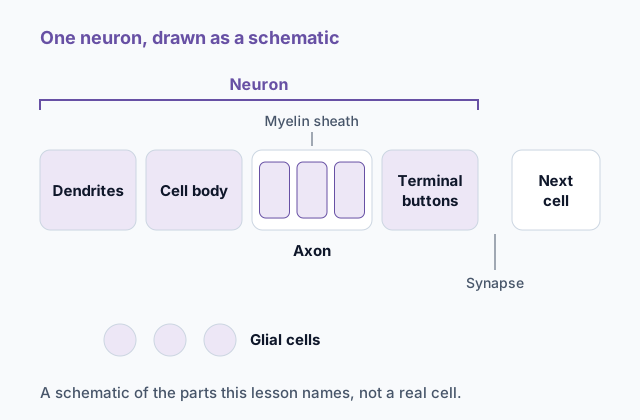
Branching dendrites take in messages from other neurons. The cell body keeps the neuron alive and combines the messages coming in. The axon, a long fiber, carries the neuron's own message away from the cell body. Many axons are wrapped in a myelin sheath, a fatty layer that insulates the axon and speeds the message along. At the far end, the terminal buttons release chemical messengers into the synapse, the tiny gap between one neuron and the next cell.
Neurons also differ in the job they do. Sensory neurons carry messages from the body in toward the brain and spinal cord. Interneurons, inside the brain and spinal cord, pass messages from one neuron to another. Motor neurons carry commands out to the muscles.
The hot pan used all three, in a reflex arc. A sensory neuron carried the message from your fingers to your spinal cord, an interneuron there passed it straight to a motor neuron, and your arm muscles pulled back. The central and peripheral nervous systems worked together, and your brain was not needed for the first move.
Quick check · Match
Tap a part, then tap the situation that points to it.
2b. How a neuron fires
A neuron at rest still holds a slight negative charge inside, compared with the outside, a state called the resting potential. Messages arriving at the dendrites nudge that charge up or down. If they push it to a level called the threshold, the neuron fires: gates in the axon open, positively charged particles flow in, and the inside briefly turns positive. That change is depolarization, and it races down the axon as an action potential, the neural impulse.
Firing follows the all-or-none principle. Once the threshold is reached, the neuron fires at full strength, and below it, the neuron does not fire at all. A stronger stimulus does not make a bigger action potential. It makes the neuron fire more often.
Right after it fires, the neuron goes through a refractory period, a brief pause in which it cannot fire again while it returns to its resting potential.
When the action potential reaches the terminal buttons, they release chemical messengers into the synapse, and the next cell picks up the message. The sending neuron then draws the leftover messengers back inside, which is reuptake.
Two disorders disrupt this process. In multiple sclerosis, the immune system damages the myelin sheath in the brain and spinal cord, so messages slow or fail. In myasthenia gravis, the immune system attacks the places on muscles where acetylcholine, one of those chemical messengers, attaches, so muscles weaken and tire quickly.
Quick check · Put it in order
A neuron that carries sound messages receives input from its neighbors, fires once, and then resets. Tap these steps in the order they happen.
2c. Chemical messengers: neurotransmitters and hormones
The chemicals released into the synapse are neurotransmitters. Each one sends either an excitatory message, making the next neuron more likely to fire, or an inhibitory one, making it less likely. What a neurotransmitter does can depend on where in the nervous system it is released. You need eight:
- Glutamate: the brain's main excitatory neurotransmitter, important in learning and memory.
- GABA: the brain's main inhibitory neurotransmitter, which calms neural activity.
- Acetylcholine: carries the message from motor neurons to muscles, and helps with learning and memory.
- Dopamine: movement, and the feeling of reward that makes you want to repeat something.
- Serotonin: mood, hunger and sleep.
- Norepinephrine: alertness and arousal.
- Endorphins: the body's own pain relievers, which also bring pleasure.
- Substance P: carries pain messages.
Hormones do similar work outside the nervous system. Cells release them into the bloodstream, so they travel farther and more slowly, and their effects last longer. You need five:
- Adrenaline: readies the body for action, with a pounding heart in fear or excitement.
- Ghrelin: released when the stomach is empty, and signals hunger.
- Leptin: released by fat cells, and signals that the body has enough energy stored, which lowers hunger.
- Melatonin: rises in the evening as it gets dark, and brings on sleepiness.
- Oxytocin: bonding and trust, such as between a parent and a newborn.
Quick check · Match
Tap a neurotransmitter, then tap the moment it fits best.
2d. How psychoactive drugs work
A psychoactive drug changes behavior and mental processes by changing how neurotransmitters work. The course names three kinds of action:
- An agonist encourages firing. Many agonists copy a neurotransmitter, attaching where it attaches and sending the same message.
- An antagonist discourages firing. Many antagonists sit in those same places without sending the message, blocking the neurotransmitter out.
- A reuptake inhibitor blocks reuptake, so the neurotransmitter stays in the synapse longer and keeps acting.
These kinds overlap: a reuptake inhibitor strengthens a message, so some books count it as an agonist. Where both names are offered, reuptake inhibitor is the more exact one.
Drugs have psychological effects, on mood, alertness, perception and thinking, and physiological effects on the body. Caffeine, for example, makes you more alert (psychological) and raises your heart rate (physiological). Four groups are named for what they typically do:
- Stimulants, such as caffeine and cocaine, typically increase neural activity.
- Depressants, such as alcohol, typically decrease neural activity.
- Hallucinogens, such as marijuana, typically distort perception, thinking or both.
- Opioids, such as heroin, typically act as pain relievers.
With repeated use comes tolerance: the same dose has less effect, so a person needs more for the effect one dose used to give. Addiction is a compulsive need for a drug that continues despite the harm it causes. Once a person is addicted, stopping can bring withdrawal, the distressing symptoms that follow when the drug is no longer taken.
Quick check · Sort it
Tap a card, then tap the group of drugs it belongs to.
Stimulant
Depressant
Hallucinogen
Opioid
Part 3 Watch it done Working out how a drug acts
Follow each step, then take the last one on your own.
In a lab dish, researchers add a made-up drug, Drug S, to neurons that use serotonin. With Drug S present, serotonin stays in the synapse longer than usual and keeps acting on the receiving neuron. Drug S itself never attaches to the receiving neuron. How is Drug S acting?
Step 1 · Check whether the drug touches the receiving neuron
Drug S never attaches to the receiving neuron, so it is not copying serotonin there or blocking it there, which is how many agonists and antagonists work. It must be changing the message some other way.
Why this step?
Why check first whether the drug attaches to the receiving neuron?
Because copying or blocking at the attachment places is the most common way a drug changes a message, so ruling it out narrows the search fast. A drug that never touches those places must be changing how much serotonin is released or how long it stays in the synapse.
Step 2 · Ask what happened to the neurotransmitter
Serotonin stays in the synapse longer and keeps acting. Normally the sending neuron draws leftover serotonin back in by reuptake, which ends its effect. Something is stopping that from happening.
Your step · Decide and justify
Finish the classification. In a lab dish, a made-up drug, Drug S, never attaches to the receiving neuron, yet with Drug S present serotonin stays in the synapse longer than usual and keeps acting. Which of the three kinds of drug action is the exact name for this?
Which reason supports your answer?
Part 4 Try it Hormones, drug effects, and a study
Try it · Match
Each moment shows a hormone at work. Tap a hormone, then tap its moment.
Try it · Sort it
Two made-up drugs, Drug Q and Drug R, each have several effects. Tap a card, then tap the kind of effect it is.
Psychological effect
Physiological effect
Illustrative study (made up for practice, not a published study). Researchers wanted to know whether bright light in the evening lowers the level of melatonin. Thirty adults each spent two evenings in a sleep lab, one evening in dim light and one in bright light, a week apart. A coin flip decided which evening came first for each person. At 11 p.m. on each evening, the researchers measured melatonin in a saliva sample. The mean level was 18.4 picograms per milliliter after the dim evenings and 7.9 after the bright evenings, and a statistical test showed the difference was statistically significant.
Try it · Decide and justify
In an illustrative study, 30 adults each spent one evening in dim light and one in bright light, with a coin flip deciding which came first. Their melatonin at 11 p.m. averaged 18.4 picograms per milliliter after dim evenings and 7.9 after bright evenings, a statistically significant difference. Can the researchers conclude that bright evening light lowered melatonin?
Which reason supports your answer?
Part 5 Explain it Answer an article analysis question
Nothing you type leaves this page.
Free response is 33.3% of the exam score. This one is shaped like Question 1, Article Analysis Question.
Free-response practice · Question 1 style
Illustrative study (made up for practice, not a published study). Researchers wanted to know whether a newly developed compound, here called Compound K, makes people more alert, as a stimulant would. A review board approved the study. The researchers recruited 72 healthy adult volunteers from one city. Each volunteer read and signed a consent form that described the compound's possible effects and said they could stop taking part at any time. A coin flip put each volunteer in one of two groups. One group swallowed a capsule containing Compound K, and the other swallowed an identical-looking placebo capsule with no active ingredient. Neither the volunteers nor the researchers who tested them knew which capsule each person had taken. Thirty minutes later, each volunteer watched a screen for 20 minutes and pressed a key whenever a small dot flashed, 60 dots in all, and the researchers counted how many dots each volunteer missed. The Compound K group missed a mean of 4.2 dots and the placebo group a mean of 9.6, and a statistical test showed the difference was statistically significant.
(A) Identify the research method used in this study.
(B) State the operational definition of alertness in this study.
(C) Identify one ethical guideline described in the study. Describe one way the researchers applied it.
(D) Explain how the results support classifying Compound K as a stimulant.
Model answer
(A) This is an experiment, because a coin flip assigned each volunteer at random to take Compound K or a placebo.
(B) Alertness was measured as the number of flashing dots, out of 60, that a volunteer missed during a 20-minute screen task, with fewer misses meaning more alert.
(C) Informed consent. Before taking part, each volunteer read and signed a form that described Compound K's possible effects and said they could stop at any time.
(D) Stimulants typically increase neural activity, which shows up as a person being more alert. Volunteers who took Compound K missed a mean of 4.2 dots against 9.6 for the placebo group, a statistically significant difference, and because the groups were formed at random and the capsules looked identical, the compound was the planned difference between them. Staying more alert on a long watching task is the effect a stimulant would produce, so the result supports classifying Compound K as one.
Score your own answer. This is a self-check, not a grade. Tick each point your answer makes.
Part 6 Check yourself One neuron, six conditions
Several multiple-choice questions on the exam can share one table, the way these three do.
Illustrative data (made up for practice). A researcher records how often one neuron in a lab dish fires under six conditions. Drug D and Drug E are made-up drugs. Each condition was run many times, and the table gives the mean number of action potentials per second.
| Condition | Action potentials per second |
|---|---|
| Nothing added | 8 |
| Glutamate added | 26 |
| GABA added | 2 |
| Drug D added alone | 24 |
| Drug E added alone | 8 |
| Glutamate and Drug E added | 9 |
Case question 1 · Calculate
In a table of one neuron's firing rate, the neuron fires 8 action potentials per second with nothing added, 26 with glutamate added, and 9 with glutamate and Drug E added. How many more action potentials per second does it fire with glutamate added than with nothing added?
Case question 2 · Multiple choice
A neuron in a lab dish fires 8 action potentials per second with nothing added and 26 with glutamate added. With made-up Drug D added alone it fires 24. With made-up Drug E added alone it fires 8, and with glutamate and Drug E together it fires 9. Which statement fits these results?
Case question 3 · Decide and justify
A neuron in a lab dish fires 8 action potentials per second with nothing added and 2 with GABA added. A classmate says GABA sent an excitatory message, because the neuron still fired. Is the classmate right?
Which reason supports your answer?
The rest stand on their own and do not use the case.
Check yourself · Fill the statement
Tap a blank, then tap a word or phrase.
Pressing harder on a person's arm does not make each action potential in a touch neuron bigger. It makes the neuron fire more often, because firing is . After a message crosses the synapse, the sending neuron draws the leftover neurotransmitter back inside, which is called . A person whose immune system damages the myelin sheath in the brain and spinal cord shows a disruption that fits , and a person whose muscles weaken because acetylcholine cannot attach to them properly fits .
Check yourself · Put it in order
A barefoot child steps on a tack and lifts her foot before she feels the pain. Tap the steps of this reflex arc in order.
Check yourself · Spot the error
Over a year, Jordan uses a psychoactive drug more and more often. A student explains what is happening. Tap the first line that goes wrong.
Part 7 Keep it Bring back earlier ideas
Pulling an older idea back out of memory is what keeps it there.
Bring it back · Multiple choice
As Dani walks onto a stage, her heart starts racing without her choosing it, and she raises her hand to wave at the crowd. Which part of the peripheral nervous system governs each of these?
Bring it back · Multiple choice
In an adoption study, children adopted as babies are compared with their birth parents, who share their genes but did not raise them, and with their adoptive parents, who raised them. On one trait, the children turn out much more like their birth parents than their adoptive parents. Which influence does this pattern point to most?
In three lines
- Neurons carry messages and glial cells support them; in a reflex arc, sensory neurons, interneurons and motor neurons let the spinal cord act before the brain.
- A neuron fires all or none once it reaches threshold, then releases neurotransmitters whose messages are excitatory or inhibitory, and hormones carry similar messages in the blood.
- Psychoactive drugs encourage firing, discourage it or keep a neurotransmitter acting longer, have psychological and physiological effects, fall into four groups by their typical effects, and can lead to tolerance, addiction and withdrawal.
Vocabulary
- Neuron
- A neural cell that transmits information.
- Glial cells
- Cells that provide structure, insulation, communication and waste transport for neurons.
- Reflex arc
- A pathway in which sensory neurons, interneurons and motor neurons in the spinal cord work together to respond to a stimulus.
- Sensory, motor and interneurons
- Neurons that carry messages in from the body, carry commands out to muscles, or pass messages between neurons inside the brain and spinal cord.
- Resting potential
- The slight negative charge inside a neuron that is not firing.
- Threshold
- The level of stimulation a neuron must reach before it fires.
- Depolarization
- The change in charge, from negative toward positive inside the axon, that makes up an action potential.
- Action potential
- The brief electrical impulse that travels down a neuron's axon when it fires.
- All-or-none principle
- A neuron either fires at full strength or does not fire at all.
- Refractory period
- The brief pause after firing in which a neuron cannot fire again.
- Reuptake
- The sending neuron's reabsorption of leftover neurotransmitter from the synapse.
- Multiple sclerosis and myasthenia gravis
- Disorders that disrupt neural transmission, by damage to the myelin sheath or by an attack on the places where acetylcholine meets the muscles.
- Neurotransmitter
- A chemical messenger that neurons release into the synapse; for this course, dopamine, serotonin, norepinephrine, glutamate, GABA, endorphins, substance P and acetylcholine.
- Excitatory and inhibitory
- A neurotransmitter message that makes an action potential more likely, or less likely.
- Hormone
- A chemical messenger outside the nervous system that acts like a neurotransmitter; for this course, adrenaline, leptin, ghrelin, melatonin and oxytocin.
- Agonist
- A drug that encourages neural firing, often by copying a neurotransmitter's message.
- Antagonist
- A drug that discourages neural firing, often by blocking a neurotransmitter's message.
- Reuptake inhibitor
- A drug that blocks the reabsorption of a neurotransmitter back into the sending neuron.
- Psychological and physiological effects
- A drug's effects on the mind and behavior, such as mood or alertness, and its effects on the body, such as heart rate.
- Stimulants, depressants, hallucinogens and opioids
- Drugs that typically increase neural activity, decrease it, distort perception or thinking, or relieve pain.
- Tolerance
- Needing more of a drug to get the effect a smaller dose once gave.
- Addiction and withdrawal
- A compulsive need for a drug despite harm, and the distressing symptoms that can follow when the drug is no longer taken.
Course alignment, for teachers
AP Psychology topic 1.3, Unit 1: Biological Bases of Behavior.
- Skill 1.A: Apply psychological perspectives, theories, concepts, and research findings to a scenario.
- Skill 2.A: Determine the type of research design(s) used in a given study.
- Skill 3.A: Identify psychology-related concepts in descriptions or representations of data.
This lesson maps all 12 essential knowledge statements of the topic to the part that teaches each one: 12 are checked by a scored question. The map is in the lesson file.