Unit 1 · Topic 1.5 · about 30 minutes · 7 parts · 14 scored checks, 2 of them multiple choice
AP Psychology 1.5: Sleep
Unit 1: 15 to 25% of the multiple-choice section
 Tap to open the picture full size
Part 1 Think first Morning after a night with no sleep
Guess before you learn. A wrong guess still makes the answer stick.
Predict first
Dev stayed up all night to finish a group project and never went to bed. Around 4 a.m. he felt awful: heavy eyes, rereading the same line over and over. He still has not slept at all. Compared with how he felt at 4 a.m., how is he most likely to feel at 11 a.m.?
In short. Sleep is a state of consciousness, timed by a body clock that runs on about a day, and a night of it moves through stages that each have their own pattern of brain activity.
- A night cycles through three stages of NREM sleep and through REM sleep, and the balance shifts as the night goes on, with less deep NREM sleep and more REM toward morning.
- Restoration and memory consolidation are theories of why we sleep, while activation-synthesis and consolidation theory try to explain why we dream.
- Insomnia, narcolepsy, REM sleep behavior disorder, sleep apnea and somnambulism interrupt sleep, and their effects reach into waking life.
Part 2 Learn it Four short ideas, each checked as you go
2a. Two states of consciousness on a daily clock
Consciousness is your awareness of your own thoughts, feelings and behavior and of events around you, in your internal world and the external one. That awareness comes in levels. Reading a hard paragraph, you are highly aware of it. Half asleep on a bus, you might still catch your stop being called while missing everything else. Sleep and wakefulness are two types of consciousness, not consciousness switched on and off.
Moving between the two follows a schedule. The sleep/wake cycle is a circadian rhythm, a biological rhythm that in humans runs on about a 24-hour cycle. It pushes alertness down at some hours and up at others, which is why a person kept awake all night can feel sharper at 11 a.m. than at 4 a.m.
The rhythm keeps its own time, so it can fall out of step with a person's life. Jet lag is one disruption: fly from Los Angeles to Paris and your body runs on Los Angeles time for days, sleepy in the Paris afternoon and wide awake at Paris midnight. Shift work is another. A baker who starts at 3 a.m. or a nurse on night shifts has to be alert when the rhythm is pushing toward sleep, and has to sleep in daylight when it is pushing toward waking.
Quick check · Fill the statement
Tap a blank, then tap a word.
Ines, a hospital nurse, has just moved from day shifts to night shifts. Being asleep and being awake are two types of , and she moves between them on a rhythm that runs on about 24 hours. Her new schedule throws that rhythm out of step with her life, much as does for a traveler who has just flown across several time zones.
2b. A night in stages
Sleep researchers record brain waves with an EEG, sensors on the scalp that track the brain's electrical activity. Each stage of sleep has its own EEG pattern, and that pattern is how the stages are told apart.
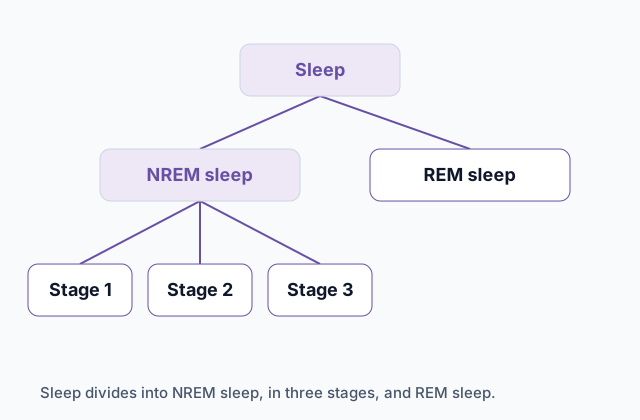
NREM sleep (non-REM) comes in Stages 1 through 3. As a person drifts into Stage 1, the waves slow from their waking pattern, and hypnagogic sensations can come with it: a feeling of falling, a sudden jerk, or a brief image or sound that is not there. Stage 2 is deeper. In Stage 3, the deepest, the waves are large and slow, and the sleeper is hard to wake.
REM sleep, named for its rapid eye movements, is called paradoxical sleep. Its EEG shows fast waves much like wakefulness, yet the body is at its most relaxed, with the muscles nearly limp. Dreaming typically happens in REM.
A night runs through these stages in repeated cycles, and the cycles change. NREM time, the deep Stage 3 most of all, shrinks from one cycle to the next, while REM comes more often and lasts longer toward morning. Take REM away by waking someone each time it starts, and on the next undisturbed night REM increases, as if the body were catching up. That is REM rebound.
Quick check · Spot the error
A sleep-lab technician writes notes on one healthy volunteer's night, using her EEG and what can be seen. Tap the first line that goes wrong.
2c. Why we sleep, and why we dream
Two current theories explain why sleep happens at all. Restoration theory says sleep restores resources the body and brain used up during the day, so a day of hard physical or mental work leaves a person needing more of it. Memory consolidation theory says sleep is when the brain organizes and consolidates memories, making what was learned that day more lasting. On this view, material learned shortly before sleep should be remembered better than the same material followed by the same number of hours awake.
Dreams have theories of their own. Activation-synthesis theory says that during REM the brain stem sends out bursts of neural activity, and the cortex tries to make sense of them by building a story. That would explain why dreams are so often strange, jumping from one scene to another: the story is stitched together on the spot from activity that had no plan.
Consolidation theory of dreams says dreaming is part of the brain's work of sorting and storing memories. That would explain why pieces of recent experience, such as a play a student rehearsed all week or a route a new driver practiced, so often turn up in dreams.
The names overlap, so keep the questions apart: one pair of theories asks why we sleep, the other asks why we dream.
Quick check · Sort it
Each card is an illustrative finding, made up for practice. Tap a finding, then tap the theory of why we sleep that it fits best.
Restoration
Memory consolidation
2d. When sleep goes wrong
Many disorders interrupt healthy sleep, and their effects on waking life vary. Short or broken sleep can slow reactions and weaken attention and memory the next day, and over time it can wear on physical health. These five are the ones psychologists most often study:
- Insomnia: ongoing trouble falling asleep or staying asleep.
- Narcolepsy: sudden, uncontrollable attacks of sleep during the day, sometimes dropping straight into REM.
- Sleep apnea: breathing stops again and again during sleep, briefly waking the person each time, often without their knowing it. Loud snoring is common.
- Somnambulism, or sleepwalking: walking or doing other things while still asleep, usually in deep NREM sleep early in the night.
- REM sleep behavior disorder: the muscles fail to stay relaxed during REM, so the person acts out dreams, sometimes by kicking or punching.
Treating a sleep disorder can improve how well a person performs while awake and their overall well-being. So can keeping a regular schedule for sleeping and waking.
To tell the five apart, ask when the trouble shows up (getting to sleep, during the night, or in the daytime) and what the body is doing.
Quick check · Match
Tap a sleep disorder, then tap the person whose signs fit it.
Part 3 Watch it done Predicting REM rebound from a study
Watch each step, then do the last one yourself.
Illustrative study (made up for practice, not a published study). Volunteers slept in a lab for four nights, and a coin flip put each of them in one of two groups. On nights 1 to 3, the REM group was woken each time the EEG showed REM starting. The NREM group was woken just as many times, but always during NREM sleep. On night 4 nobody was woken. Which group would you expect to spend more of night 4 in REM?
Step 1 · Find what differs between the groups
Both groups were woken the same number of times, so both had the same broken nights. The only difference is which stage was cut short. The REM group lost REM. The NREM group lost some NREM sleep but kept its REM.
Why this step?
Why wake the NREM group at all, instead of letting it sleep through?
Because being woken again and again is disruptive in itself. If only the REM group were woken, any change on night 4 could come from broken sleep in general. Waking both groups equally leaves the loss of REM as the one difference.
Step 2 · Recall what happens when REM is taken away
When a person is deprived of REM, the body tends to make up for it the next time it can sleep undisturbed. So the question becomes: which group was deprived of REM for three nights?
Your step · Decide and justify
Finish the prediction. In an illustrative study, a coin flip put volunteers into two groups. For three nights, one group was woken whenever REM began, and the other was woken just as often, but only during NREM sleep. On night 4 nobody was woken. Which group would you expect to spend more of night 4 in REM?
Which reason supports your answer?
Part 4 Try it Read a study: shift schedules and focus
Illustrative study (made up for practice, not a published study). A researcher studied 80 nurses at one large hospital. Forty worked rotating shifts, switching between day and night shifts every week. The other forty worked fixed day shifts. The nurses were already on these schedules, and the researcher did not assign anyone to one. At the start of a day shift, every nurse took the same 10-minute attention test, pressing a key whenever a target flashed on a screen. The rotating-shift nurses missed a mean of 9.4 targets and the fixed-day nurses a mean of 5.1. The difference was statistically significant.
Try it · Decide and justify
In an illustrative study at one hospital, 40 nurses already working rotating day and night shifts missed a mean of 9.4 targets on an attention test, and 40 nurses already working fixed day shifts missed 5.1. The researcher did not assign anyone to a schedule, and the difference was statistically significant. A newsletter reports: "Rotating shifts cause nurses to lose focus." Does this study support that cause-and-effect claim?
Which reason supports your answer?
Try it · Multiple choice
In an illustrative study, nurses already working rotating shifts missed more targets on an attention test than nurses already working fixed day shifts. Which change to the design would let researchers test whether a rotating schedule causes more missed targets?
Part 5 Explain it Answer an article analysis question
Nothing you type leaves this page.
Free response is 33.3% of the exam score. This one is shaped like Question 1, Article Analysis Question.
Free-response practice · Question 1 style
Illustrative study (made up for practice, not a published study). Researchers wanted to know whether sleep helps people hold on to what they have just learned. They recruited 60 students at one community college. Before anything began, each student was told what the study would involve, including that they might be asked to nap in a lab, and signed a form agreeing to take part. At 1 p.m. every student studied the same list of 30 word pairs, such as river and lamp, for 15 minutes. A coin flip then put each student in one of two groups. The nap group slept for 90 minutes in a quiet room, and an EEG confirmed that each of them fell asleep. The awake group spent the same 90 minutes in a similar room, sitting quietly with no phone, book or screen. Thirty minutes after the 90 minutes ended, every student was shown the first word of each pair and wrote down the second. The nap group recalled a mean of 21.2 pairs and the awake group a mean of 16.5. The difference was statistically significant.
(A) Identify the research method used in this study.
(B) State the operational definition of memory in this study.
(C) Identify one ethical guideline described in the study. Describe one way the researchers applied it.
(D) Explain how the results support the memory consolidation theory of why people sleep.
Model answer
(A) This is an experiment, because a coin flip assigned each student at random to the nap group or the awake group.
(B) Memory was measured as the number of the 30 word pairs each student wrote correctly when shown the first word of each pair.
(C) Informed consent. Before anything began, each student was told what the study would involve, including that they might nap in a lab, and signed a form agreeing to take part.
(D) Memory consolidation theory says sleep is when the brain organizes and consolidates new memories. Both groups studied the same list at the same time and were tested after the same delay, and the only difference was whether they slept during the 90 minutes in between. The nap group recalled 21.2 pairs against 16.5 for the awake group, a statistically significant difference, so sleeping after learning left more of the pairs remembered, which is what the theory predicts.
Score your own answer. This is a self-check, not a grade. Tick each point your answer makes.
Part 6 Check yourself Read a night of sleep data
On the exam, some multiple-choice questions share one set of data. These three questions share this table the same way.
Illustrative data (made up for practice). A sleep lab recorded 20 healthy adult volunteers for one night each, using an EEG to identify every stage. Each volunteer's night ran through five sleep cycles. The table shows the mean minutes per cycle that the volunteers spent in Stage 3 and in REM sleep.
| Cycle | Stage 3 | REM |
|---|---|---|
| 1 | 38 | 9 |
| 2 | 27 | 17 |
| 3 | 14 | 24 |
| 4 | 6 | 31 |
| 5 | 2 | 38 |
Case question 1 · Multiple choice
In illustrative data from 20 volunteers, mean minutes of Stage 3 sleep in cycles 1 to 5 were 38, 27, 14, 6 and 2, and mean minutes of REM were 9, 17, 24, 31 and 38. Which conclusion do these data best support?
Case question 2 · Calculate
In illustrative data from 20 volunteers, mean minutes of Stage 3 sleep in cycles 1 to 5 were 38, 27, 14, 6 and 2, and mean minutes of REM were 9, 17, 24, 31 and 38. Suppose an alarm ends a volunteer's night after cycle 3, and the three cycles before it run as in the data. How many minutes of REM does the volunteer miss compared with sleeping all five cycles?
Case question 3 · Spot the error
In illustrative data from 20 volunteers recorded with an EEG, mean minutes of Stage 3 sleep fell from 38 in cycle 1 to 2 in cycle 5, and mean minutes of REM rose from 9 to 38. A student explains the data. Tap the first line that goes wrong.
The rest stand on their own and do not use the case.
Check yourself · Sort it
Tap an explanation of a dream, then tap the theory it comes from.
Activation-synthesis
Consolidation theory
Check yourself · Decide and justify
In an illustrative study, 40 adults with sleep apnea who had not yet been treated were randomly assigned either to begin treatment at once or to wait two months. After two months, the treated group made significantly fewer errors on a driving simulator than the waiting group. Does this study support the claim that treating their sleep apnea improved their waking performance?
Which reason supports your answer?
Part 7 Keep it Bring back earlier ideas
Coming back to older ideas is how they stay usable on the exam.
Bring it back · Match
Tap a way of studying the brain, then tap the study that uses it.
Bring it back · Sort it
Tap an action, then tap the part of the peripheral nervous system that governs it.
Somatic nervous system
Autonomic nervous system
In three lines
- Sleep and wakefulness are two types of consciousness, and the sleep/wake cycle is a circadian rhythm of about 24 hours that jet lag and shift work disrupt.
- Stages are told apart by their EEG patterns: NREM sleep, Stages 1 to 3, shrinks through the night (deep Stage 3 most of all), while REM, paradoxical and the usual time for dreams, grows and rebounds after it is lost.
- Restoration and memory consolidation explain why we sleep, activation-synthesis and consolidation theory explain dreams, and five disorders show how broken sleep reaches waking life.
Vocabulary
- Consciousness
- Varying levels of awareness of thoughts, feelings, behavior and events in a person's internal and external worlds; sleep and wakefulness are two types of it.
- Circadian rhythm
- A biological rhythm that in humans runs on about a 24-hour cycle, such as the sleep/wake cycle.
- Jet lag and shift work
- Disruptions of the circadian rhythm, from crossing time zones or from working when the body expects to sleep.
- EEG
- A recording of the brain's electrical activity through sensors on the scalp, used to identify the stages of sleep by their patterns.
- NREM sleep
- Sleep Stages 1 through 3; NREM time, deep Stage 3 most of all, decreases as the night goes on.
- Hypnagogic sensations
- Sensations, such as a feeling of falling, that occur as a person enters Stage 1 sleep.
- REM sleep
- Paradoxical sleep, with brain waves similar to wakefulness while the body is at its most relaxed; dreaming typically occurs in it.
- REM rebound
- An increase in REM sleep after a person has been deprived of it.
- Restoration theory
- The theory that sleep restores resources depleted during the day.
- Memory consolidation theory
- The theory that sleep is useful for organizing and consolidating memories.
- Activation-synthesis theory
- The theory that dreams are the brain's attempt to make sense of bursts of neural activity during REM sleep.
- Consolidation theory of dreams
- The theory that dreaming is part of the brain's work of processing and storing memories.
- Insomnia
- A sleep disorder marked by ongoing trouble falling asleep or staying asleep.
- Narcolepsy
- A sleep disorder marked by sudden, uncontrollable attacks of sleep during waking hours.
- REM sleep behavior disorder
- A sleep disorder in which the muscles fail to stay relaxed during REM, so the person acts out dreams.
- Sleep apnea
- A sleep disorder in which breathing stops again and again during sleep, briefly waking the person each time.
- Somnambulism
- Sleepwalking: walking or doing other things while asleep, usually during deep NREM sleep.
Course alignment, for teachers
AP Psychology topic 1.5, Unit 1: Biological Bases of Behavior.
- Skill 1.B: Explain how cultural norms, expectations, and circumstances, as well as cognitive biases apply to behavior and mental processes.
- Skill 2.C: Evaluate the appropriate use of research design elements in non-experimental methodologies.
- Skill 2.D: Evaluate whether a psychological research scenario followed appropriate ethical procedures.
- Skill 4.A: Propose a defensible claim.
This lesson maps all 8 essential knowledge statements of the topic to the part that teaches each one: 8 are checked by a scored question. The map is in the lesson file.